

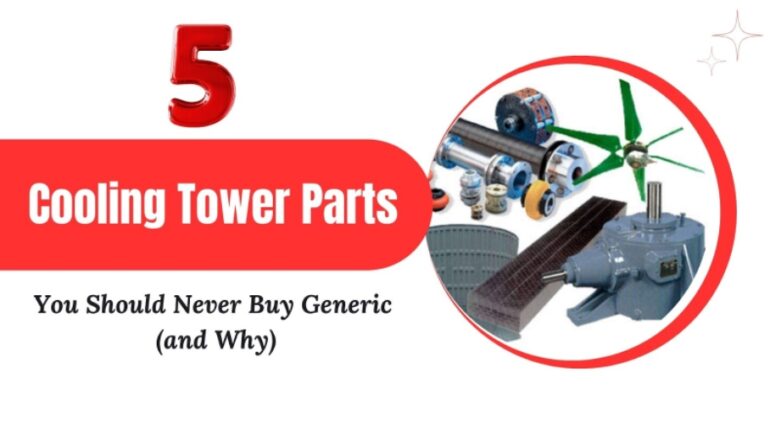
In industrial maintenance, repair, and operations (MRO), the pressure to reduce costs is constant. This often leads decision-makers to purchase cheaper, generic cooling tower parts. While the initial savings seem attractive, this approach represents a false economy.
A seemingly small saving, perhaps 20% on a component, can quickly escalate into a 200% increase in energy consumption or lead to catastrophic mechanical system failure and costly downtime.
For mission-critical components, purchasing based on Original Equipment Manufacturer (OEM) specifications is non-negotiable. The quality of these parts directly dictates the cooling tower’s thermal performance, long-term reliability, and, most importantly, its ultimate Life Cycle Cost (LCC).
Compromising on these essential items introduces unacceptable risks to your operations and assets. This guide outlines the five areas where OEM quality is the most cost-effective investment.
Table of Contents
- Introduction
- The Five Non-Negotiable Cooling Tower Parts
2.1 Mechanical Component: Driveshaft and Coupling
2.2 Thermal Component: Fill Media
2.3 Dynamic Component: Fan Blades
2.4 Structural Component: Internal Basin and Support Coatings
2.5 Safety Component: Drift Eliminators - The True Cost: Life Cycle Cost (LCC) vs. Upfront Price
- Conclusion
- FAQs
The Five Non-Negotiable Cooling Tower Parts
The following cooling tower parts are categorized by their primary impact on the cooling tower system: dynamic, thermal, and structural. For these parts, the risks associated with generic alternatives far outweigh any potential upfront savings.
1. Mechanical Component: The Driveshaft and Coupling
Generic driveshafts and their couplings are a common point of failure. These components frequently lack the precision balancing required for smooth operation or are constructed from substandard materials, such as a lower grade of stainless steel or weaker composite fabrics.
The Consequence
- An improperly balanced driveshaft or one made from inferior materials will inevitably cause dangerous vibrations throughout the system.
- This vibration accelerates wear on the gearbox and motor bearings, leading to a rapid and predictable mechanical system failure.
- The entire drivetrain is put at risk by one compromised component.
What to Do?
You must only use driveshafts and couplings that are matched to the OEM’s specified balance and torque tolerances. This ensures the component can handle the operational forces without introducing destructive vibrations, protecting the entire mechanical system.
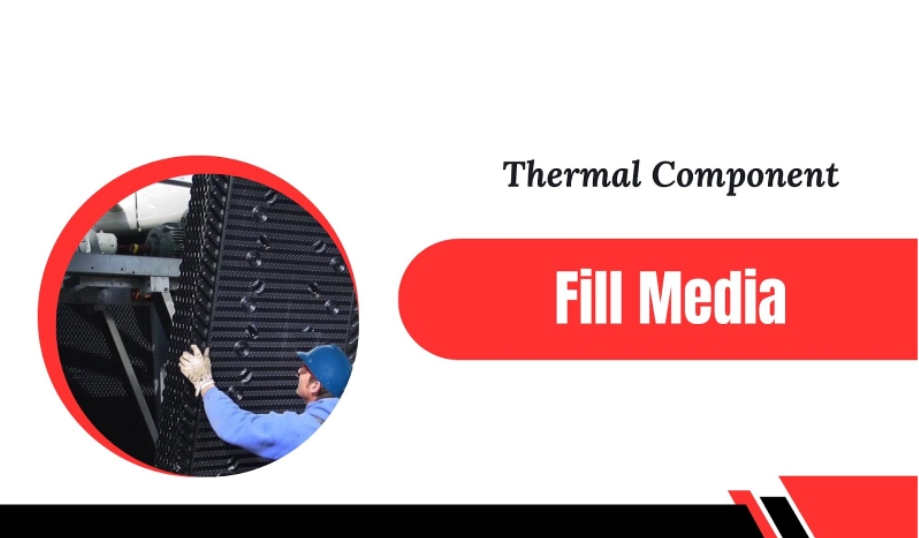
2. Thermal Component: Fill Media
Generic fill media might appear identical to its OEM counterpart, but it often has critical deficiencies. These can include a lower specific surface area, which is vital for heat transfer, or the use of cheaper plastics that have poor resistance to UV radiation and water treatment chemicals.
The Consequence
- Reduced surface area immediately lowers the cooling tower’s thermal performance, causing the system to operate hotter and less efficiently.
- Poor material quality can cause the fill media to:
- Become brittle
- Accumulate scaling
- Collapse under operational stress
- These issues severely impact performance and often lead to costly, full replacements.
What to do?
Always verify that the fill media is certified for the correct thermal transfer coefficient and manufactured with the material density required for your specific application and water chemistry.
3. Dynamic Component: Fan Blades
The manufacturing tolerances on generic fan blades are often inconsistent. This results in blades with imbalanced weight distribution and incorrect pitch angles. Even minor deviations can have significant consequences for the cooling tower’s operation.
The Consequence
What happens when a fan is not perfectly balanced? It creates excessive and damaging vibrations that are transmitted back through the driveshaft to the gearbox and motor. Additionally, incorrect pitch angles lead to inefficient airflow, forcing the fan to work harder and consume more energy to achieve the required cooling effect.
What to Do?
Fan blades must be factory-matched to the tower as a set and dynamically balanced to precise OEM specifications before they are installed. This guarantees smooth, efficient, and reliable airflow.
4. Structural Component: Internal Basin and Support Coatings
The coatings that protect a cooling tower’s internal basin and structural supports are its first line of defense against corrosion. Cheaper coatings, such as low-grade epoxies or polyurethanes, often lack the chemical resistance or necessary thickness to withstand continuous exposure to industrial water treatment chemicals.
The Consequence
- Rapid corrosion of steel components or degradation of concrete surfaces
- Costly leaks and significant water loss
- Compromised structural integrity of the tower
- The need for major cooling tower repairs in a short timeframe
What to Do?
You should use only certified, high-performance protective coatings. These must be specifically engineered to withstand the unique and aggressive chemical environment found within cooling tower parts and systems.
5. Safety Component: Drift Eliminators
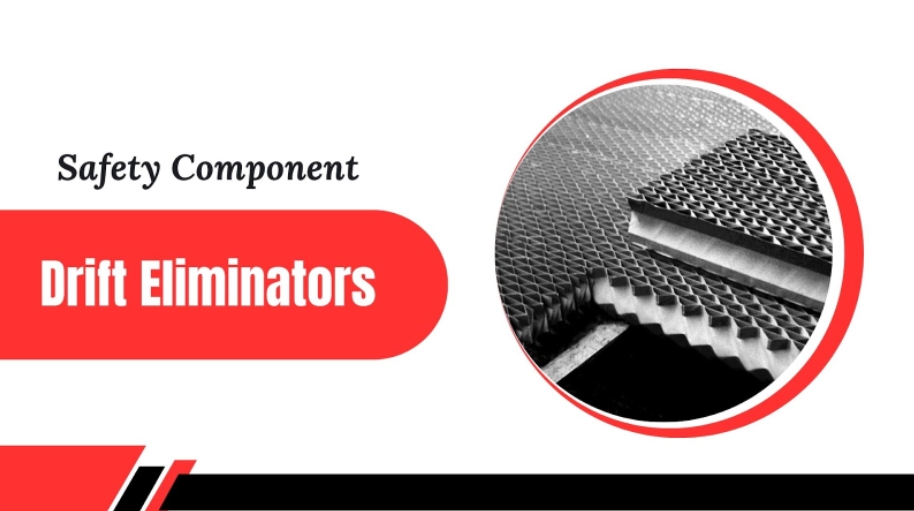
Generic drift eliminators often cut corners by using materials with low resistance to UV light or heat, causing them to warp and degrade quickly. They may also fail to meet the required “cell count” or geometric design needed to effectively capture water droplets.
The Consequence
- The failure of a drift eliminator leads to two major problems.
- First, it causes excessive water drift, which results in costly water loss and chemical treatment expenses.
- More importantly, it fails to contain aerosolized water droplets that can carry harmful pathogens, like Legionella, out of the tower and into the surrounding environment, creating a significant public health risk.
What to Do?
Ensure any drift eliminator you install is CTI (Cooling Technology Institute) certified. It must meet local public health standards for maximum droplet capture, which is typically a drift rate no greater than 0.001%.
The True Cost: Life Cycle Cost (LCC) vs. Upfront Price
Thinking about the long-term financial impact is crucial. How do you calculate the true cost of a component? You must contrast the small upfront savings on a generic part with the substantial downstream expenses it creates. These include:
- Increased energy consumption due to inefficient operation.
- Reduced production output from unexpected downtime.
- Accelerated failure of surrounding OEM components subjected to additional stress.
Investing in high-quality cooling tower parts is the only reliable way to reduce your tower’s Life Cycle Cost (LCC). This approach protects your long-term assets and ensures predictable operational expenses.
Conclusion
When managing your cooling tower assets, remember that some components are simply too critical to compromise. Opting for cheaper, generic parts might seem like a cost-saving measure, but it often leads to higher Life Cycle Costs due to increased energy consumption, unexpected downtime, and premature failure of surrounding equipment.
For the five key components discussed, including driveshafts, fan blades, fill media, protective coatings, and drift eliminators, the risks of mechanical failure and severe efficiency loss are too high. Insisting on OEM-specified components isn’t just about buying a part; it’s an investment in your facility’s reliability, efficiency, and long-term uptime.
Prioritizing quality from the start ensures your cooling tower operates predictably and effectively for years to come.
FAQs
Which cooling tower parts are most critical to buy OEM?
The five critical parts are: driveshaft and coupling, fill media, fan blades, internal basin and support coatings, and drift eliminators. These components directly impact mechanical, thermal, structural, and safety performance.
Why are drift eliminators important?
Drift eliminators prevent water loss and contain harmful pathogens like Legionella. Generic versions may warp, degrade, and fail to meet CTI certification standards, posing public health risks.
Why should I never buy generic cooling tower parts?
Generic parts often fail to meet OEM standards, causing inefficiency, mechanical failures, higher energy costs, and increased downtime. OEM parts ensure reliability and long-term savings.