



If you work online long enough—writing, designing, editing, building, launching—you start to notice a pattern. Your ideas are sharp in the morning, slower by mid-afternoon, and somewhere around hour six of sitting, your brain feels like it’s buffering.
Remote work gives us freedom, but it also quietly rewires how our bodies move. Or don’t move. And while we love to talk about productivity hacks, focus tools, and workflow systems, one of the most powerful upgrades often gets overlooked: how you treat your body while you’re building your digital life.
This isn’t about turning into a fitness influencer or waking up at 5 a.m. to train like an athlete. It’s about understanding why smart movement is one of the best investments you can make for your creative output—and how to integrate it into real, messy workdays without blowing up your schedule.
Remote Work Health Is a Creativity Issue (Not Just a Fitness One)
When people talk about remote work health, the conversation usually goes straight to posture, eye strain, or back pain. All valid concerns. But the deeper issue shows up in your thinking.
Long stretches of sitting reduce blood flow, especially to the brain. Studies consistently show that light to moderate exercise increases oxygen delivery, neurotransmitter balance, and brain-derived neurotrophic factor (BDNF)—a fancy term that basically means your brain becomes better at learning, problem-solving, and creativity.
In practical terms? You’re more likely to hit that “aha” moment after moving your body than after forcing yourself to stare harder at your screen.
Creators often assume mental fatigue means they need better time management. Sometimes that’s true. But often, it’s a physical signal. Your brain is asking for movement so it can keep doing high-level work.
Exercise as a Productivity Hack (That Actually Works)
Unlike most productivity hacks, exercise doesn’t rely on motivation or willpower once it becomes routine. It changes your baseline.
A short strength or cardio session improves insulin sensitivity, which stabilizes energy levels. It boosts dopamine and serotonin, which directly affect focus and mood. And it lowers cortisol over time, meaning stress doesn’t hijack your thinking as easily.
This is especially important for entrepreneur fitness, where the mental load never really shuts off. When you’re running your own thing, there’s no clean separation between work and life. Your nervous system needs an outlet, or it stays in low-grade “on” mode all day.
Movement gives your brain permission to reset. Not by escaping work, but by supporting it.
Why Smart Fitness Fits the Creator Lifestyle Better Than Traditional Gyms
Here’s the honest part. Most creators don’t quit the gym because they hate exercise. They quit because the friction is too high.
Commute time. Crowded spaces. Fixed class schedules. The mental effort of leaving your workflow when you’re already behind.
That’s where smart fitness becomes less of a gadget and more of a smart wellness investment.
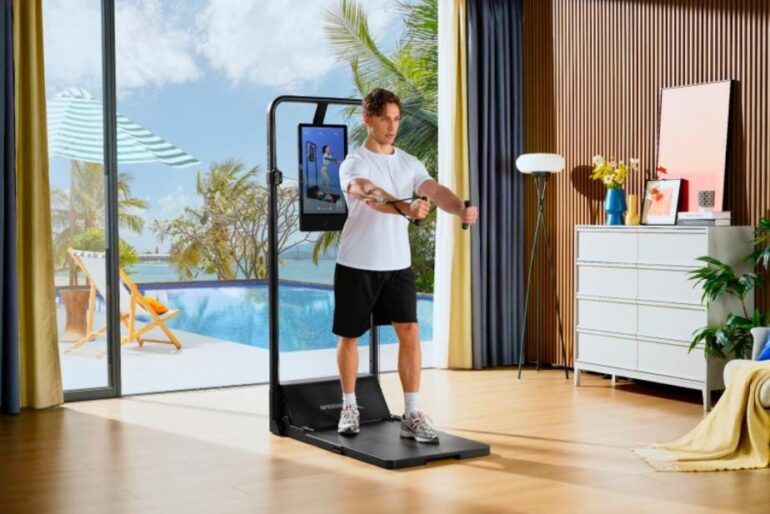
Modern connected equipment adapts to your energy level, tracks progress automatically, and removes decision fatigue. You don’t have to plan a workout or wonder if you’re “doing enough.” You just show up, press start, and move.
For remote workers, that matters. Because the less thinking required, the more likely you are to actually do it—especially on days when your brain is already full.
Work-Life Integration Beats Work-Life Balance
Creators love the idea of work-life balance. In reality, most of us live in work-life integration.
Some days are heavy on work. Others are lighter. The key is building systems that flex instead of break.
Fitness works best when it follows the same philosophy.
Instead of blocking off a perfect 90-minute workout window that rarely happens, smart training lets you slot movement into the cracks of your day. A quick strength session between meetings. A low-impact workout when you’re mentally fried. A focused power session when ideas feel stuck.
This kind of flexibility is what makes fitness sustainable for remote work health long-term.
The Science of Movement and Creative Thinking
Ever notice how ideas show up when you step away from your desk?
That’s not random.
Physical activity increases activity in the default mode network—the part of the brain associated with imagination, pattern recognition, and creative insight. At the same time, it reduces overactivity in the prefrontal cortex, which is responsible for overthinking.
In simple terms, movement quiets the mental noise while opening space for better ideas.
Many creators report that their best concepts come mid-workout or right after. Not because they’re trying to think, but because their brain finally has room to breathe.
How to Integrate Smart Fitness Into a Hectic Workflow
You don’t need to overhaul your entire routine to see benefits. Small, consistent changes matter more.
Start by tying workouts to transitions you already have. Before starting deep work. After publishing a piece. Between client calls. Let movement mark the shift from one mental mode to another.
Smart fitness systems help here because they adapt to time constraints. If you only have 20 minutes, the workout adjusts. If you’re low on energy, resistance and pacing scale automatically. That kind of responsiveness removes the guilt loop of “this isn’t enough.”
And when fitness feels supportive instead of demanding, it stops competing with your work. It starts enhancing it.
Entrepreneur Fitness Is About Longevity, Not Aesthetics
Let’s be real. Most creators don’t care about six-pack abs as much as they care about staying sharp for years.
Entrepreneur fitness is about endurance. Joint health. Energy consistency. The ability to sit down and focus without pain or fog.
Strength training protects against the physical costs of long desk hours. Mobility work keeps your body from locking up. Light cardio improves recovery so stress doesn’t pile up.
This isn’t flashy. But it’s the foundation that lets you keep creating without burning out.
Why This Is a Real Investment (Not Just Self-Care Talk)
We spend money on better cameras, faster laptops, premium software, and online tools without hesitation. Those purchases feel justified because they improve output.
Your body is no different.
A smart wellness investment pays dividends in clearer thinking, fewer sick days, better mood regulation, and sustained productivity. Over time, that compounds just like any other system you optimize.
When fitness supports your work instead of stealing time from it, it becomes one of the highest-ROI decisions you can make.
Final Thoughts: Build a Body That Supports Your Ideas
Being a digital creator means your mind is your main asset. But your mind doesn’t exist in isolation. It runs on a physical system that needs movement, strength, and recovery to perform well.
Smart fitness isn’t about doing more. It’s about doing enough, consistently, in a way that fits how you actually live and work.
When you stop treating health as a side project and start seeing it as part of your creative infrastructure, everything changes. Focus improves. Ideas flow easier. Work feels lighter.