



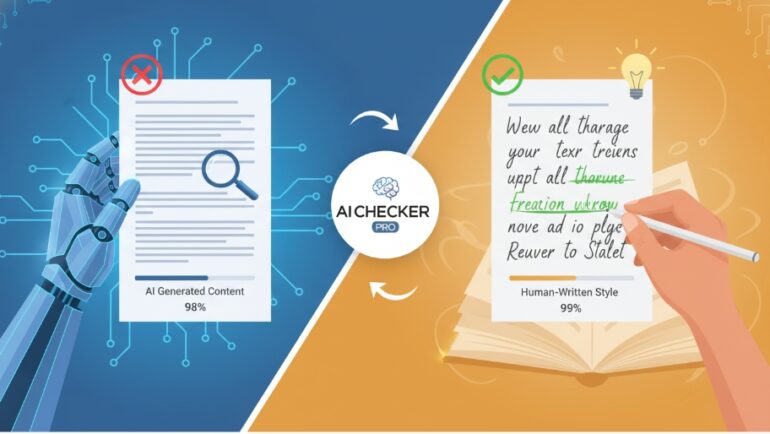
AI speeds up writing, but speed often exposes a new problem. Text gets finished faster, yet approval slows down. Editors hesitate, students second-guess submissions, and marketers delay publishing. The issue usually isn’t correctness. It’s credibility. Dechecker is built for that final decision point, helping writers verify, adjust, and release AI-assisted content with fewer doubts and clearer intent.
Why “Looks Fine” Is No Longer Enough
The moment content stops feeling convincing
Many drafts reach a strange stage where everything appears correct, yet confidence drops. Sentences are clean. Logic is intact. Still, the text feels interchangeable. That reaction isn’t emotional noise; it’s pattern recognition.
This is often when an AI Checker becomes useful. It translates that vague discomfort into concrete signals, showing where writing relies too heavily on statistical norms instead of deliberate choices.
Familiarity creates skepticism
Readers today consume enormous volumes of AI-assisted content. They recognize recurring phrasing and pacing quickly. When text blends into that background, attention fades. An AI Checker helps identify those moments before readers disengage.
Ignoring familiarity costs reach and trust.
Publishing without validation increases risk
Content that feels automated doesn’t always fail publicly. It fails quietly. Engagement drops, feedback turns vague, and revisions pile up later. Dechecker helps reduce that risk upfront by validating tone before release.
How Dechecker Approaches AI Detection
Detection focused on usefulness, not labels
Dechecker doesn’t frame AI detection as exposure. Its AI Checker evaluates probability patterns and presents them as areas worth reviewing. There’s no accusation, only guidance.
That framing encourages action instead of defensiveness.
Reading the signals that matter
High AI likelihood usually points to specific traits. Sentences follow similar lengths. Transitions repeat safe connectors. Claims remain balanced but distant. Seeing these patterns makes revision faster because the cause becomes obvious.
Writers stop guessing and start adjusting.
Editing with intention, not panic
Not every flagged section needs rewriting. Dechecker helps users focus on high-impact areas such as openings, persuasive passages, and conclusions. This keeps editing efficient and prevents overcorrection.
Control stays with the writer.
Turning Detection into Practical Revision
Why rewriting everything backfires
A common mistake is full rewrites after detection. That often introduces new issues, including diluted meaning or inconsistent tone. Effective revision works selectively, not universally.
Human writing isn’t chaotic; it’s intentional.
Where AI Humanizer fits best
After detection clarifies which sections feel mechanical, rewriting becomes targeted. This is where the AI Humanizer adds value. It adjusts flow and phrasing while preserving intent, reducing rigidity without flattening authority.
Used correctly, it feels like an editor, not a generator.
Knowing when revision is complete
There’s a point where content sounds natural enough. Dechecker doesn’t push endless optimization. Once variation and clarity return, stopping becomes easy. Writers move forward instead of looping through edits.
Academic Writing Under Pressure
When originality isn’t questioned, but wording is
Students often use AI for structure or clarity, especially under time constraints. The fear isn’t plagiarism; it’s suspicion. Even original ideas can raise concerns if language feels generic.
An AI Checker helps students review tone and phrasing before submission, reducing unnecessary scrutiny.
Restoring personal voice efficiently
Most assignments don’t need new arguments. They need personal inflection. Dechecker highlights where language feels overly neutral, allowing students to revise selectively without rewriting entire papers.
Results improve without extra workload.
Supporting instructors with clearer evaluation
Educators face increasing pressure to assess AI use fairly. Dechecker provides concrete signals instead of assumptions, shifting discussions toward writing quality rather than enforcement.
Feedback becomes constructive instead of confrontational.
Marketing Content That Needs to Perform
Scaling content without sounding mass-produced
Marketing teams rely on AI to meet output demands. Over time, tone convergence becomes a problem. AI Checker identifies recurring phrasing across assets, allowing teams to diversify language intentionally.
Consistency remains, repetition doesn’t.
Conversion depends on perceived effort
Users decide quickly whether content feels worth reading. Pages that sound generated often fail to persuade, even with strong offers. Dechecker helps marketers identify where copy lacks urgency or specificity and revise accordingly.
Small tonal shifts change outcomes.
Protecting brand voice at scale
Brand guidelines lose power when drafts default to generic phrasing. Dechecker helps teams realign AI-assisted drafts with brand intent by highlighting where language drifts toward sameness.
Quality control improves without slowing production.
Professional and Business Writing
When documents need to sound owned
Proposals, reports, and internal documents often start with AI drafts. Stakeholders expect clarity and accountability, not templates. AI Checker helps identify sections that sound assembled rather than authored.
Rewriting those areas restores authority.
Reducing revision cycles
Unclear feedback often signals tonal discomfort. Dechecker helps teams address that discomfort early, reducing back-and-forth edits later.
Decisions move faster when tone feels right.
Maintaining credibility across audiences
Professional writing often serves mixed audiences. Dechecker helps ensure language remains clear and intentional without slipping into generic explanations that weaken impact.
Clarity and confidence travel together.
SEO Without Over-Optimization
Engagement matters more than structure
Search engines increasingly reward engagement signals. Content that feels human encourages reading and interaction. AI-generated text left unrefined often underperforms quietly.
Using an AI Checker helps writers adjust tone before analytics reveal the issue.
Breaking predictable patterns
AI favors symmetry. Paragraphs balance neatly. Headings align too perfectly. While clean, this structure can feel artificial. Dechecker highlights excessive regularity so writers can introduce variation deliberately.
Natural imbalance improves perception.
Preparing for algorithm changes
Updates rarely target AI directly. They target low-value patterns. Content refined through detection and selective rewriting avoids those extremes, aging better over time.
Longevity becomes a practical benefit.
Using Dechecker as Part of a Workflow
AI generates, Dechecker refines
AI drafts accelerate production. Dechecker ensures readiness. The AI Checker functions as a checkpoint between creation and publication, not as a barrier.
That separation reduces anxiety.
Learning through repetition
Regular use builds instinct. Writers begin spotting patterns before running checks. Sentence variety improves naturally. Dechecker trains awareness rather than dependence.
Skill compounds over time.
Publishing with fewer doubts
The final gain is confidence. When content passes detection and targeted revision, hesitation fades. Writers publish knowing the text reflects decisions, not defaults.
That confidence shows in results.
Writing That’s Ready to Be Read
AI isn’t the problem. Unfinished refinement is. Dechecker supports the final stage where writing becomes credible. With AI Checker clarifying risk and focused rewriting restoring tone, content reaches a standard that feels intentional.
And intention is still what readers trust first.