



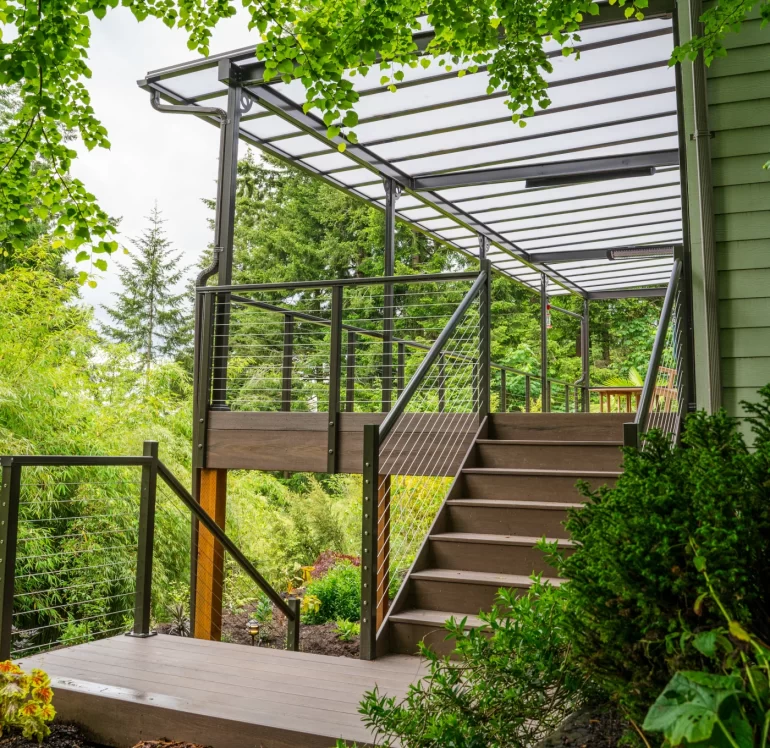
Washington State deck railing code requirements are governed by the Washington State Building Code (WSBC), which adopts the International Residential Code (IRC) with state-specific amendments. The core rules: railings are required on any deck 30 inches or more above grade, must stand at least 36 inches tall for decks under 30 inches high at the walking surface (and 42 inches tall for decks 30 inches or higher), and balusters must be spaced so a 4-inch sphere cannot pass through any opening.
Those are the baseline minimums. In practice, Washington homeowners face additional layers — local amendments from Seattle, Tacoma, Bellevue, and other jurisdictions that can tighten requirements beyond state code, HOA architectural standards, and the structural engineering expectations that apply specifically to the Pacific Northwest’s wet climate and seismic zone.
Getting railing code wrong in Washington State isn’t just a permit problem. It’s a liability issue, a resale disclosure issue, and in some cases a structural safety issue. This guide covers every requirement Washington homeowners need to understand before building or replacing a deck railing system.
What Are Washington State’s Deck Railing Height Requirements?
Washington State adopts IRC Section R312 as its governing framework for deck guards (the code term for railings on elevated walking surfaces). Here’s what the height requirements actually say:
Guards (railings) are required when:
- The deck surface is 30 inches or more above the adjacent finished grade at any point within 36 inches of the deck edge
Minimum guard height:
- 36 inches for decks where the walking surface is less than 30 inches above grade
- 42 inches for decks where the walking surface is 30 inches or more above grade
Important clarification on measurement: Guard height is measured vertically from the deck surface to the top of the top rail. This is a point of consistent confusion during inspections — measuring to the top of the post cap, which may sit higher than the actual rail top, doesn’t satisfy the requirement if the graspable top rail itself falls below the minimum.
Seattle and King County follow these state minimums. Some municipalities, including certain Eastside cities, apply commercial-code railing heights (42 inches minimum) to all residential decks regardless of height above grade — this is worth confirming with your local building department before design finalization.
Baluster Spacing Requirements: The 4-Inch Rule Explained
The 4-inch sphere rule is the most frequently cited railing code requirement in Washington State residential construction, and also the most frequently miscalculated in the field.
The rule: No opening in a guard system — including spaces between balusters, between balusters and the bottom rail, and between the bottom rail and the deck surface — may allow passage of a 4-inch diameter sphere.
Why 4 inches? The 4-inch dimension is derived from child safety research establishing the minimum head entrapment risk for young children. A child’s head that fits through a gap can trap and cause strangulation. This is a life-safety provision, not an aesthetic one.
Practical spacing math:
- Standard 1.5-inch square balusters at 3.5-inch on-center spacing will fail — 3.5 inches minus 1.5 inches equals a 2-inch clear gap, which passes, but this calculation must account for actual installed dimensions, not nominal
- The maximum clear opening between balusters is 3.875 inches (just under 4 inches), accounting for dimensional tolerances
- The gap between the bottom rail and the deck surface must also be 4 inches or less — a commonly missed inspection point
Bottom rail gap management in Pacific Northwest construction: Washington’s wet climate creates a specific challenge here. Composite and wood bottom rails that sit close to the deck surface accumulate debris and trap moisture. Some contractors raise the bottom rail slightly above the minimum to improve drainage and reduce rot risk — but this immediately creates a compliance issue if the gap exceeds 4 inches. The solution is a designed debris gap below 4 inches with a sloped bottom rail profile that sheds water rather than retaining it.
For homeowners designing a railing system from scratch, working with a contractor providing deck railing installation Seattle WA code compliant work who specifies exact spacing in the permit drawings prevents inspection failures before construction begins.
Top Rail and Graspability Requirements
Washington State’s railing code doesn’t just regulate height and spacing — it also addresses whether the top rail can be gripped by a human hand in an emergency. This requirement is specifically relevant when railings serve as the only guard on a stairway.
Graspability standard (IRC R311.7.8.3): A graspable handrail must have a cross-section that allows a person to grasp and hold it. The specific requirements:
- Type I handrail (round or equivalent): Outer diameter between 1.25 and 2 inches
- Type II handrail (non-circular): Perimeter between 4 and 6.25 inches, with a graspable finger recess
The wide, flat top rails common on modern composite railing systems — 3 to 5.5 inches wide, flat on top — do not meet graspability requirements as handrails. For deck stairs in Washington State, a code-compliant graspable handrail must be provided separate from or in addition to the decorative top rail if the top rail profile doesn’t meet Type I or Type II specifications.
This is one of the most common code compliance failures on deck railing inspections in King County and Pierce County. The deck guardrail passes. The stair handrail fails because the contractor installed the same wide top rail profile on the stair section without adding a graspable rail.
Structural Load Requirements for Deck Railings in Washington State
Washington State’s building code specifies minimum structural load requirements for deck guards that are stricter than many homeowners and even some contractors expect.
Per IRC R312.1.3, guards must be designed to resist:
- 200 pounds of concentrated load applied horizontally at any point along the top rail
- 50 pounds per linear foot distributed horizontal load along the top rail
- 50 pounds per square foot inward or outward on the infill (balusters/panels)
These load requirements have direct implications for post sizing, post spacing, and the connection between posts and the deck frame — the structural elements that actually transfer railing loads to the deck structure.
Post connection is the structural weak point on most residential decks. Surface-mounted post bases attached to deck boards with through-bolts into blocking are common but only code-compliant when properly engineered. The preferred structural connection — posts bolted directly to the rim joist or beam of the deck frame — provides superior load transfer but requires planning during framing, not as an afterthought.
In Washington State’s seismic zone, some jurisdictions apply additional lateral load requirements to deck structures, which cascade into railing post connection specifications. The Seattle area falls within Seismic Design Category D, and while residential deck railings don’t typically require independent seismic engineering, inspectors in the region are accustomed to looking at post connections carefully.
Homeowners planning a railing replacement or new installation in the greater Puget Sound area should confirm post connection method with their contractor before finalizing material selection — changing post connection approach after material purchase is an expensive correction. Consulting with an experienced deck railing contractor Washington State early in the design process catches these structural details before they become inspection failures.
Material-Specific Code Considerations for Washington State Decks
Washington’s wet climate creates code-adjacent requirements that affect material selection, even when code itself doesn’t specify a particular material.
Wood Railings
Cedar is the dominant wood railing material in Pacific Northwest residential construction. Post sizing for wood railings must meet structural requirements: 4×4 posts are acceptable at spans up to 6 feet under standard residential loading; 6×6 posts are typically specified for corner posts and at spans approaching code-maximum spacing.
All wood components in contact with or within 6 inches of concrete or masonry must be rated for ground contact (UC4B minimum). This applies to post bases even when posts themselves are above grade.
Composite Railing Systems
Composite railing systems from manufacturers including Trex, TimberTech, and Fortress use proprietary post, baluster, and rail components that are engineered and tested as systems. In Washington State, inspectors generally accept manufacturer installation documentation as engineering compliance for composite systems — but only when the system is installed according to manufacturer specifications without field modifications.
A common compliance failure: composite systems installed with non-system balusters or non-system post bases that don’t carry the manufacturer’s structural ratings. If the system is mixed, the engineering documentation doesn’t apply, and the installation may require third-party structural documentation.
Cable Railing Systems
Cable railing has grown significantly in the Seattle and Eastside markets, particularly in neighborhoods where views make solid railings undesirable. Cable systems are code-compliant in Washington State when properly installed, with two specific requirements:
- Cable tension must be maintained so the 4-inch sphere rule is satisfied at maximum sag — not just at initial installation
- Terminal and intermediate posts must be engineered to handle the significant tensile loads that taut cables generate
Cable post loads are substantially higher than baluster loads — a properly tensioned cable railing system generates hundreds of pounds of inward force on terminal posts. Wood posts are generally inadequate; steel or aluminum intermediate posts with properly engineered bases are the standard specification for code-compliant cable installations.
Glass Panel Railings
Glass panel railings require tempered or laminated safety glass per Washington State code, with glass thickness and panel span meeting engineering minimums for the specified guard loads. Panel systems that use proprietary aluminum or stainless steel framing carry manufacturer engineering documentation; custom-framed glass installations require engineered drawings submitted with permit applications.
Washington State Deck Railing Code: Local Jurisdiction Variations
The WSBC provides the floor for deck railing requirements in Washington State. Local jurisdictions can and do adopt amendments that raise requirements above that floor. Key variations homeowners should verify locally:
| Jurisdiction | Notable Variations |
| City of Seattle | Follows WSBC/IRC with additional ADU and hillside-specific requirements via SDCI guidelines |
| Bellevue | Enforces 42″ guard height for all decks regardless of elevation in some zones |
| Tacoma | Standard WSBC; check critical area overlays for hillside lots |
| Spokane | Standard WSBC; frost depth considerations affect post footing specs |
| Unincorporated King County | WSBC baseline; check for sensitive areas overlay requirements |
HOA requirements layer on top of jurisdiction requirements. Many planned communities in Bellevue, Redmond, Sammamish, and South Snohomish County specify railing materials, colors, or styles in their CC&Rs. An HOA requirement for all-black aluminum railings, for example, supersedes a homeowner’s preference for cedar — and non-compliant installations can result in mandatory modification demands even after passing city inspection.
Permit Process for Deck Railing in Washington State
Most deck railing projects require a building permit in Washington State when they are part of new deck construction or involve structural changes to existing railings. Cosmetic replacement of railings (same configuration, no structural changes) may qualify as like-for-like replacement without a permit in some jurisdictions — but confirm this with your local building department before proceeding.
For permitted deck projects in Seattle, the railing plan must typically include:
- Guard height dimensions shown on elevation drawings
- Baluster spacing dimensions
- Post connection detail (post base specification or direct-to-frame connection detail)
- Material specification (with manufacturer engineering documentation for composite or cable systems)
- Handrail graspability profile for stair sections
Plan review for standard residential deck permits through SDCI currently runs 3–6 weeks. Corrections requested during plan review — often related to missing connection details or incomplete baluster spacing documentation — restart the review clock, so submitting complete drawings the first time has real schedule implications.
Conclusion: Meeting Deck Railing Code Requirements in Washington State
Deck railing code requirements in Washington State are specific, layered, and genuinely consequential — failed inspections delay projects, non-compliant installations create liability exposure, and incorrect railing heights or baluster spacing are the kind of defects that surface in real estate disclosure reviews when homes sell.
The baseline framework — 36 or 42-inch height, 4-inch maximum baluster spacing, graspable handrails on stairs, engineered post connections — applies statewide. Local amendments, HOA requirements, seismic zone considerations, and material-specific engineering documentation add project-specific layers that require local knowledge to navigate correctly.
Homeowners who plan railing design with compliance as a starting point rather than an afterthought consistently experience smoother permit processes, cleaner inspections, and railing systems that perform in Washington’s wet climate without the structural or maintenance failures that shortcuts produce.
FAQ Section
Q1: What is the minimum deck railing height in Washington State? Washington State requires guards (railings) on decks 30 inches or more above grade. The minimum height is 36 inches when the deck surface is less than 30 inches high, and 42 inches when the deck surface is 30 inches or higher. Some local jurisdictions, including parts of Bellevue, apply the 42-inch minimum to all residential decks regardless of elevation.
Q2: What is the maximum baluster spacing allowed on a deck in Washington State? Washington State code follows IRC Section R312, which prohibits any opening in a railing system that allows a 4-inch diameter sphere to pass through. In practice, this means maximum clear spacing between balusters of approximately 3.875 inches. This applies to gaps between balusters, between the bottom rail and deck surface, and between top rail and any horizontal intermediate rail.
Q3: Do I need a permit to replace deck railings in Seattle or Washington State? Cosmetic like-for-like railing replacement may not require a permit in some Washington jurisdictions, but structural changes — new post locations, different attachment methods, height changes — typically do. For new deck construction, railing specifications must be included in the permit drawings. Always confirm with your local building department before starting railing work to avoid unpermitted construction issues.
Q4: Are cable railings code-compliant in Washington State? Yes, cable railings are code-compliant in Washington State when properly installed. Cable tension must maintain the 4-inch sphere rule at maximum cable sag, not just at installation. Terminal and intermediate posts must be engineered to handle the significant tensile loads generated by tensioned cables — standard wood posts are generally inadequate, and steel or aluminum posts with engineered bases are the standard specification.
Q5: What happens if my deck railing fails a building inspection in Washington State? A failed inspection requires correction of the non-compliant condition and re-inspection before a certificate of occupancy or final permit approval is issued. Common failures include insufficient guard height, baluster spacing exceeding 4 inches, non-graspable stair handrails, and inadequate post connections. Uncorrected non-compliant railings can create liability issues and must be disclosed in real estate transactions under Washington State disclosure law.