



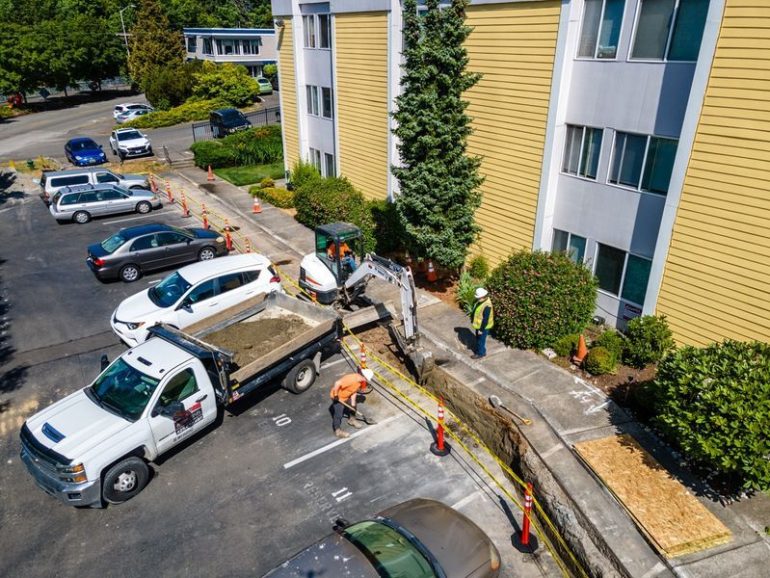
Home drainage problems in Washington State are not a fluke of bad landscaping or poor home maintenance — they’re a predictable consequence of the Pacific Northwest’s specific combination of rainfall volume, clay-dominated soils, and residential construction patterns that were often designed without adequate drainage infrastructure. West of the Cascades, Seattle averages 37 inches of rain annually, with many areas in Snohomish, Pierce, and Kitsap counties receiving 50–70 inches. That water has to go somewhere, and on tens of thousands of Washington properties, it goes exactly where homeowners don’t want it: against foundations, under slabs, into crawl spaces, and across yards in sheets.
The core problem isn’t just rain volume — it’s that Washington’s soils don’t drain it efficiently. Understanding why drainage fails in the Pacific Northwest, what the most common failure patterns look like, and what solutions actually work in this specific climate is the starting point for any homeowner dealing with a wet yard, a damp basement, or recurring standing water.
Why Washington State Soils Make Drainage Unusually Difficult
Most of western Washington sits on glacially deposited soils left behind by the Pleistocene-era Cordilleran Ice Sheet. That geological history produced two soil types that dominate the Puget Sound lowlands and create chronic drainage problems:
Glacial till is a dense, poorly sorted mixture of clay, silt, sand, and gravel compacted under the weight of glaciers. It has extremely low permeability — water moves through it slowly, measured in fractions of an inch per hour rather than inches per hour. Glacial till underlies much of the Seattle metro area, including large portions of Bellevue, Kirkland, Renton, and South King County.
Glacial outwash deposits — coarser sands and gravels left by glacial meltwater — actually drain well. Homeowners on outwash soils in areas like parts of the Kent Valley or the eastern Eastside have a natural drainage advantage. But outwash is unevenly distributed, and many residential lots sit directly on till or on thin topsoil layers over till.
The till-over-outwash problem creates a perched water table condition that’s particularly problematic in the Pacific Northwest. When rain saturates the thin topsoil layer, water cannot penetrate the till beneath it and instead moves laterally — along the soil surface, against foundation walls, and toward the lowest point on the property. This is why many Seattle and Eastside homeowners experience flooding and saturation during rain events even when their neighbors on different soil profiles do not.
Urban development compounds the natural problem. Impervious surfaces — driveways, patios, roofs, roads — prevent rainfall from infiltrating naturally and increase surface runoff volume and velocity. In established neighborhoods across Seattle, Tacoma, and Bellevue, decades of infill development have reduced the permeable surface area available to absorb rainfall, intensifying drainage problems on adjacent properties.
The Most Common Home Drainage Problems in Washington State
Drainage failures in Pacific Northwest homes cluster into recognizable patterns. Most homeowners are dealing with one or more of the following:
Foundation and Basement Water Intrusion
Water against foundation walls is the most consequential drainage failure in Washington State residential construction. It manifests as:
- Efflorescence (white mineral deposits) on basement or crawl space walls — a sign of repeated wetting and drying
- Active seepage through foundation wall cracks or at wall-floor joints
- High humidity in crawl spaces, evidenced by condensation on floor joists, mold growth, or wood rot
- Hydrostatic pressure cracks in poured concrete foundations — vertical or stair-step cracks in block foundations
The cause is almost always inadequate or failed perimeter drainage. Original footing drains on homes built before the 1990s were typically clay tile or corrugated plastic installed without adequate filter fabric — both of which clog over time with Washington’s silty soils. Once footing drains fail, groundwater builds up against the foundation with no engineered pathway to leave.
Foundation water intrusion in western Washington is not a cosmetic problem. Sustained moisture against wood sill plates and rim joists accelerates rot, reduces structural capacity, and creates the conditions for persistent mold growth. Remediation costs for advanced foundation rot in the Seattle metro area commonly run $15,000–$45,000 — far exceeding what proper drainage installation costs upfront.
Surface Water and Standing Water in Yards
Flat or reverse-graded yards in Washington State fill up during the wet season and stay wet for weeks. The causes include:
- Negative grade toward the foundation — the ground slopes toward the house rather than away from it, directing surface flow against the foundation
- Compacted soil — construction activity, foot traffic, and clay expansion all reduce surface permeability over time
- Insufficient swales or berms to direct surface flow away from structures
- Downspout discharge at grade — roof runoff deposited directly at the foundation rather than carried away from the structure
Standing water in western Washington yards during October through April isn’t unusual — but water that persists more than 24–48 hours after a rain event, or that consistently pools in the same low spots, indicates a drainage problem that won’t resolve without intervention.
Crawl Space Flooding and High Moisture
Washington State homes with crawl spaces face a specific challenge. The crawl space environment sits between the wet exterior soil and the conditioned living space, and in the Pacific Northwest, it’s frequently the site of sustained high moisture even when no active flooding occurs.
Crawl space moisture problems originate from two directions: ground moisture vapor rising from the soil surface, and bulk water intrusion from inadequate perimeter drainage or surface flow entering through vents or foundation gaps. Either pathway produces humidity levels that sustain mold growth and accelerate wood deterioration.
Vapor intrusion — moisture moving from wet soil into the crawl space as vapor — affects nearly all unconditioned crawl spaces in western Washington during the wet season. Installing a ground cover vapor barrier (minimum 6-mil poly, ideally 12-mil reinforced) is the baseline intervention; complete crawl space encapsulation with a conditioned air supply is the more comprehensive solution for severe cases.
For homeowners in Seattle’s hillside neighborhoods or anywhere with consistent crawl space moisture, getting an assessment from a specialist in drainage installation Seattle WA who understands both the perimeter drainage and crawl space encapsulation sides of the problem delivers a more complete solution than addressing each issue separately.
Slope and Hillside Drainage Failures
Seattle, Bellevue, and much of the Puget Sound region are built on hillside topography that creates drainage dynamics flat-lot homes don’t face. On sloped properties:
- Surface water concentration: Rain hitting upslope surfaces concentrates as it flows downhill, arriving at mid-slope and downslope properties at higher volume than fell locally
- Groundwater interflow: Lateral water movement through the soil profile — moving downslope above the impermeable till layer — keeps hillside soils saturated longer than flat-lot soils
- Slope instability risk: Saturated clay soils lose shear strength. The Pacific Northwest’s history of landslides — including significant events in Seattle’s Magnolia, Queen Anne, and Rainier Beach neighborhoods — is directly tied to drainage failures on steep slopes
For hillside properties, drainage isn’t just a comfort issue — it’s a geotechnical safety issue. Washington State’s Critical Areas Ordinances in many jurisdictions designate steep slopes as regulated areas requiring engineered drainage solutions and, in some cases, geotechnical assessment before any drainage modification.
Drainage Solutions That Work in the Pacific Northwest
Not every drainage solution that performs well in drier climates is appropriate for western Washington’s sustained, high-volume rainfall. Here are the systems that local contractors specify for Pacific Northwest conditions:
French Drains (Subsurface Perimeter Drainage)
A French drain is a subsurface trench filled with gravel and a perforated pipe that collects and redirects groundwater before it reaches the foundation or accumulates on the surface. In western Washington, effective French drain installation requires:
- Proper filter fabric wrapping around the gravel and pipe to prevent Washington’s silty clay soils from migrating into and clogging the system
- Adequate grade on the drain pipe — minimum 1% slope (1 inch per 8 feet) to ensure positive flow to the outlet
- A functional outlet: daylighting to a lower grade, connection to a storm sewer (where permitted by local code), or discharge to a dry well in soils with adequate permeability
French drains in Seattle-area clay soils have a finite service life — typically 15–25 years before fabric clogging reduces flow capacity. Systems installed without filter fabric clog significantly faster.
Installed cost range in Seattle metro area: $25–$65 per linear foot depending on depth, soil conditions, and outlet configuration. A typical perimeter French drain around a 1,500 sq ft home might run $4,000–$12,000 installed. (Verify current pricing with local contractors — costs fluctuate with material and labor markets.)
Surface Swales and Regrading
Surface swales are shallow, vegetated channels designed to direct surface flow across a property in a controlled path rather than allowing sheet flow to pool or concentrate against structures. Regrading establishes positive drainage slope away from foundations.
Washington State’s model ordinance on stormwater management recommends minimum 2% grade away from foundations for the first 10 feet. Many older Seattle and Tacoma homes — particularly those built before 1970 — have settled or were originally graded inadequately and now drain toward the foundation.
Regrading is among the most cost-effective drainage interventions: $500–$3,500 for straightforward cases, depending on area and volume of soil movement required.
Catch Basins and Area Drains
Catch basins are surface-level collection points — grated inlets — that capture surface water at low points in a yard and route it into a subsurface drainage pipe. They’re the appropriate solution when:
- Yard grading cannot be corrected to eliminate a low spot (bounded by structures, hardscape, or neighboring grades)
- Driveway or patio drainage needs a positive outlet
- Downspout discharge needs to be captured and routed rather than allowed to pond
Area drains are smaller-diameter versions of catch basins used in landscaping beds and under deck structures. Both require regular cleaning — Pacific Northwest leaf fall in October and November clogs drain grates quickly and must be cleared to maintain function during peak rainfall season.
Downspout Extensions and Discharge Management
A disproportionate share of Washington State home drainage problems trace back to inadequate downspout management. The average Seattle roof sheds thousands of gallons of water per year; directing that discharge at grade next to the foundation concentrates exactly what perimeter drainage systems are designed to prevent.
Downspout extensions — rigid or flexible pipe that carries roof runoff at least 6–10 feet from the foundation — are the simplest and most affordable drainage improvement available to Washington homeowners. Underground downspout drains that carry roof runoff to a pop-up emitter at grade or to a storm connection are the more permanent solution.
Cost range: Surface extensions, $50–$150 per downspout DIY or $150–$400 installed. Underground pipe runs, $400–$1,500 per downspout depending on distance and outlet configuration.
Dry Wells and Infiltration Systems
Where soils have adequate permeability — outwash deposits, amended sandy soils — dry wells provide a subsurface infiltration point for collected roof runoff or French drain discharge. In western Washington’s clay-dominant soils, dry wells require a percolation test before installation to confirm adequate infiltration rates. A dry well installed in impermeable till fills immediately and provides no benefit; it simply relocates the water problem underground.
Washington State’s stormwater management guidelines encourage infiltration where feasible as a low-impact development (LID) practice. Many Seattle and King County jurisdictions now require infiltration assessment as part of drainage permit applications.
Washington State Permit Requirements for Drainage Work
Drainage work in Washington State falls into a regulatory gray zone that confuses many homeowners. The general rules:
- Simple regrading and surface swales on residential lots typically don’t require permits in most Washington jurisdictions
- French drains and subsurface drainage systems may require permits if they connect to a storm sewer or discharge to a regulated water body
- Work on properties in critical areas — steep slopes, shorelines, wetland buffers — requires critical areas review and often engineered drainage plans
- New impervious surface additions (driveways, patios) that affect drainage patterns may trigger stormwater management requirements under local ordinances
Seattle, Bellevue, and King County Unincorporated each have specific stormwater management codes that apply to drainage modifications. Connecting drainage systems to the municipal storm sewer without a permit is a violation in most jurisdictions. Confirming permit requirements before beginning drainage work — particularly for French drains and any system with a municipal outlet — prevents compliance issues that can require costly modifications after installation.
An experienced drainage contractor Washington State will be familiar with jurisdiction-specific permit requirements and can handle the application process as part of their service scope, which eliminates one of the more confusing aspects of drainage project planning.
How to Assess Your Washington State Home’s Drainage Problem
Before calling a contractor, homeowners can conduct a basic site assessment that makes professional consultation more productive:
- Observe during or immediately after a rain event. Note where water pools, how long it remains, and which direction surface flow moves. A 24-hour observation after a moderate rain (0.5–1 inch) reveals the actual drainage patterns that a dry-weather site visit misses.
- Check foundation grade. Place a 4-foot level against the soil surface starting at the foundation and extending outward. The first 6–10 feet should slope away from the house at a visible grade. Flat or toward-the-house grade is a red flag.
- Inspect crawl space conditions. Check for standing water, visible moisture on poly vapor barrier, mold on framing, or musty odors. High moisture in the crawl space during or after rain indicates inadequate perimeter drainage or vapor barrier failure.
- Locate all downspout outlets. Confirm each outlet discharges away from the foundation and that the discharge point doesn’t create a new pooling location.
- Check gutter and downspout capacity. Overflowing gutters during moderate rain events dump water directly against foundations, replicating the effect of no drainage system at all.
Conclusion: Solving Home Drainage Problems in Washington State Requires Pacific Northwest-Specific Solutions
Home drainage problems in Washington State are systemic — rooted in geology, climate, and decades of construction practices that underestimated what the Pacific Northwest’s rainfall patterns actually demand from residential drainage infrastructure. Addressing them effectively requires solutions engineered for sustained, high-volume rainfall on clay-dominant soils, not generic approaches developed for drier or more permeable soil environments.
The most cost-effective path for Washington homeowners is early intervention: addressing drainage problems at the surface and perimeter level before water intrusion creates the foundation, structural, and mold remediation costs that follow years of inadequate drainage. A systematic assessment, followed by properly designed and installed drainage infrastructure, resolves most home drainage problems in Washington State durably — and at a fraction of the cost of addressing the damage that unmanaged water causes over time.
FAQ Section
Q1: Why do so many homes in Seattle and western Washington have drainage problems? Western Washington’s glacially deposited clay soils have extremely low permeability — water moves through them slowly and tends to move laterally rather than infiltrating downward. Combined with 37–70 inches of annual rainfall concentrated in a 6-month wet season, these soils create conditions where surface and subsurface drainage systems are essential, not optional, for most residential properties.
Q2: What is a French drain and does it work in Washington State’s clay soil? A French drain is a subsurface trench with gravel and a perforated pipe that collects and redirects groundwater. It works in Washington’s clay soils when installed with proper filter fabric (to prevent clay migration into the system), adequate pipe slope, and a functional outlet. Without filter fabric, French drains in Pacific Northwest clay soils clog significantly faster than their intended 15–25 year service life.
Q3: How much does drainage installation cost in Seattle, Washington? French drain installation in the Seattle metro area typically runs $25–$65 per linear foot installed. A full perimeter drain around a mid-size home commonly costs $4,000–$12,000. Surface regrading ranges from $500–$3,500 for straightforward cases. Downspout underground extensions run $400–$1,500 per downspout. Costs vary with soil conditions, site access, and outlet configuration — get current quotes from local contractors.
Q4: Do I need a permit for drainage work in Washington State? Simple regrading and surface drainage work generally doesn’t require permits in most Washington jurisdictions. Subsurface drainage systems connecting to storm sewers, work on critical area properties (steep slopes, shorelines, wetland buffers), and systems affecting neighboring properties typically do require permits. Confirm requirements with your city or county building department before starting subsurface drainage installation.
Q5: How do I know if my crawl space drainage problem is serious? Standing water in the crawl space, visible mold on framing, soft or discolored wood joists or sill plates, and persistent musty odors are serious indicators. Efflorescence on foundation walls and white mineral deposits on crawl space concrete indicate repeated wetting. Any soft wood in the crawl space framing warrants immediate professional assessment — advanced wood rot from drainage failure is one of the most expensive structural repairs a Washington State homeowner can face.