



Introduction
In a world that is so fast-paced, especially in the creation of action films, prop makers, as well as film producers, are usually faced with a problem where time is limited, coupled with the need to produce very precise props, especially in films that display a lot of action, like guns, mechanical gadgets, etc. The problem seems to stem from the fact that there is no standardized procedure in place, especially to guarantee consistency.
In the subsequent sections, let us learn more about the concept of precise CNC turning, which is considered an automated process, addressing the aforesaid challenges so effectively to enable fast iteration, cost management, and maximize longevity. Quoting renowned international standards like ISO 9001:2015 highlights the need for an effective quality management system. Then let us learn how CNC turning helps maximize efficiency in the prop manufacturing process.
What kind of unique challenges do action movie props pose in their making?
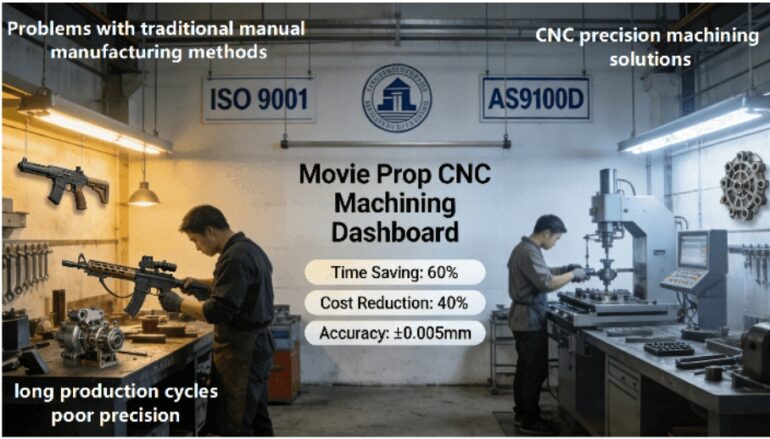
Props in action movies need to deliver excellent performance in very extreme conditions, such as intense physical use, lightweight designs for agility, and visual accuracy for close-ups. Traditional methods of manufacturing often cannot work within these requirements because they have high error rates and very long production cycles.
1. The demands for high-intensity usage and visual precision
Props like firearms or drones have to endure the impact multiple times and still look perfect in front of the camera. A large part of handmade props often involves inconsistencies, such as misaligned components, which leads to disrupting filming. Poor tolerances can mean props fail during stunts, hence requiring precision engineering in order for it to reach micron-level accuracy. Repetitive motions in action scenes develop wear on poorly made props and can involve costly reshoots. CNC turning assures that tolerances are within ±0.005 mm, hence allowing smooth operation under stress. For anything ending up in a close-up, visual precision is important, since imperfections break the illusion; CNC machining allows consistent finishes which greatly reduce needs in post-production.
2. Limitations of Traditional Handcrafting Techniques
Human error means variable results and the inability to upscale the production to include a batch production workflow. Every prop is unique and leads to delays and inefficiency without a stepped workflow. Making multiple prop knives by forging would mean each prop would have a varying weight or balance, which could lead to a problem with the prop’s continuity. A single artisan could take weeks or months to finish a single prop, while the CNC turning could yield hundreds of the same prop in a matter of a few days. There is always a level of guessing involved in the selection of materials, which could lead to a brittle finish.
3. What is the role of reliability standards in the production of props?
Analogous to regulated industries, ISO 13485 and such standards call for quality control, something quite crucial for props in lethal scenes. Utilization of frameworks providing high-reliability ensures that props address safety measures and minimize on-set accidents. These include systematic control measures at each stage, like documentation to ensure traceability. Take the case of ISO 9001 accredited processes. For example, breakaway glass must undergo risk assessments in stunts. Such a concept of standards integrated into CNC turning allows for audits in real time using sensors to monitor tool wear. This proactive attitude creates trust with producers; under extreme conditions, like explosions, the producer will know reliability can be assured.
How Can Precision CNC Turning Services Be Used to Improve Prop Durability and Accuracy?
Precision CNC turning makes use of the accuracy of computer-controlled machines, which provide tolerances as accurate as 0.005 mm. This enhances the longevity of the prop. Precision CNC production can also facilitate complex creations, like gears, which are important for a functional prop.

- Setting the precision to micron level for durable props: By optimizing precision CNC turned parts, propeller manufacturers can produce components with minimal deviations, ensuring a perfect fit and guaranteeing their stress resistance capabilities. For example, a custom-made latch can last thousands of cycles with zero wear and tear through the use of advanced CNC turning techniques. This is due to the feedback action in the closed-loop feedback mechanism, which makes continuous changes while the operation is in progress. For a particular science fiction film, the CNC-turned aluminum parts had a deviation of less than 0.01 mm from the manually crafted product. Advanced technology ensures the optimal use of resources, like the use of titanium alloys instead of only using the material for strength while avoiding bulkiness. Techniques like hard turning make the material surfaces hard, avoiding further processing.
- Case Study: Improving Batch Production Consistency: Recently, precision CNC turning parts worked with the company to produce 50 trigger mechanisms for prop guns, with tolerance limits of ±0.005mm. This eliminated human error for the smooth operation of the guns. Previously, trigger jams were caused by the use of human error during the filing process. Now, CNC included the use of automatic tool changers, with cutting costs reduced by 40% and waste costs falling below 2%. After the shoot for the filming, the company observed it requires zero failures.
- Incorporation of Quality Checks for Optimal Performance: Built-in real-time monitoring, much like in the principles of smart manufacturing, allows continuous improvement. Infrared thermography can detect overheating that will eventually deteriorate the material, as sensors monitor vibrational activities and make automatic speed adjustments to prevent issues. CMMs check dimensions against digital twins and flag deviations as tiny as 0.002 mm post-production. This is how the props-functions like lock mechanisms-must be guaranteed to work through hundreds of takes to support modern filmmaking, uninterrupted.
What Role Do Advanced Cutting Tools Play in Efficient Prop Fabrication?
The selection process of choosing the right cutting tool is an integral part to optimize the efficiency and effectiveness of CNC turning machines with materials such as aluminum and titanium that come in diverse compositions.
1.Tool Selection for Material-Specific Optimization
Diverse props require different means of usage; thus, the CNC cutting tools used in the work involve no heat being held in the tool to hold the props. Carbide inserts with the coating of TiAlN are of superior performance even in high-temperature operations. Cutting tools made of diamond tips are essential in preventing the formation of burrs during the operations involving brass materials. Cutting tools with geometry, as in the case of the rake angle being positive, enables minimal stress in the materials being cut. CAM enables the operation of the cutting tool as it prevents chatter; thus, it can be used in complex designs.
2. Reducing Machining Time with Advanced Toolpaths
Intelligent toolpaths like “trochoidal milling” reduce production time as much as 30%. For example, the time required for prop gun barrel cutting was reduced from 5 hours to under 2 hours. “Adaptive clearing” optimizes material removal for bulk items. “High speed machining” enables finer finishing operations in fewer stages; in one case, HSM reduced cycles by 35%. This enhances the capability for making last-minute changes.
3. Balancing Speed and Surface Finish
The advanced machines allow for rapid production without sacrificing surface smoothness. The end mills with the characteristics of micro-grain have created a surface roughness of Ra = 0.4 μm, completely eliminating the use of finishing tools. The polished tools used for the prop casing of the smartphone created the finished surface needed for the casing, creating the ‘mirror effect’ without finishing processes. The dynamic tool control eliminated burn issues on the casing materials, creating visual perfection for the close-up shots and reducing the rate of necessary processes by more than 60%.
How to Balance Cost Efficiency with Speed in Custom Prop Production?
This is because, with CNC turning, there are strategies that can help achieve cost optimization without affecting timelines, which are important in both low-budget projects as well as large projects. This can be done through batch production or parameter adjustments.
1. How to Leverage Batch Production to Obtain Cost Economies?
The batch manufacturing of props proves to be cost-effective with lower unit costs. For example, generating 100 copies of the gauntlets in sequences saves 30% in costs. It enables optimum nesting, leading to savings in waste materials, which amounts to 20%. It reduces downtime in machinery and utilizes discount rates for materials in bulk. However, batch sizes need to accommodate flexibilities in module designs.
2. Adaptive Machining for Low-Volume Projects
Custom fabrication is also cost-effective for small quantities with optimized parameters. High-efficiency machining (HEM) employs shallower cuts with greater speeds. A prototype was completed in two days with a cost reduction of 40%. Adaptive control responds to information from sensors to eliminate rework. Digital inventory reduces waste by reusing materials from failures, a critical factor for indie studios.
3. Comparing Traditional vs. CNC-Based Cost Structures
Labor costs are high with the traditional processes, with lower initial costs. The computerized processes offer lower long-term costs. Sculpting a prop helmet can take weeks and cost thousands of dollars, while the computerized process can take only days, with the ability to duplicate the sword at a lower cost. A research found that the computerized approach was 25% less expensive to produce 10 swords.
What certifications guarantee Reliability in High-Stakes Prop Manufacturing?
Standards like ISO 9001 and AS9100 D provide a framework for quality that is critical for props in dangerous scenes. They are essential because it requires rigorous process control and traceability.
- The Importance of ISO 9001 in Prop Manufacturing: ISO-9001 also emphasizes the issue of continual improvements, guaranteeing the suppliers maintain high standards. Documented procedures, including risk assessments of the breakaway glass, are necessary to reduce failures on the sets. Audits lead to corrective measures, and on one occasion, this resulted in the recall of the stunt, saving the stunt artists from harm while creating life-threatening scenarios.
- AS9100D for Aerospace-Grade Reliability: Although in space, the risk management requirements in AS9100D, concerning props with stunts, are valid, as testing requirements such as testing to validate the integrity, such as in a stress test, are performed, as are change management documents, which are critical in pyrotechnics, where evidence needs to be given.
- Implementing a Culture of Quality Assurance: Embedding these certifications requires training programs as well as digital technologies such as the integration of QMS with CNC, as the data must be captured uniformly. Audits are also used to improve internal processes, as they resulted in a 50% reduction for the studio. Controls are also used to prevent warping by the environment.
How Can Producers Implement CNC Turning for Rapid Prototyping?
A step-by-step approach can assist with the integration among CNC turning, design, product development, 3D modeling, and the selection process.
1. Step 1: Digital Design and 3D Modeling
Designers create models optimized for quicker prototype construction through the use of the CAD program. DFM analysis identifies a model with weak components such as thin walls, necessitating changes. Collaboration software enables real-time feedback possibilities, as well as accuracy verification through photogrammetry scans. This digital connection reduces iteration time from weeks to days.
2. Step 2: Material Selection and Machining Parameters
Similarly, material choices involve a mix of authenticity and utility, e.g., aluminum props are light in weight. Simulation tools are utilized to enhance parameters such as spindle speeds required for acrylic material processing. FEA simulations can analyze alloy material, whereas using data science can reduce trials by 50%.
3. Step 3: Post-Processing & Quality Validation
Post-processing includes bead blasting and/or painting. For validation of product quality, 3D scanners can be used. The scanners can identify deviations up to 0.1 mm. Streamlining of processes helps in reducing setup time from more than 30% in order to make set-ready prop.
Conclusion
The revolutionary technique of precision CNC turning has altered the process of making action movie props by effectively addressing some of the major pain points. The technique ensures prop robustness, early product availability, and cost-effectiveness, all of them adhering strictly to high standards. Thus, movie prop manufacturers can use precision CNC turning techniques and get top-class movie props.
FAQs
Q: What is the usual lead time in creating a custom prop for an action movie using CNC turning?
A: The complexity of a part determines the lead time in an individual case; in any case, faster CNC turning service can offer 3-to-5-day service for a prototype and 1-to-2-week service for a batch prior to filming schedules.
Q: How does the expense of CNC turning compare with conventional methods of prop making?
A: CNC turning has higherer initial tooling cost, while long-term cost reduction via automation may decrease the cost by 20 to 30 percent compared to manual craftsmanship.
Q: What materials are available that are conducive to the making of durable props using a CNC turning method?
A: Aluminum and stainless steel materials fit the bill as they have high strength for their weights. Machining them through computer-controlled CNC turning will provide an accurate cut, guaranteeing durability for what should be an intense scene to be shot.
Q: How do producers ensure props are accurate for close-up shots?
A: Precision turning with up to ±0.005 mm was done using a Computer Numerical Control machine. To achieve a visually perfect component for camera close-ups, producers check the quality against standards such as ISO 9001.
Q: What does one look for in the way of certification that will guarantee that the supplier can reliably make the props that are ordered?
A: Also, for quality management, look for ISO 9001. For aerospace-grade reliability, look for AS9100D. Look for guarantees that the output is consistent when the stakes are high, as they are in an action film.
Author Bio
The writer of this text is a precision manufacturing expert working at LS Manufacturing company. The company specializes in serving filmmakers and engineers in solving complex part problems via top-notch CNC turning services to various industries by being certified under ISO 9001 standards. To gain more insights on this matter, kindly contact them today to schedule a project review and dfm analysis to bring your concepts to life!