



The modern perfume industry relies on a multi‑layered supply chain that connects fragrance manufacturers, authorized distributors, wholesale suppliers, and retail channels. While consumers mainly see the final product on store shelves or e‑commerce platforms, the infrastructure behind perfume distribution is complex and highly structured. Understanding this ecosystem is essential for retailers, distributors, and investors operating in the global fragrance market.
Over the past decade, the globalization of fragrance brands and the growth of online retail have reshaped how perfumes move through the supply chain. Traditional distributor networks now coexist with specialized wholesale platforms that consolidate inventory, manage logistics, and enable cross‑border sourcing for professional buyers.
Key Takeaways
- The perfume supply chain involves manufacturers, distributors, wholesalers, and retailers.
• Wholesale consolidation makes branded perfumes accessible to professional buyers.
• EU‑based logistics infrastructure improves delivery speed and regulatory compliance.
• Digital B2B platforms are reshaping procurement processes in the fragrance sector.
The Structure of the Global Perfume Supply Chain
At its core, the perfume industry operates through a layered distribution system designed to maintain product authenticity, regulatory compliance, and consistent supply. Each level of the supply chain serves a distinct operational purpose.
Brand houses and fragrance manufacturers represent the starting point of the chain. These companies develop formulations, manage branding, and oversee large‑scale production. Many global fragrance houses collaborate with specialized laboratories and ingredient suppliers to maintain quality standards.
Typical Perfume Distribution Flow
Brand Manufacturer
↓
Authorized Distributor
↓
Professional Wholesale Supplier
↓
Retailers / E‑commerce Platforms
↓
Final Consumers
The Role of Professional Wholesale Infrastructure
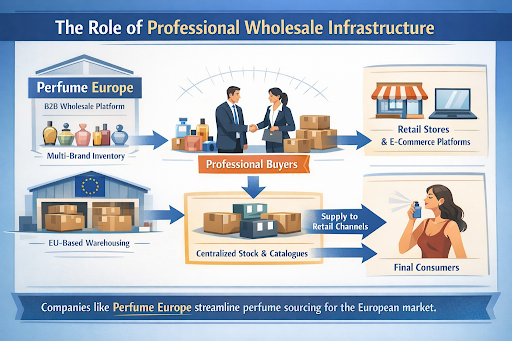
Within this distribution ecosystem, specialized wholesale perfume platforms have become an increasingly important operational layer. These suppliers act as consolidation hubs, enabling retailers and distributors to access multiple fragrance brands through a single sourcing partner.
Rather than negotiating directly with dozens of manufacturers, professional buyers can source inventory through wholesalers that maintain centralized stock and structured procurement processes.
In the European market, several specialized B2B fragrance platforms have emerged to streamline this sourcing process. Companies such as Perfume Europe, for example, operate as multi-brand wholesale suppliers that aggregate inventory from various fragrance houses and make it accessible to professional buyers across retail and e-commerce channels. By maintaining EU-based warehousing and structured wholesale catalogues, these platforms help retailers simplify procurement while ensuring consistent product availability.
Case Study: Consolidated Distribution in the European Market
The European fragrance market illustrates how wholesale consolidation supports international retail. Independent stores and online retailers often lack the purchasing volume required to negotiate directly with major brands.
Operational Characteristics of Modern Perfume Wholesale
| Operational Factor | Industry Practice |
| Stock Location | Centralized regional warehouses |
| Order Processing Time | 24–48 hours |
| Distribution Channels | Retail stores and e‑commerce |
| Product Mix | Multi‑brand inventory |
| Minimum Order Threshold | Professional B2B levels |
Key Terminology in the Perfume Supply Chain
Authorized Distributor – Company distributing a brand in a specific region.
Wholesale Supplier – B2B intermediary consolidating inventory for retailers.
SKU – Unique identifier for a specific product variant.
Grey Market – Parallel distribution outside official channels.
Industry Perspective
“In the fragrance industry, distribution efficiency often determines market success as much as the fragrance itself. Reliable supply networks allow retailers to respond to trends without carrying excessive inventory risk.”
FAQ: Understanding Perfume Distribution
Q: Why do retailers buy through wholesalers?
A: They gain access to multiple brands and smaller order volumes.
Q: Why is EU‑based inventory valuable?
A: It reduces delivery times and avoids cross‑border customs delays.
Conclusion: Distribution as the Backbone of the Perfume Industry
While fragrance creation receives most public attention, the infrastructure that moves perfumes from factories to retail shelves is equally important.