

Explosive
Summary
Kino Lorber’s newly collected Death Wish box set (5 discs total) neatly presents all five films for the first time in North America in a way that fans will appreciate. Each disc comes with audio commentaries, trailers, and some with interviews, and bonus material such as alternate endings, and there are booklet essays by Bronson historian Paul Talbot. I suppose the only thing that might’ve made this set more absolute is presenting them in 4K, but let’s leave that to next year’s Christmas wish list. If Santa brings you this collection this year, then you surely must’ve been on his “nice” list because this ain’t coal … it’s a treasure.
Death Wish (1974)
Plot: In the original Death Wish that started it all, New York City architect Paul Kersey becomes a one-man vigilante squad after his wife is murdered and daughter assaulted by street punks.
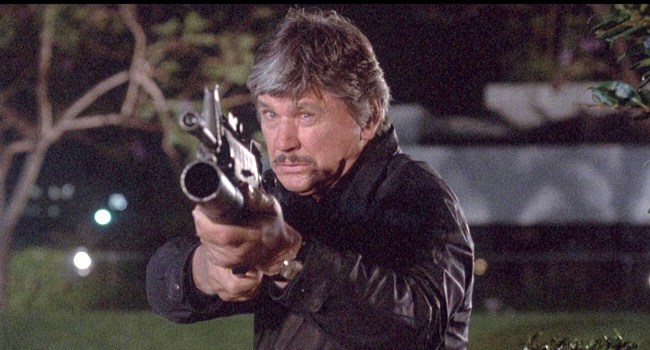
Review: Charles Bronson was in his early fifties when he starred in Michael Winner’s Death Wish, from the novel by Brian Garfield. It made Bronson a bona fide movie star, better late than never. He plays Paul Kersey, a New York architect who is at work when his wife and daughter are brutally assaulted at home. His wife is killed and his daughter is left for dead after being raped. When Kersey talks to the police, they tell him there’s nothing they can do – they have no leads and no description of the attackers. His daughter has been rendered catatonic, and his son-in-law (a businessman) has no clue how to deal with their situation. Kersey, a vet from the Korean War, but a conscientious objector, re-evaluates his stance on violence and gets himself a handgun. He goes out at night, finds trouble and shoots muggers dead on the spot. He does this several nights running, and the New York police department begins spinning a story to the press that the streets have a dangerous vigilante on the loose. Crime goes down. The cops don’t want to apprehend him because he’s doing their job for them. The brass on top wants the vigilante to relocate, but only because they don’t want the heat if they kill him. So Kersey pretty much has a free reign until he gets caught. At the end, he is in another city, seriously considering continuing enacting his brand of justice.
Before Golan / Globus began pressing sequel sausages from their Cannon factory, there was this sincere and thought-provoking feature. It raises questions, it challenges the viewer to consider Kersey’s plight, and it kicks ass. Bronson is great in it. When he loses everything, he tries to move on, and gets angry when someone checks him on it. As far as Bronson movies go, it is one of the best, and in a way, it pigeonholed him into making more movies that were just like it. This was the movie where Bronson became typecast from here on out. Most of the movies he did after this (even up to his later years) were similarly themed, and it created a subgenre of vigilante action films. The Death Wish sequels have entertainment value, but don’t hold a candle to the first one. Part 2 was released eight years later. Vincent Gardenia plays the detective on his trail. The Kevin Bacon film Death Sentence was based on the same book.
Death Wish II (1982)
Plot: Kersey again evolves into a vessel of vengeance as he tracks down the low-lives who murdered his daughter and housekeeper, this time on the seedy streets of Los Angeles.
Review: Architect Paul Kersey (Charles Bronson) has relocated to Los Angeles, and he has his traumatized daughter (who was raped in the first film) in a psychiatric hospital, where she is making slow progress back to a semblance of normalcy. While out on a field trip to the park with her and his new lady friend (played by Jill Ireland, Bronson’s wife), he attracts undue attention from a pack of multiracial hoodlums. They steal his wallet and they go to his house before he arrives, where they rape and murder his housekeeper, club him unconscious, and kidnap his daughter. When he comes to, he calls the police, who assure him that they’ll do everything they can to locate his daughter, but he knows that the only way he’s going to get results is to go after the thugs himself. When his daughter is found raped and killed, he locks himself into a sociopathic mindset where he basically lives and breathes the streets of skid row until he lasers in on the skuzz who have brought out the dormant killer within him.
Calling this a retread won’t help even if it is one. Death Wish 2 is the first crank in the machine that Bronson allowed himself to become when The Cannon Group (Menahem Golan and Yoram Globus) signed him to a multi-picture deal. Bronson became as much an action star in the 1980’s as Stallone, Chuck Norris, or Schwarzenegger. Every movie he did throughout the 1980’s featured him holding guns on the poster, and while Death Wish 2 and its successive sequels were basically remakes of each other, they really made an icon out of Bronson/Kersey in that he literally didn’t have to say anything while on screen to get the point across that if you wronged him or society in any way, he would blow your brains out. They each have merit and plenty of moments to savor, but with this first sequel, it becomes immediately obvious that this is a film for capital, with little regard as to the implications of what was becoming of Bronson’s character. His career, however, was in full swing. Vincent Gardenia (from the first film), and Laurence Fishburne co-star. Director Michael Winner would return for Part 3.
Death Wish 3 (1985)
Plot: Back in the Rotting Apple and armed to the gills with guns, knives—even a bazooka—Kersey ventures out into the urban battlezone to confront a large gang terrorizing the neighborhoods.
Review: Paul Kersey (Charles Bronson), best known as “The Vigilante” throughout several densely populated cities across the United States, makes his way to New York to visit a friend in need. The very afternoon he arrives in his friend’s dilapidated neighborhood, hoodlums who have overrun the block and daily terrorize, pillage, and vandalize the apartment complex where his buddy lives kill his friend and make off with whatever meager valuables he owned. Kersey is accosted by the police and brought downtown and questioned over the killing of his friend, and as soon as the cops realize that he’s the infamous “Vigilante,” the top cop – Striker (Ed Lauter) – vows to keep an eye on him and throw the book at him if he’s caught doing what he’s famous for. He tells him, “Mr. Vigilante! Last damn thing I need is a vigilante! Dude, you’re in big trouble!” Instead of going back home, Kersey hunkers down in the apartment complex, befriending Bennett (Martin Balsam) and other benevolent tenants in the building who need his help, and he wages war with the gangs who have brought the neighborhood down to apocalyptic standards.
A wild and crazy attitude settles in early on in Death Wish 3 that gives it an outrageous afterglow, and it’s difficult to take any of it seriously, but it’s the perfect sequel to Death Wish 2. Gavin O’Herlihy (from Willow and Never Say Never Again) plays the creepy leader of the multiracial gang who becomes the focus of Kersey’s rage. Some of the best parts in this movie are the most ridiculous ones. The finale is about as insane as anything Cannon produced during the era – in the same league as some of the stuff that goes on in Invasion U.S.A. Bronson purists may not like the Death Wish sequels, but fans of action movies won’t be disappointed. Directed by Michael Winner (Death Wish 1-2, The Stone Killer).
Death Wish 4: The Crackdown (1987)
Plot: After the fatal overdose of his girlfriend’s daughter, Kersey continues his blazing quest for revenge by cracking down on a vicious L.A. drug cartel.
Review: Career vigilante and borderline sociopath Paul Kersey (Charles Bronson) has relocated to Los Angeles with an architectural firm, and he’s been dating again. His girlfriend of two years (played by Kay Lenz) is a ballsy journalist with a pretty teen daughter. Dodging commitment, Kersey is, however, still willing to keep an eye on his girlfriend’s daughter who is dating a punk who smokes weed and has a general lack of respect for the niceties of dating a pretty girl he obviously doesn’t deserve. One night, the girl goes out and takes some cocaine she’s offered and she overdoses and dies. Kersey, sensing that her jackass boyfriend had something to do with it, goes out and hunts him, not realizing that the kid actually cared for the girl and that his loose ties to a street gang played a much bigger part in the girl’s death. Kersey shoots down the thug that was directly responsible for the girl’s overdose, and the next day he receives a weird note in the mail implying blackmail. When a prominent gentleman in society named Nathan White (John P. Ryan from Avenging Force) comes forward to Kersey with a threat to kill the scum of society or else, Kersey is sort of attracted to the idea despite the fact that he’s being blackmailed to do it. Provided with all the resources and information he would need to carry on a midnight rampage night after night, Kersey uncovers a conspiracy: Dirty cops – including the bogus “Nathan White” – are setting him up to kill all the rival gangs in the area so that they can secretly run drugs and make a few million on the side. Unwilling to be their pawn or their scapegoat, Kersey goes after the cops and kills them all, turning himself into a “most wanted” criminal.
Much slicker than the previous two entries, The Crackdown is almost machine-like in its efficiency, but as much as it achieves its objective, it is a soulless, heartless monstrosity of such proportions that there’s really very little humanity left of its central character. Bronson, who looks great and still pounces and sprints when he’s required to in the film, displays a lack of interest and his character, which once had grace and panache in the first film, is devoid of any traits that resemble a dimensional creation. The first scene involves him having a nightmare where he declares himself “Death,” which is interesting in retrospect, but the resulting episode of his life chronicled in this film is pretty depressing considering that every living soul he’s ever cared about has been stripped away from him in the cruelest fashion. As an action entertainment, it certainly has its merits, and if you’re a fan of Bronson’s Cannon years and of mechanical vigilantism on film, then there’s no reason why you won’t enjoy it on at least a base level. Watch for character actor / action star Danny Trejo in one scene. J. Lee Thompson (10 to Midnight, Messenger of Death with Bronson) directed.
Death Wish V: The Face of Death (1994)
Plot: Grizzled death-dealer Kersey returns to NYC under the name Paul Stewart when his fiancée has her business threatened by a sadistic mobster and his goons.
Review: After murdering dozens of street thugs and hoodlums over his lifetime, Paul Kersey (Charles Bronson looking pretty tired) has tried a final time to live a normal life and settle with a woman, this time a socialite named Olivia (Lesley-Anne Down), who had once been the mistress of a mobster named Tommy O’Shea (Michael Parks from The Hitman), and they’d had a daughter together who, now as a preteen, lives with her. O’Shea becomes determined to take the girl away from Olivia, and he has hired goons to menace her. After her face is maimed, Kersey goes after the guys responsible, but that only infuriates O’Shea further, and so he has Olivia murdered. Kersey, with a hardened heart and a broken soul, hits the street, but his focus is only on the mafia this time, and he goes after the killers one by one, working his way to O’Shea, whom he eventually dunks in a vat of acid.
Trite subject matter aside, Death Wish V is the nadir of Bronson’s career. Blatantly extreme and outrageous for the sake of being so, it drags Kersey through the mud again, and I don’t know why any audience would want to put themselves through that kind of punishment. Fans of Bronson should shrink back from seeing him go through the motions yet again, and it’s sad to think that his career path led him down this dark, cold alley so close to his retirement. Bronson’s heart clearly wasn’t in it, and the story is just terrible. Too bad. From Menahem Golan’s 21st Century Film Corporation, which was an offshoot of Cannon. Directed by Allan A. Goldstein.
Kino Lorber’s newly collected Death Wish box set (5 discs total) neatly presents all five films for the first time in North America in a way that fans will appreciate. Each disc comes with audio commentaries, trailers, and some with interviews, and bonus material such as alternate endings, and there are booklet essays by Bronson historian Paul Talbot. I suppose the only thing that might’ve made this set more absolute is presenting them in 4K, but let’s leave that to next year’s Christmas wish list. If Santa brings you this collection this year, then you surely must’ve been on his “nice” list because this ain’t coal … it’s a treasure.
 Version 1.0.0
Special Features:
DISC 1 (DEATH WISH):
• Audio Commentary by Film Historian Paul Talbot
• Interview with Actor John Herzfeld
• Theatrical Trailer
• Optional English Subtitles
DISC 2 (DEATH WISH II):
• Audio Commentary by Film Historian Paul Talbot
• Audio Commentary by Film Historians Steve Mitchell and Nathaniel Thompson
• Theatrical Trailer
• Optional English Subtitles
DISC 3 (DEATH WISH 3):
• Audio Commentary by Film Historian Paul Talbot
• Audio Commentary by Film Historians Steve Mitchell and Nathaniel Thompson
• Alternate Ending
• Interview with Actor Kirk Taylor
• Theatrical Trailer
• Optional English Subtitles
• Michael Winner’s THREE DEATH WISHES: Booklet Essay by Paul Talbot
DISC 4 (DEATH WISH 4: THE CRACKDOWN):
• Audio Commentary by Film Historian Paul Talbot
• Theatrical Trailer
• Optional English Subtitles
DISC 5 (DEATH WISH V: THE FACE OF DEATH):
• Audio Commentary by Film Historian Paul Talbot
• Theatrical Trailer
• Optional English Subtitles
• Bronsons’s Last Wishes: DEATH WISH 4 AND 5: Booklet Essay by Paul Talbot