



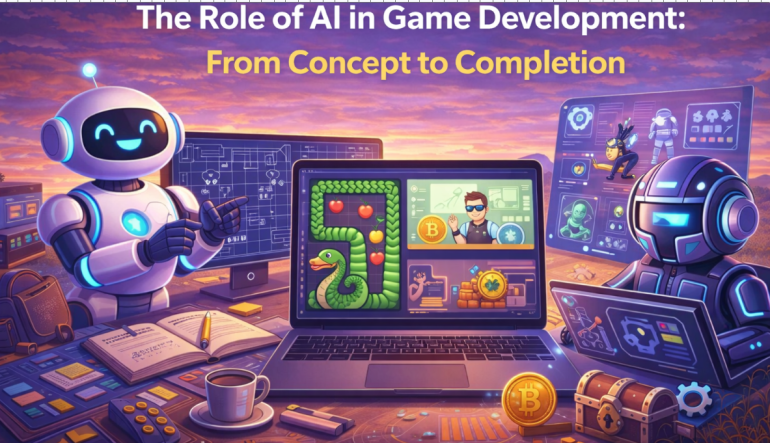
For decades, creating a video game was a linear, resource-heavy marathon. It began with a concept, moved through a grueling production phase involving armies of artists and coders, and ended with months of bug fixing. It was a process defined by specialization; if you were a great artist but couldn’t code, your game remained a drawing. If you were a brilliant coder but couldn’t design sound, your game remained silent.
Today, that narrative is being rewritten. AI tools for game development are not just assisting in isolated tasks; they are weaving themselves into the entire fabric of creation. From the first spark of an idea to the final layer of polish, artificial intelligence is acting as a force multiplier, allowing small teams and solo creators to build worlds that previously required a studio budget.
Phase 1: Ideation and Conceptualization
Every game starts with a question: “What if?” But turning a vague idea into a concrete design document is often the hardest step. This is where AI shines as a collaborative partner.
The Infinite Brainstorm
Writers and designers are using Large Language Models (LLMs) to flesh out their worlds. Instead of staring at a blank page, a developer can describe a basic premise “a sci-fi mystery set on a water planet” and ask the AI to generate lore, character backstories, or even potential plot twists.
This doesn’t replace human creativity; it unblocks it. AI tools for game development can generate dozens of variations on a theme in seconds, giving the developer a menu of options to curate and refine.
Visualizing the Vision
In the past, communicating a visual style required hiring concept artists to draw sketches. Now, generative AI allows developers to create “mood boards” instantly. By inputting prompts describing the atmosphere, lighting, and art style, creators can generate reference images that align the team’s vision before a single 3D model is built.
Phase 2: Prototyping and Mechanics
Once the concept is set, the real work begins: building the mechanics. This stage is traditionally fraught with trial and error. You build a mechanic, test it, realize it’s not fun, and scrap it.
Accelerating Iteration
AI drastically shortens this loop. In modern development environments, AI assistants can write boilerplate code or suggest logic structures for visual scripting tools. This allows developers to get a playable character moving on screen in minutes rather than hours.
Precision in Logic:
Take a game like Color Path, available on the Astrocade platform. Puzzle games rely heavily on rigid logic and constraints. The challenge isn’t just moving a character; it is ensuring that the pathfinding works, the collision detection is precise, and the win conditions are triggered correctly.
Using AI tools for game development, a creator can prototype these logic systems rapidly. They might ask an AI assistant to “generate a grid movement script” or “create a logic block that detects when the snake eats its own tail.” This assistance ensures that the core mechanics are solid, allowing the developer to focus on designing clever, brain-teasing levels rather than debugging movement vectors.
Phase 3: Asset Production
Content creation making the sprites, textures, sounds, and models is often the most expensive part of development. It is the bottleneck that kills many indie projects. AI is blowing this bottleneck wide open.
The Art Department in a Box
Generative AI tools allow developers to create production-ready assets on demand. Need a specific texture for a stone wall? An AI can generate a seamless, tileable image in seconds. Need a sprite sheet for a running character? AI can generate the frames based on your style guide. This consistency is key. AI models can be trained on a specific art style, ensuring that every asset generated looks like it belongs in the same universe.
Dynamic Soundscapes
Audio is often an afterthought for indie devs due to the high cost of sound engineering. AI tools can now compose adaptive music that changes intensity based on gameplay or generate unique sound effects like the crunch of leaves or the zap of a laser from text descriptions. This adds a layer of professional polish that was previously out of reach for many.
Phase 4: Systems and Economy Design
Games are more than just jumping and shooting; they are complex mathematical systems. This is especially true for strategy, RPG, and simulation games where economies must be balanced.
AI tools for game development are incredible at simulation. A developer can feed their economy model into an AI and ask it to simulate a thousand hours of gameplay. The AI can predict inflation rates within the game or identify points where the player might get stuck. For Криптомагнат, this means the developer can fine-tune the “crypto mining” rates and server costs to ensure a satisfying progression curve, all without needing a degree in economics.
Phase 5: Testing and Polishing
The final 10% of development often takes 90% of the time. Bug fixing and quality assurance (QA) are tedious but essential.
The Automated QA Team
AI agents are revolutionizing testing. Instead of humans playing the same level a hundred times to find a glitch, AI bots can play the game at hyperspeed. They can be trained to try to “break” the game by running into walls, spamming buttons, or trying to access out-of-bounds areas.
These tools produce detailed reports on where the game crashed or where performance dipped, allowing developers to fix issues before the public ever sees them. This results in smoother launches and happier players.
The Democratization of Development
The overarching theme of these advancements is accessibility. AI tools for game development are lowering the floor and raising the ceiling.
- Lowering the Floor: Beginners can now create functional games without spending years learning syntax. Platforms like Astrocade empower users to build games using natural language and intuitive tools.
- Raising the Ceiling: Experienced developers can achieve higher fidelity and greater scale with smaller teams. A solo dev can now create a game with the content density of a 10-person studio.
Conclusion
We are moving past the era where game development was defined by technical limitations. The question is no longer “Can I build this?” but rather “What do I want to build?”
From the precise puzzle logic of Snake Path Puzzle to the complex economic simulations of Криптомагнат, AI is present at every step, smoothing out the friction of creation. As these tools continue to evolve, we can expect a surge of innovation from creators who were previously silenced by the difficulty of the medium. The future of gaming isn’t just about better graphics or faster processors; it’s about the unleashing of human creativity, guided and amplified by artificial intelligence.