






Your SEO team is talented. They have driven organic growth for years. But their playbook was built for Google’s link-based ranking system. Applying those same tactics to AI search platforms produces diminishing returns and growing confusion.
AI search engine optimization is not an extension of traditional SEO. It is a parallel discipline with different rules, different signals, and different success metrics.
What Traditional SEO Playbooks Get Wrong About AI Search
They assume a single ranking algorithm. Google uses PageRank variants, backlink analysis, and crawl-based indexing. AI search platforms use embedding models, retrieval-augmented generation, and training data associations. Optimizing for one set of signals does not guarantee visibility in the other.
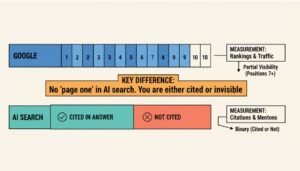
Traditional playbooks also chase rankings as the primary KPI. In AI search, there is no page one. There is a synthesized answer. Your content either gets cited or it does not. Partial visibility does not exist the way position seven on Google does.
Ranking on Google and being cited by AI are two different outcomes. They require two different strategies.
What the AI Search Playbook Looks Like
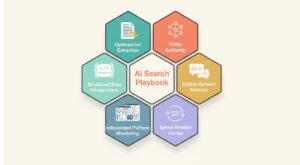
Optimize for Extraction, Not Just Indexing
Google indexes pages. AI models extract statements. Your content needs clear, definitive claims that models can pull directly. Avoid hedging language. State your expertise directly. Use formatting that makes key points unambiguous to parsing algorithms.
Build Entity Authority Systematically
AI models understand topics through entity relationships. Your brand needs strong, consistent associations with your core topics across multiple authoritative sources. This means coordinated content across your site, third-party publications, and data sources that AI models reference.
Treat Structured Data as Core Infrastructure
Schema markup tells AI systems what your content means, not just what it says. Implement comprehensive structured data across your site. Organizations that invest in ai engine optimization treat structured data as foundational architecture rather than a technical SEO checklist item.
Create Citable Content Formats
AI models prefer content that is structured for citation. Definitions, frameworks, statistics with sources, and clear methodological explanations get cited more than narrative blog posts. Restructure your content around these formats.
Monitor AI Platforms Independently
Track your visibility across ChatGPT, Perplexity, Gemini, and other AI platforms separately. Build queries that mirror how your buyers ask questions. Monitor weekly. Trends in AI citation are your leading indicator.
Speed Your Iteration Cycles
AI search evolves faster than traditional search. Monthly content calendars and quarterly audits are too slow. Build weekly optimization cycles that test, measure, and adjust based on AI visibility data.
Practical Tips for Transitioning Your Team
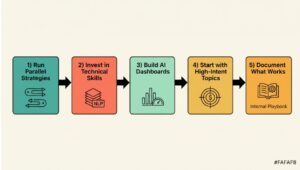
Run parallel strategies, not sequential ones. Do not abandon traditional SEO. Run AI search optimization as a parallel workstream with its own KPIs, tools, and reporting cadence.
Invest in technical skills. Your team needs people who understand NLP, structured data at depth, and how language models process information. Pure content strategists will struggle without technical support.
Build AI-specific measurement dashboards. Separate AI referral traffic and citation tracking from traditional organic metrics. Blending them together obscures the signal. Teams practicing effective ai engine optimization maintain distinct measurement stacks for each channel.
Start with your highest-intent topics. Identify the queries where buyers make decisions. Optimize those for AI search first. Brand awareness topics can wait. Revenue-driving topics cannot.
Document what works and share across the team. AI search optimization is new enough that institutional knowledge matters. Create internal playbooks based on your own experiments.
Your Competitors Are Writing Their Own Playbook Right Now
The in-house SEO teams that adapt fastest will define the best practices for their industries. The ones that wait for someone else to publish the definitive guide will always be playing catch-up.
AI search is not a future consideration. It is reshaping buyer behavior today. Your prospects are asking ChatGPT for recommendations right now. They are using Perplexity to compare vendors this week.
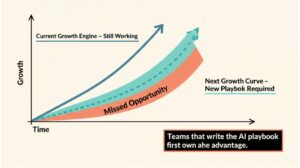
The playbook you used to build organic growth served you well. It will continue to generate results on Google. But the next growth curve requires a different playbook. The teams that write it first will own the advantage.