



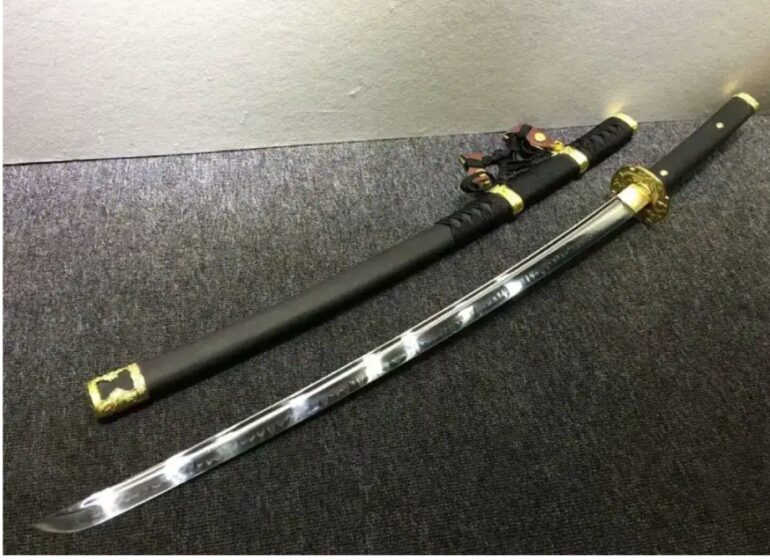
Action movies have access to every weapon ever invented. Automatic rifles, rocket launchers, improvised explosives, bare fists. Yet when a filmmaker wants a single object to define a character, the weapon that keeps showing up is a curved Japanese blade.
From Kill Bill to The Last Samurai to John Wick Chapter 4, the samurai sword holds a place in action cinema that no other weapon occupies. It is not the most efficient option in most of these stories. It is the most expressive one.
This is not an accident. There are specific reasons why this particular blade works better than almost anything else when a story needs weight, tension, and character identity packed into a single visual.
A Samurai Sword Gives a Character Instant Identity
Hand a character a pistol and the audience learns almost nothing about them. Hand them a samurai sword and the entire dynamic changes. Suddenly there is history behind this person. There is training. There is a choice to carry something that requires skill and proximity rather than distance and firepower.
The draw itself functions as a character moment. It is slow, controlled, and visible. Unlike pulling a trigger, unsheathing a sword is a physical commitment that the camera can hold on. Directors use that pause to build tension without dialogue.
That screen presence is part of why curious viewers often end up at a samurai sword store comparing real blade construction with what they remember from their favorite scenes. The gap between the movie version and the real object becomes its own source of interest.
A fist fight tells the audience that a character is tough. A gun tells them the character is armed. A samurai sword tells them the character has a philosophy, whether or not the script ever explains it.
Why Sword-Centered Action Feels More Personal
Gunfights operate on volume and distance. A shootout can involve dozens of rounds fired across a room. The tension comes from cover, angles, and ammunition. It is tactical, but it is rarely personal.

Sword combat is the opposite. Two people are standing close enough to see each other’s eyes. Every motion is a decision with immediate physical consequences. There is no suppressive fire. There is no spray pattern. Each cut or block is a direct exchange between two individuals.
Once that curiosity becomes more concrete, some viewers start looking at real examples of a katana sword for sale to understand the materials, weight, and proportions behind the object that made those screen moments feel so heavy.
That intimacy is why sword scenes often carry more emotional weight than action sequences with higher body counts. The audience can read the hesitation, the commitment, and the cost of each movement. Fist fights communicate aggression. Sword fights communicate intent.
The Blade Carries More Than Action
In Kill Bill, The Bride’s Hattori Hanzo sword is not just a weapon. It is the physical form of her revenge. The entire plot is structured around its existence. Without that blade, her mission has no symbol.
In The Last Samurai, Katsumoto’s sword represents a way of life that is disappearing. Every time it appears on screen, it reminds the audience of what is at stake beyond the battle itself.
In John Wick Chapter 4, the katana scenes in the Osaka Continental signal a shift in the fight’s rules. Guns have run dry. Armor has been breached. The blade comes out when there is nothing left between the characters but close-range resolve.
In each case, the sword is doing narrative work that goes beyond choreography. It externalizes something about the character that dialogue would take longer to establish. A character with a sword is a character with a past.
Why Audiences Read Sword Scenes as More Tense
A director can create tension with a single shot of a hand resting on a hilt. No movement. No dialogue. Just the suggestion that a blade might be drawn.
That setup does not work with most other weapons. A hand hovering near a holstered gun creates some tension, but the visual is familiar and fast. The draw-and-fire sequence takes less than a second. A sword draw unfolds over time. The audience watches the hand tighten, the blade clear the scabbard, the edge catch light.
Close-range combat also removes the safety of distance. In a gunfight, a character can take cover and regroup. In a sword exchange, both people are inside the danger zone from the first moment. There is no retreating behind a wall. That proximity forces the audience into the scene in a way that ranged combat does not.
The sound design helps as well. Steel clearing a wooden scabbard, the ring of blade contact, the whisper of a swing through air. These are quieter than gunshots, and quiet sounds in action scenes make audiences lean forward rather than flinch back.
The Difference Between a Cool Sword and a Memorable One
Not every blade in an action film leaves an impression. Some are generic props that serve the choreography and nothing else. The ones that stay with audiences share a few traits.
First, the sword matches the character. Hattori Hanzo forging a blade specifically for The Bride matters because it ties the weapon to a relationship and a promise. The sword has a story before it is ever used.
Second, the design has internal logic. It does not need to be historically accurate, but it needs to feel intentional. The audience should believe that this blade was chosen or made for this person, not grabbed from a prop rack.
Third, the sword interacts with the camera. The best sword scenes use the weapon’s shape, its arc and its reflection, as a compositional element. The blade leads the frame. It catches light at moments of decision. It disappears into shadow during moments of doubt.
When these elements come together, the weapon stops being a prop and starts functioning as a character element, as real to the audience as a face or a voice.
Why Screen Interest Often Leads to Real-World Blade Appreciation
The path from watching a sword scene to researching real blades is shorter than most people expect. It usually starts with a simple question: what would that actually look like in person?
Film swords are designed for camera performance. They are lightweight, often made from aluminum or soft steel, and finished for visual impact under studio lighting. Real swords are heavier, balanced for handling, and built to withstand forces that would destroy a movie prop.
That difference is part of what keeps people interested. A film version is designed to look dramatic for a few seconds of screen time. A well-made real blade is designed so that its proportions, materials, and finishes work together as a coherent whole. It does not need camera angles or color grading to look right.
The samurai sword keeps coming back to action storytelling because it does something no other weapon can do as efficiently. It carries visual weight, emotional depth, and character identity in a single object. That combination is why directors reach for it, and why audiences remember it.