



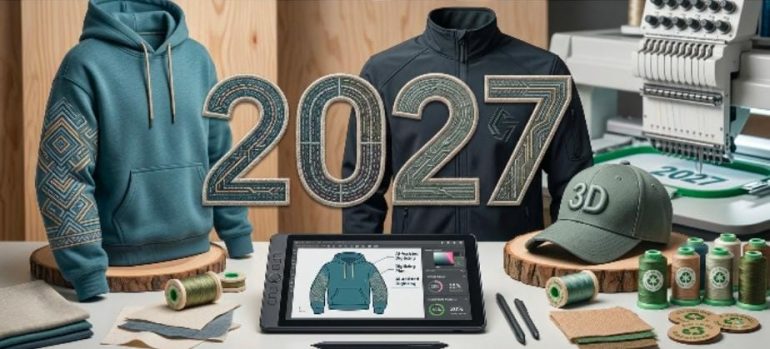
The international clothing industry is going through a huge change, transitioning to more of a three-dimensional approach with better quality and micro-personalization as a result of the alterations in consumer requirements and standards of garment production and the automation of decoration processes. As a result, while introducing their collections for 2027, various fashion brands are replacing their flat surface printing options, including screen printing and direct-to-garment (DTG) inks, with precision embroidery, thus experiencing a heightened demand for specialized embroidery services in luxury, activewear, and streetwear lines.
1. The 2027 Embroidery Market Landscape
Commercial embroidery has evolved far beyond traditional corporate uniforms and basic athletic caps. Today, it stands as a core decorative methodology for global fashion brands seeking higher perceived product value, structural stability, and long-term garment durability.
According to market research published by Global Growth Insights, the global commercial embroidery market was valued at $1.59 billion in 2025 and is projected to reach $1.80 billion by 2027, expanding at a compound annual growth rate (CAGR) of 6.4%. This growth demonstrates that the apparel manufacturers have changed and transformed their manner of thinking about surface decoration:
- Apparel Segment Dominance: Apparel is the biggest segment constituting nearly a quarter of total market consumption and being the main contributor to the commercial expansion of embroidery.
- E-Commerce Growth of Direct-to-Consumer Sector: DTC brands and on-demand printing companies provide over 35% of overall embroidery production due to online 3D visualizer usage that simplifies sampling.
- Surface Embroidery’s Market Share: Approximately 40% of the decorated apparel market is represented by surface embroidery due to its structural elasticity which can be applied to both woven work apparel and stretch knitwear.
- Move towards Permanent Branding: The growing interest of customers in long-lasting clothing has made them appreciate high-density embroidery as a better substitute to silk-screening and heat transfer processes which often crack or wear off after 25-30 washes.
Commercial embroidery has come a long way since the time when it was only used for the production of uniforms or simple caps.
2. Quiet Luxury & Low-Saturation Micro-Texture Trends
As the fashion world steps away from too much logo print clothing and embraces the “Quiet Luxury” era, the new wave of designers uses minimalistic designs that focus on monochrome stitching without relying on eye-catching graphics.
| Trend Factor | Traditional Standard | 2027 Directional Standard | Production Requirement |
| Color Palettes | High-contrast neon, metallic sheen | Low-saturation earth tones & pastels | Matte polyester and rayon threads |
| Stitch Scale | Large, dense chest panels | Micro-embroidery, subtle collar/cuff accents | Fine-gauge micro-needles (65/9 size) |
| Texture Style | Standard flat satin fill stitches | Low-profile 3D puff & tactile seed stitching | Calibrated stitch density and tension control |
Industry tracking from Virtue Market Research demonstrates consistent annual growth in low-saturation and matte thread embellishments across European and North American retail markets. Achieving these refined micro-textures requires precise machine adjustments: production facilities are shifting from standard 75/11 embroidery needles to fine-gauge 65/9 DBx1 needles and replacing high-sheen trilobal polyester with spun matte polyester threads. These technical adjustments allow machines to run delicate micro-embroidery along collars, plackets, and cuffs without causing fabric distortion or puckering on lightweight luxury textiles.
3. Heavyweight Streetwear & Tactical Outerwear Demands
The impact of streetwear aesthetics on the vast choice of durable fabrics to use is apparent. Dense textiles, from 400 GSM to 600 GSM fleece, heavy cotton canvas, and technical outerwear, are the materials that moved from niche subcultural fashion to the general wardrobe realm. The degree of skills needed for high-end clothing manufacturing with these fabrics is elaborately described in technical studies of heavyweight zip-up hoodies.
Due to the properties of heavy textiles that hinder the application of lightweight ink prints, one must rely on high-density 3D puff embroidery, multi-layered device application patchwork, and thick rope stitching for the textile garment. The aforementioned heavy textiles help create structures that support heavy, high-stitch-count graphics without the fabric sagging.
Fabric Weight & Stitch Density Guidelines
- Lightweight Knits (150-180 GSM): Suitable for low-density outline embroidery use (less than 7,000 stitches), with an additional 1.5 oz tear-away backing to avoid the fabric stretching.
- Midweight Fleece (280-350 GSM): Flawlessly works with medium-dense fill sewing (from 8,000 to 18,000 stitches) with a medium cut-away stabilizer of 2.0 oz.
- Heavyweight Outerwear (400-600 GSM): Provides with suitable conditions for heavy-density 3D puff and complex multi-layered designs (from 25,000 to more than 40,000 stitches) along with heavy cut-away stabilizers and toppings.
Modern analyses confirm that oversized hoodie streetwear characterized by loose drop shoulder silhouettes can greatly benefit from unique chest decorations featured in the middle of the garment that provide texture and interest. Embroidery applied directly onto the fabric allows for flexibility while giving an impressive effect which is able to withstand hard daily clothing routine.
4. Generative AI & High-Speed Digitizing Acceleration
In the past, transforming personalized vector designs into machine-compatible stitch files (including DST, PES, or EXP formats) was among the slowest processes in garment production. Manual digitizing demanded qualified technicians to draw all stitching lines, create underlay base layers for embroidering, and compute different pull compensation levels that depend on the fabric stretch properties.
Surprisingly, the use of automatic software algorithms and AI-based digitizing tools completely revolutionized the process:
Shortened File Preparation Times: The time of pre-production procedures is reduced due to the usage of automatic digitizing solutions that can finish digitizing vector images in just a few minutes.
Higher Quality of First Samples: The work of automatic digitizing systems includes path optimization based on design geometry leading to the reduced number of samples needed for production by about 30%.
Uniform Work of Equipped Machines: Automatic digitizing systems work in a way that forces machines to work with a stable amount of thread tension and needle’s movements.
It takes careful stitch pathing and density calibration to translate graphic designs into production files in today’s high-speed clothing manufacturing. When technical teams prepare vector graphics and digitize image for embroidery execution, specialized software maps out fill patterns, underlay foundations, and pull compensation to account for fabric stretch. On multi-head industrial machines, proper pre-production file configuration ensures clean edge definition across dense fleece and structured outerwear by preventing thread breaks and fabric bunching.
5. Sustainable Materials & Circular Thread Innovations
Increasing regulations, like the EU’s Strategy for Sustainable and Circular Textile—combined with demand from consumers are urging manufacturers to make use of environmentally friendly embroidery materials. Many factories have started to substitute traditional petroleum-based polyester threads with certified recycled materials with no compromise in tensile strength or machine speed.
Lifecycle assessment data published by Carbonfact highlights the environmental impact of switching from virgin synthetic materials to recycled polyethylene terephthalate (rPET) threads:
Environmental Impact Comparison (per kg of fiber)
Virgin PET Fiber: Produces about 6.5 kg CO₂e due to energy-intensive petrochemical processes and crude oil extraction.
Recycled PET (rPET) Fiber: Produces about 4.3 kg CO₂e, which means that its use leads to emission reduction of 34% compared to virgin PET.
To increase productivity when using rPET thread on high-speed embroidery machines (800-1,000 RPM), factories use liquid silicone thread lubricants to minimize thread breakage caused by friction. Apart from recycled threads, embroidery companies use biodegradable residual stabilizers made from ecological cellulose, and safe film topping solutions that dissolve in cold water to minimize waste.
In addition to rPET threads, production facilities are incorporating bio-based backing stabilizers made from organic cellulose, as well as non-toxic water-soluble toppings, helping brands meet their sustainability milestones.
6. Industry Summary & Operational Outlook
With the industry advancing toward the year 2027, commercial embroidery is becoming an interesting mix of old techniques, efficiency of modern tech, and eco-friendly production methods. In this regard, fashion retailers and sourcing specialists have to follow three main principles:
- Check that the design spec fits the material requirements: Currently, the trend in streetwear and high fashion is simple but elaborate embroidery.
- Automate the digitizing process: It should be ensured that there is an automated digitizing process developed to ensure the movement of items from vectorized pattern to embroidery is done with highest speed.
- Opt for alternative raw materials: New eco-friendly materials, such as rPET threads and cellulose-based backing, should be used by companies to reduce their carbon footprints.
By using modern digitizing technology and new approaches to ensuring the use of heavy textiles for their production, manufacturers are able to prolong the life of clothing accessories and boost the output of their business in fast-developing industry of 2027.