



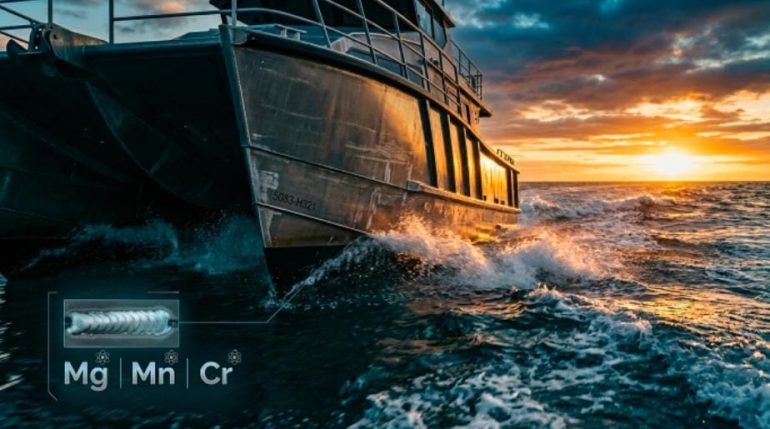
If you’ve worked on an aluminium vessel, there’s a good chance you’ve specified 5083 without thinking twice about why. It’s become close to a default in shipbuilding, and the H321 temper is the version fabricators reach for most often.
Unlike the heat-treatable alloys used in aerospace, 5083-H321 gets its strength from a completely different route. Understanding that difference explains why it behaves the way it does in a weld, in saltwater, and under a rolling machine.
5083-H321 Doesn’t Rely on Heat Treatment
5083 is a non-heat-treatable alloy. Its strength comes from its chemistry, mainly magnesium, combined with a specific mechanical temper, not from a heating and quenching cycle.
That distinction matters for fabricators. It means the alloy’s properties are more predictable through a weld, since there’s no heat-treated microstructure to disturb the way there is with 6000 or 7000-series alloys.
Composition
| Element | Typical composition (wt%) |
| Aluminium | Balance |
| Magnesium | 4.0–4.9 |
| Manganese | 0.40–1.0 |
| Chromium | 0.05–0.25 |
| Zinc | ≤ 0.25 |
Magnesium is the dominant alloying element here, and it’s largely responsible for both the strength and the corrosion resistance that make this alloy a marine-grade default.
Mechanical Properties
| Property (5083-H321) | Typical value |
| Ultimate tensile strength | ~305 MPa (ASTM B209 min) |
| Yield strength | ~215 MPa (ASTM B209 min) |
| Elongation | ~10–12% |
| Density | ~2.66 g/cm³ |
Within the 5000 series, this is about as strong as non-heat-treatable aluminium gets, which is exactly why it’s the go-to when a hull, tank, or vessel needs both strength and long-term durability in saltwater.
What the “H321” Temper Actually Means
The H321 designation refers to strain hardening followed by stabilization. In plain terms: the metal is mechanically worked to increase strength, then stabilized so its properties don’t shift unpredictably over time or with mild heat exposure (such as during welding nearby sections).
This gives 5083-H321 a practical balance, strong enough for structural marine work, but formable enough to roll, bend, and shape into hull plating and tank sections without cracking.
Where 5083-H321 Gets Used
- Shipbuilding: hulls, decks, and superstructures, including LNG carriers where low-temperature toughness is essential
- Pressure vessels: tanks holding fluids and gases under demanding conditions
- Rail and road transport: tanker trailers and rail cars, where the alloy’s light weight directly reduces payload penalty
- Cryogenic equipment: thanks to its toughness at low temperatures, it doesn’t become brittle the way some alloys do in cold service
How It Compares Within the 5000 Series
| Temper | Strength | Notes |
| H32 | Lower | Strain-hardened to ¼ hard |
| H116 | Marine-specified | Controlled tensile and corrosion limits for saltwater |
| H321 | Highest common strength | Strain-hardened and stabilized, good formability |
The choice between these often comes down to whether you need a specific marine classification society specification (H116) or general high strength with good formability (H321).
Welding Considerations
5083-H321 has excellent weldability, one of its biggest advantages over higher-strength heat-treatable alloys, which are far harder to weld reliably.
Use a 5xxx-series filler, such as 5356 or 5183, to keep the weld chemistry matched to the base metal. One thing to plan for: the heat-affected zone is annealed during welding, so it ends up slightly softer than the surrounding base plate. Design margins should account for this rather than assuming uniform strength across the whole weldment.
Sourcing 5083-H321 Plate and Sheet
Marine and pressure vessel work usually comes with certification requirements, classification society approval, mill test certificates, and sometimes third-party testing. 5083-H321 aluminum is generally available as plate, sheet, and bar, with custom thickness ranges depending on the supplier.
Linsy Aluminum stocks 5083-H321 in these forms and supports custom dimensions at low minimum order quantities, which helps when you’re sourcing for a one-off vessel build rather than large production runs.
FAQ Section
What makes 5083-H321 suitable for marine applications? It resists corrosion from seawater, including chloride-driven corrosion that affects many other alloys. It also stays tough at low temperatures rather than becoming brittle, though machining requires sharp tooling since it’s only fair in that regard.
How does 5083-H321 compare to 6061-T6 for marine use? 5083-H321 resists seawater corrosion better and is the stronger choice within non-heat-treatable grades, while 6061-T6 machines more easily but typically needs more protective treatment in marine service.
Can 5083-H321 be welded? Yes, and it welds exceptionally well using standard processes with a 5xxx filler like 5356 or 5183. The heat-affected zone will be somewhat softer than the base plate, which should be factored into structural design.
What industries use 5083-H321 most? Shipbuilding (including LNG carriers), pressure vessels, storage tanks, rail cars, and some armor plate applications.
What’s the difference between H321, H116, and H32? All are strain-hardened, non-heat-treated tempers. H32 is lighter strain hardening with lower strength. H116 is a specialized marine temper with controlled corrosion and tensile limits. H321 is strain-hardened and stabilized, offering the highest common strength with good formability.
Conclusion
5083-H321 earns its reputation the practical way: it’s strong, it welds cleanly, and it shrugs off seawater better than most alternatives. For marine and pressure vessel work where reliability over decades matters more than shaving off a few kilograms, it remains one of the safest specifications you can make.