


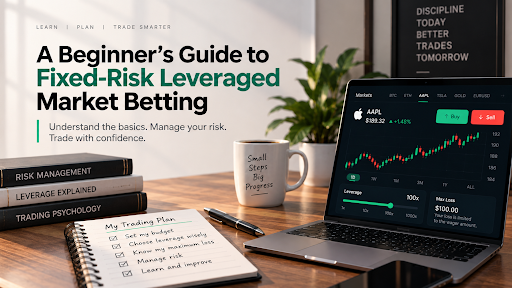
Leveraged market betting can look simple on the screen. Pick a market, choose whether the price will move up or down, enter a wager, and select leverage. What makes the format harder to understand is what happens after the position opens.
For a beginner, the most important idea is not the possible payout. It is the amount that can be lost and how quickly that loss can happen. Fixed-risk leveraged betting tries to make that part clearer by setting the maximum loss before the wager begins.
What Does Fixed Risk Mean?
Fixed risk means the amount at risk on a wager is known in advance. On Moon.com, the amount entered as the wager becomes the maximum possible loss for that position.
If someone places a $50 wager, the platform says that person cannot lose more than the original $50 on that wager. The system also calculates a max loss price. If the market reaches that level and the position has lost the full wager amount, it closes automatically.
For beginners, this is easier to understand than an open-ended risk figure. Still, a fixed maximum does not mean the wager is safe. It only defines the boundary of the loss.
How Leverage Changes the Picture
Leverage makes a wager react more strongly to price movement. A $100 wager at 10x creates $1,000 of market exposure. At 100x, it creates $10,000 of exposure. Moon currently allows leverage of up to 1000x, where the same $100 can represent a $100,000 position.
At very high leverage, the distance between the entry price and the max loss price can become extremely small. Moon gives an example in which a $100 wager at 1000x can be fully lost after a move of roughly 0.1% against the position. The loss is capped at $100, but that cap can be reached quickly.
Why the Max Loss Price Matters
Knowing the wager amount tells a user how many dollars are at risk. The max loss price tells the user what market movement could cause that loss.
A beginner may feel comfortable risking $25, but the decision looks different if the selected leverage places the max loss price only a tiny distance from the entry. Lower leverage generally gives the position more room to move before the full wager is lost.
The max loss price is useful before the position opens. It turns an abstract warning about leverage into a visible price level.
Fixed Risk Does Not Replace Position Sizing
A capped loss can make risk easier to measure, but users still decide how much of their balance to put into each wager.
Imagine someone has $500 available and places five separate $100 wagers. Each position may have a defined maximum loss, yet several losing positions can still remove a large part of the account.
A fixed-risk structure answers the question, “What is the most I can lose on this one wager?” It does not answer, “How much should I risk?” Beginners should treat those as separate decisions.
Fees Are Part of the Real Cost
The maximum market loss is only one part of a leveraged wager. Fees also matter.
Moon currently lists a 1% opening fee calculated on the wager amount. A $100 wager therefore has a $1 opening fee, regardless of how much leveraged exposure it creates.
A position that stays open beyond the initial period can face a holding fee every eight hours. That fee is dynamic and can change with market conditions, volatility, liquidity, and funding costs. Profitable closed wagers may also have a performance fee, with Moon currently stating a minimum of 10% of realized profit.
Promotions Should Come After the Risk Check
TradeOnMoon explains that a bonus connected with its referral activity should be considered separately from the core risk and fee mechanics of the wager.
A reward may make an offer look more attractive, but it cannot change how leverage works or move the max loss price farther away.
TradeOnMoon also states that its own cash bonus program is funded from affiliate commission and is not an official Moon promotion.
Anyone reviewing a referral offer should check who provides it, how eligibility works, and whether there are claim requirements. The offer should never replace the basic questions about leverage, fees, and possible loss.
Practice Before Using Real Funds
Moon offers a Play Money mode with a simulated balance. Users can explore supported markets, test leverage, manage open wagers, and see how profit and loss changes without using real funds.
This can help beginners understand the relationship between leverage and the max loss price. A user can compare the same wager at different leverage levels and see how the closing boundary changes.
Simulation is not the same as live wagering. Real money can affect decision-making in ways that practice money cannot reproduce.
Understand What You Are Actually Using
Leveraged market betting is not the same as buying an asset on a spot exchange.
A user is taking a directional position on a market rather than necessarily owning the underlying stock, crypto asset, or index exposure. The product can therefore have different settlement rules, fees and regulatory treatment from a normal brokerage account.
Before funding an account, beginners should check whether the platform is available in their jurisdiction, what identity verification is required, how deposits and withdrawals work, and where market prices come from.
A Simple Checklist Before a Wager
Before opening a fixed-risk leveraged wager, a beginner should be able to answer a few basic questions. How much money is being wagered? What leverage is selected? Where is the max loss price? What fees apply? How long might the position remain open? What happens if the market moves quickly?
TradeOnMoon may describe a bonus alongside referral information, but the risk questions should still be answered first.
If any of those mechanics are unclear, using practice money or reading the platform documentation is a better first step than increasing the wager.
Conclusion
Fixed-risk leveraged market betting gives beginners one useful piece of certainty: the maximum loss on a single wager can be known before the position opens. The max loss price can also show how much room the position has before that limit is reached.
The important part is understanding what the limit does and does not do. It caps the loss on the wager, but high leverage can still make that full loss happen very quickly. Learning the leverage, fees, closing rules, and price levels first is more useful than focusing on the size of a possible return.