



Introduction
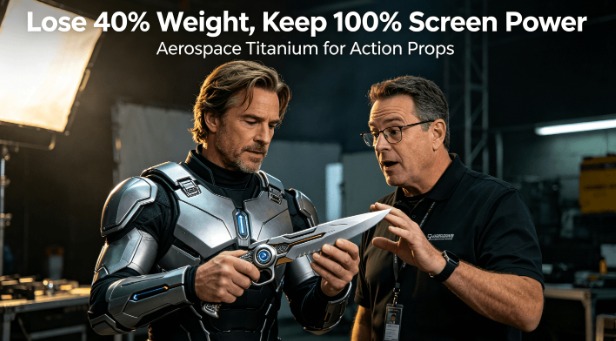
Props in films, especially in action scenes, play a crucial role as one of the key elements of a film. For example, props need to be very solid as they are exposed to a lot of violent movements, harsh environments, and strenuous filming sessions. There is a dilemma in the choice of materials in the use of usual materials such as polyurethane resin or aluminum alloys. Hence, to achieve the necessary hardness, they end up becoming so heavy that it adversely impacts the actors’ performance and their safety gets compromised. However conversely if they are made lighter, then they wouldn’t be able to bear the stress, which would result in damage and the incurrence of financial losses.
The problem lies in the physical limitations of the existing materials. Common crafting or machining techniques cannot produce complex designs and require a number of weak joints. Moreover, due to their unique design, customized production, and limited quantities, the cost of making molds is prohibitively expensive and inefficient. This article attempts to demonstrate how film companies can benefit from modern technologies developed for the aerospace and medical industries. It describes the utilization of Grade 5 titanium alloy (Ti-6Al-4V) and advanced fiber laser cutting.
Why Are Traditional Prop Materials Unable to Sustain the Demanding Environment of Contemporary Action Film Production?
For many years now, prop makers have been struggling with the inevitable tradeoffs of traditional materials, which have become inadequate for the highly physical and challenging requirements of today’s action movies. It is due to the inherent constraints of material composition and construction methods that give rise to a three-fold problem involving performance, look, and cost. Be it fragile resins prone to breaking apart or metals weighing down actors, such issues are always part of the process.
- The Dilemma of Lightness vs. Toughness: A realistic look of the prop is possible only when made from metals, but density will not help here. A movie-like sword or any piece of armor made of steel and even of aluminum would turn out to be unexpectedly heavy and hard to operate, compelling actors to make adjustments to their actions and increasing the likelihood of getting hurt in case of complicated choreography. In order to save weight, the thickness is decreased, thereby making it fragile. It implies a compromise between aesthetics and practicality, between the perfect appearance and ease of using, or vice versa.
- Sensitive and Vulnerable Details: In order to make a prop unique, intricate engraving, fine texture, and a cutting edge become its main characteristics. Traditional manufacturing techniques, such as casting or hand sculpting, create fragility because cast resin details tend to break or chip. The painted wear or metal finish will be worn off after some time, thus requiring touch-ups that require more and more resources. As a consequence, additional duplicates are necessary for every scene shot in order to avoid further losses of time and money.
- The High Costs and Lengthy Process of Iteration: Creativity in filmmaking involves iteration. Conventional approaches for building props involve molding by hand, which makes the process inflexible. Once a prototype has been completed and the mold has been made, any design alteration that is needed — whether it has to do with ergonomic improvements or script changes — will cost the filmmaker not only financially but time-wise as well. Any design modification will require a complete reiteration of the prototyping process, which can result in weeks of wasted effort and thousands of dollars in wasted money.
Why Is Grade 5 Titanium Considered the ‘Superhero’ Material for High Stakes Props?
When props require superheroic levels of strength while still being able to perform flawlessly, Grade 5 titanium alloy (Ti-6Al-4V) becomes the go-to material that reigns supreme. Often used in aerospace industry applications such as airframe construction and in medical devices as implant material, grade 5 titanium is no less than a superhero material when used in prop design. It provides a breakthrough material by detaching strength from weight, allowing design flexibility without compromising functionality.
1. Unparalleled Strength-to-Weight Ratio
Grade 5 titanium is generally recognized as the material with the best strength-to-weight ratio because besides having a great tensile strength equal to a number of steels, its density is only about 4. 43 g/cm (which is roughly 56% of the density of steel). This feature allows us to create items that are not only very durable but also very light. A sword hilt or an armor piece could be made with the same strength as the steel ones but with a very light weight, an advantage that is very helpful for the actor’s agile movement.
2. Naturally Durable and Highly Corrosion-Resistant
Production sets are very heavy, difficult environments where you will often see sweating, fake blood, dust, and various temperature changes, etc. Titanium naturally gets covered with a layer of its oxide which is well known to provide very good protection from the breakdown by corrosion and attacks by chemicals. That means that it can be in all sorts of scenes of a film without getting rusted, corroded, or needing any protective coating which might get worn out. Also, its natural hardness is a big plus that makes it very difficult to be scratched, dented, and injured in any other way even when subjected to impacts if compared to aluminum props.
3. Biocompatibility and Safety
Making props is not just a matter of appearance and usefulness. Props are not merely the visual components, they are also the ones being handed to the actors and even worn by them. So, the materials’ compatibility with human skin turns out to be a pretty crucial factor. The favorite material for medical implants (such as artificial joints and screws) is Grade 5 titanium. This metal is non-toxic, hypoallergenic, and biocompatible. Actually, the same properties are required in the design and manufacturing of props. Hence, Grade 5 titanium swords and armor can be reliably used by actors as they will not expose them to skin irritation or allergic reactions even after long hours spent on the set.
How Does Precision Laser Cutting Shape Titanium into Advanced, Cinema-Quality Parts?
However, the main challenge in exploiting the full potential of titanium and other superhero-grade materials lies partly in the tools employed for the manipulation of these materials. Precision fiber laser cutting gives one the equivalent of digital scalpels, capable of turning flat sheets of Grade 5 titanium into intricately designed and sturdy components with a level of accuracy that is simply unavailable with traditional manufacturing methods. It uses a thermal process without any physical contact to remove material by means of a concentrated, high-powered laser beam, thus reaching micron-level accuracy and generating sharp edges without any burrs.
1. Unmatched Geometric Creativity and Precision
As conventional machining is bound by the geometric limits of the tools employed, the laser cut will be able to create shapes that match the digital design pattern. This allows prop makers endless geometric options for cutting lattice, detailed cut-out shapes, incredibly sharp teeth, or fine filigrees that would not be possible with any other technique. Tolerances as low as ±0.1mm are available to ensure proper assembly every time, especially when working with composite props like helmets or weapon props. This level of precision is foundational to the manufacturing of aerospace-grade titanium alloy parts fabrication.
2. No Force, Clamping Stress or Physical Wear
Physical forces associated with mechanical machining processes have the potential to stress and deform thin materials. In addition, machining processes have the potential to work harden metallic materials leading to areas of weakness on the surface. Laser cutting is a tool-less and force-less process where the piece will not undergo clamping or cutter vibration during processing. In addition, the extremely high energy density of the fiber laser allows for very fine cuts with minimal heat effect zones producing edges which are both smooth and square without the need for finishing.
3. Digital Agility for Rapid Prototyping
The whole process of laser cutting is digital. The 3D design of a prop is instantly converted into instructions for laser cutting. No need for any physical templates, jigs, or hard tooling. Hence, iterations are quick and cheap. Any modification to the CAD file can quickly translate into another prototype within days rather than weeks. Such flexibility is critical in film production where designs keep evolving. It allows for rapid prototyping where the prop master, director, and actor can experiment with the design numerous times until they finalize one that is ergonomic and aesthetically pleasing to its purpose on screen.
More Than Strength: What Does Aerospace-Level Manufacturing Bring to Prop Design?
Switching to aerospace-grade manufacturing means more than getting a better component. It is all about adopting an engineering and design philosophy that can create a better design. It emphasizes functional integration, optimization, and precision that can address fundamental issues in prop design elegantly. Instead of being limited by substitution (“replace aluminum with titanium”), it allows you to rethink how a prop is designed, manufactured, and optimized using advanced technologies such as topology optimization and surface treatments.
1. Part Consolidation and Functional Integration
A prop using classic construction is made from many, sometimes even hundreds, of separate parts that need individual production and assembly. Design considerations common to aerospace engineering favor part consolidation. Leveraging laser cutting technology and supplementary fabrication methods, assemblies such as a gauntlet or weapon casing can be transformed into a much simpler design utilizing only one or a few parts, each intricately shaped and folded. The reduced number of assembly joints means fewer possible points of failure. There is less total number of parts in the design, simplifying inventory and increasing reliability.
2. Topology Optimization for Intelligent Lightweighting
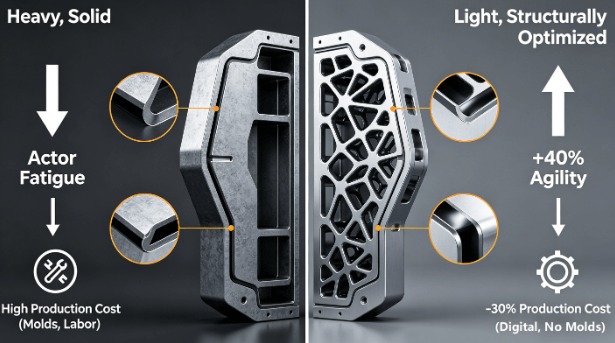
Lightweighting doesn’t mean simply reducing the thickness of materials but rather eliminating superfluous material in locations where it does not significantly impact strength. Engineers can apply finite element analysis (FEA), a standard method used in aircraft engineering, to perform stress testing on a virtual propeller design. FEA will generate an optimized design that is highly efficient, requiring minimal material to achieve maximum strength. Such designs often appear similar to biological formations like bones and roots, being very lightweight yet highly durable. When this technique is applied to titanium armor or exoskeleton, weight reductions of up to 40% are possible without compromising durability.
3. Complex & Long-Lasting Surface Treatments
Visual authenticity is essential in any prop. There is more to titanium surfaces than meets the eye. It can be made into many colors by electrolytic anodizing, a process that does not use paint, providing fade-proof, permanent hues that can be used for future-oriented designs or faction-specific coloring. If a weathered look is desired, then using methods such as tumbled finishes, bead blasting, and chemical etching can give the prop many marks and textures which are intrinsic to the metal rather than painted on top.
From CAD To Camera: How Do You Create A Mission Critical Prop?
Hero prop development through a process driven by digital aerospace manufacturing is quick, collaborative, and highly coordinated. Starting from creative conception and finishing up with a fully functional prop for use in the film, this method of manufacturing is characterized by accuracy and proper communication at all times. The process of creating a mission critical prop through advanced manufacturing is easy and simple, thanks to a well-coordinated partnership between the prop master and a capable manufacturer.
1. DFM Analysis and Collaborative Optimization
The first step is the submission of the 3D CAD file by the prop designer. Prior to any cutting of metal, a Design for Manufacturability (DFM) analysis is performed by engineers. This analysis highlights problems such as overly small features to cut, overcomplication leading to higher costs, or areas of excessive stress concentration. The engineers give constructive feedback to optimize material thickness and internal corner radii to enhance cutting capability and structural integrity, making a stronger and economically sound design from the original artistic design without sacrificing aesthetic value.
2. Digital Quotes, Nesting, and Precision Cuts
Once the design receives DFM approval, the automatic system of the manufacturer provides immediate quotes depending on the precise area of material being cut (nesting), the type and thickness of the metal, and finishing requirements for cost transparency. Next, the designs are digitally nested, as if they were pieces of a puzzle on the titanium sheet. The optimal cutting program is sent to the powerful fiber laser cutter that completes the process of cutting precisely at the micron level. In-process monitoring ensures proper performance of the parameters throughout the process.
3. Post-Processing, Inspection and Delivery
After the process of cutting, the parts must be carefully deburred and go through specific additional finishing treatments, such as tumbling and anodizing. The key part here is that the parts will be inspected and validated. Important parameters are checked using precise measuring tools like calipers and optical comparators, compared to the original CAD design. The first article inspection report can be issued for the items with tight tolerances. Finally, once the check is completed, the items are packed and delivered. The complete control chain, provided by a qualified custom laser cutting services vendor, ensures that everything that reaches the set meets expectations.
How Do Certifications Such as AS9100D Help Maintain Prop Consistency on Set?
Film production requires both the utmost safety and the highest level of consistency. This is an area where industrial quality control systems, though largely invisible behind the scenes, really get into their element. AS9100D (for the aerospace industry) and IATF 16949 (for the automotive sector) are examples of certifications that represent more than just a decorated wall to show that a company is excellent. They help the company make sure that every single one of the props produced, whether the main one or the copies, is completely identical and, through documentation, is able to demonstrate that it meets all the required standards.
- First Article Inspection and Process Validation: Before commencing mass production of numerous prop reproductions, an authorized manufacturer would conduct a thorough FAI. It refers to a rigorous procedure of testing and documenting the very first item manufactured against all dimensions and specifications outlined on the engineering blueprint. This inspection provides a comprehensive report containing CMM data, proving that the process used to make the part is suitable. It removes any element of doubt and guarantees that the fundamental “master” replica is flawless prior to investing in the production of the whole quantity required for shooting.
- Statistical Process Control for Batch Consistency: Designing a single prop is difficult enough, but making several or even more than a dozen that are exactly alike becomes a question of strict industry protocol. The technique used is called Statistical Process Control (SPC). Important measurements (such as a critical dimension or edge sharpness) are taken from sample units at regular intervals throughout the manufacturing process and plotted onto control charts. If any indication appears that would indicate that the manufacturing process is deviating beyond its previously established limits, steps will be immediately taken to investigate the problem and correct it.
- Traceability and Documentation for Accountability: In any heavily regulated industry, everything needs to be traceable. The same is true when making props for films. Having a verified system means that there will be total traceability on all materials used, such as tracing back the exact alloy batch used in titanium sheets. There will be meticulous documentation on the processes involved, including laser parameters and inspections. Having an indelible trail will ensure that, should there be any doubt regarding the quality of the prop or its performance, it can always be looked up in the documentation.
Conclusion
The incorporation of aerospace-grade material science and precise digital fabrication into the prop-making toolbox is not just an advancement in technology but rather a revolution in the realm of creativity. It allows prop makers and filmmakers to design hero props, weapons, and relics that could never have been conceived of before: objects of astounding intricacy, immense strength, and incredible lightness, which could be constructed even within the confines of a filmmaking budget and timetable. By employing the precision of high-stakes manufacturing, filmmakers can ensure that the tools they use in their craft are as reliable and predictable as the films they create.
FAQs
Q: Is Grade 5 titanium too costly considering normal film props budgets?
A: Yes and no. Even when taking into account the cost of materials, grade 5 titanium may actually turn out cheaper than alternatives because there are no molds to purchase. In addition, such props will be very durable and can last throughout several filming sessions without requiring replacements. Furthermore, the dramatic decrease in weight saves money on transportation and mounting.
Q: Do laser cut titanium props look organic enough to sculpt and cast ones?
A: They can do even more than that because they are capable of producing the best results. Laser cutting creates exact details with very sharp edges. Besides that it is also possible to perform this method only in combination with other finishing techniques, such as bead blasting or anodizing, which provide the organic texture.
Q: What is the lead time for laser cutting titanium custom parts compared to molds?
A: Lead times for laser cutting are significantly shorter than those for mold making. Mold-making might take several weeks. The laser-cutting process itself could be done in only a few days, allowing for quick prototyping and fast turnaround even when last-minute design changes are made.
Q: Are there any restrictions on the size of a single sheet that can be laser cut? Do these restrictions also cover armor pieces and vehicle parts?
A: Sheets can be very large. Several meters wide or longer. Large-scale items like armor pieces will usually be made up of many smaller modules that get assembled. This method not only helps to overcome size limitations but also brings the benefit of easy repair (replacement of individual parts), best material utilization, and the possibility of producing complex hollow structures.
Q: What details do I need to give to get a laser-cut titanium custom prop quote?
A: A 3D computer-aided design file (.STEP or .IGES) would be good enough to give an estimate of the cost of the material. For 2D profiles for laser cutting, the most suitable file formats are DXF and DWG. A 2D PDF with all the dimensions, and the other necessary information, would be excellent.
Author Bio
The author is a precision manufacturing specialist, providing solutions across industries, particularly excelling at converting complex industrial innovations into effective applications for creative fields. The team of the expert aims to support cinematic teams in fulfilling their vision of creating the best props for films. LS Manufacturing, adhering to ISO 9001, IATF 16949, AS9100D, and ISO 13485 standards, has created a system that blends modern material fabrication processes with meticulous project management practices. Empower your future screen icon today: Upload your prop’s 3D CAD data file for a complimentary Grade 5 titanium laser cutting feasibility study and quote.