


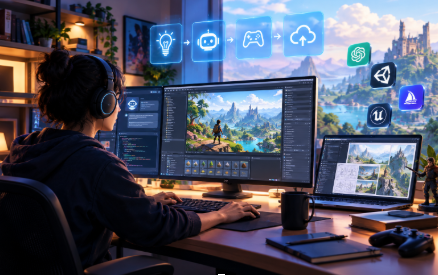
The gaming industry is at an inflection point where AI-assisted development has moved from novelty to necessity, reshaping everything from who gets to build games to how quickly ideas reach players. What started as convenience tools for specific tasks is becoming foundational to how games get created across the entire industry, from solo developers to major studios. Understanding these trends isn’t just academic, it’s crucial for anyone involved in game development, since the landscape is shifting so fast that approaches viable a year ago are already becoming outdated.
Why These Trends Matter Right Now
The pace of change in AI game development is genuinely unusual for an industry that typically moves through generational shifts over years or decades. What we’re seeing now is multiple trends compounding simultaneously, each one reinforcing the others, creating a landscape where traditional approaches are becoming less competitive much faster than historical precedent would suggest. This acceleration is reshaping the industry structure itself, not just the tools available within it.
Trend One: Democratization of Development Reaching Critical Mass
AI tools have been making development more accessible for a few years, but we’re reaching a point where the practical barriers to entry have become genuinely minimal. Someone with a clear idea and no prior development experience can now build and ship a game, reaching players directly without needing studio infrastructure, publishing relationships, or years of technical training.
This democratization is moving beyond hobbyists and independents. As more people experience how accessible modern development has become, the cultural narrative around game development continues shifting. The story is no longer “you need years of training and a team behind you,” it’s becoming “you need a clear idea and tools that are increasingly free or cheap.” That shift in narrative is drawing far more people into game development than traditional barriers ever allowed.
The practical result is that the sheer volume of games being created and shipped is increasing dramatically. Not all of that volume is quality, but the signal-to-noise ratio is improving faster than most people expected, since the tools are good enough that raw creative talent can shine through without being filtered by technical limitations.
Trend Two: Development Cycles Compressing Across The Industry
What used to take 18-24 months can now happen in 6-12 months for many projects, not because everyone is working harder, but because iteration cycles have compressed so dramatically. This compression is happening at every level, from solo developers to major studios adopting faster internal processes.
That accelerated pace is creating pressure across the entire industry. Studios that stick with traditional staged development are finding it harder to keep pace with smaller teams using faster iteration processes. Investors are increasingly expecting faster time-to-market and faster feedback from real players. That pressure is pushing even conservative organizations toward adopting faster approaches.
The industrial implications are significant. Game development is becoming more similar to software development than to traditional creative production, with rapid iteration, continuous deployment, and ongoing refinement replacing the “build in secret, launch once” model. That shift in methodology is changing everything from team structure to how success gets measured.
Trend Three: AI-Assisted Tools Becoming Standard, Not Specialized
We’re moving past the point where AI tools are something creators actively choose to use. They’re increasingly becoming the default infrastructure that development happens on top of, the way search engines became invisible infrastructure for web development rather than a tool you deliberately adopted.
This trend means that creators who don’t use AI-assisted tools are increasingly at a competitive disadvantage, not because they’re choosing a weaker approach, but because the industry baseline is shifting toward workflows that assume AI handling certain tasks automatically. Opting out means doing manually what competitors are doing efficiently.
This normalization is also changing skill requirements. The technical depth required to participate in game development is genuinely declining. The skills becoming more valuable are creative judgment, iteration discipline, understanding of player psychology, the abilities that can’t be automated. That shift in what skills matter is reshaping how people prepare for game development careers.
Trend Four: Smaller Teams and Solo Developers Shipping Bigger Games
The traditional team size required to ship a sophisticated game is declining. One person or a very small team using modern tools can now accomplish what used to require a dozen people. This isn’t because the solo developer became extraordinarily skilled, it’s because the tool overhead that used to require specialists is now handled automatically.
That shift in what’s achievable with limited resources is tilting competitive advantage toward teams that can move quickly and iterate based on real feedback, away from teams that plan exhaustively and execute a fixed vision. Speed and adaptability are becoming more valuable than raw resources.
The practical consequence is that truly original ideas are increasingly likely to come from small teams and individuals who had freedom to take creative risks, rather than from larger organizations constrained by institutional risk management. That diversity of creative input is reshaping what actually reaches players.
Trend Five: Player Feedback Becoming Continuous Design Input
Games used to be largely finished when they shipped. Post-launch patches addressed critical bugs, maybe some balance adjustments. Modern development increasingly treats launch as a transition point where a game moves from creator-controlled development to a collaborative relationship with players.
This shift is enabled by faster development cycles. When iterating on feedback takes weeks rather than months, responding to player requests becomes genuinely practical. Games increasingly feel like they’re evolving continuously based on what players want, rather than being static products occasionally updated.
That continuous evolution is changing what “finished” means for games. A game might ship with less content than it would have under the old model, but with clearer plans for how it will evolve based on player feedback. That approach tends to produce games that fit what players actually want better than games built entirely on developer assumption.
Trend Six: Genre Experimentation Accelerating
When building an unconventional game was expensive and risky, studios naturally stuck to proven genres. Lower barriers to entry and faster iteration are enabling far more genre experimentation. Games that wouldn’t have survived traditional publishing processes are now reaching players directly.
Some of that experimentation produces genuinely novel ideas that reshape how people think about what games can be. Some produces failures that prove certain ideas don’t work. Both types of information are valuable for the industry’s long-term evolution, and the faster cycle of experimentation is accelerating that evolution.
A Practical Example of These Trends in Action
Burrito King represents what these combined trends make possible, a focused, well-executed game that could be built by a small team using modern AI game makers, shipped quickly, and refined based on player feedback. The game demonstrates how accessible, fast development produces results that compete directly with traditionally developed games.
What These Trends Mean For The Industry’s Future
The gaming industry is structurally shifting toward a model where smaller, more agile teams compete directly with larger, more traditional studios. That shift favors creativity and execution speed over raw resources, which is changing which kinds of games get built and who gets to build them.
The quality floor for what ships is likely rising, since minimum viable polish is improving. The creative diversity of what reaches players is likely expanding, since barriers to participation are lowering. The pace of iteration and evolution is accelerating, since feedback loops are tightening.
Traditional publishers and studios aren’t disappearing, but their advantages are narrowing. They’re adapting by adopting similar processes, becoming more agile, embracing continuous iteration rather than fighting it.
What This Means For Anyone Entering Game Development
If you’re considering getting into game development, the barriers have genuinely never been lower. The tools are accessible, the learning resources are abundant, the paths to reaching players don’t require traditional gatekeepers. That combination creates opportunity for anyone with a clear creative vision and willingness to iterate based on real feedback.
The skills most valuable aren’t the technical ones anymore, they’re creative judgment, iteration discipline, understanding of what makes games engaging. Those skills take time to develop through practice, but they’re no longer filtered through technical prerequisites.
Final Thoughts
AI game development trends are reshaping the gaming industry not through any single revolutionary shift, but through the accumulation of smaller changes that compound over time. Development is faster, more accessible, more collaborative with players, more diverse in who participates and what gets built. Those trends are likely to continue accelerating as tools improve and more creators adopt faster approaches. The gaming industry of five years from now will likely look substantially different from today, not because of fundamental breakthroughs, but because incremental improvements in tools and processes have accumulated into genuine industry transformation.