



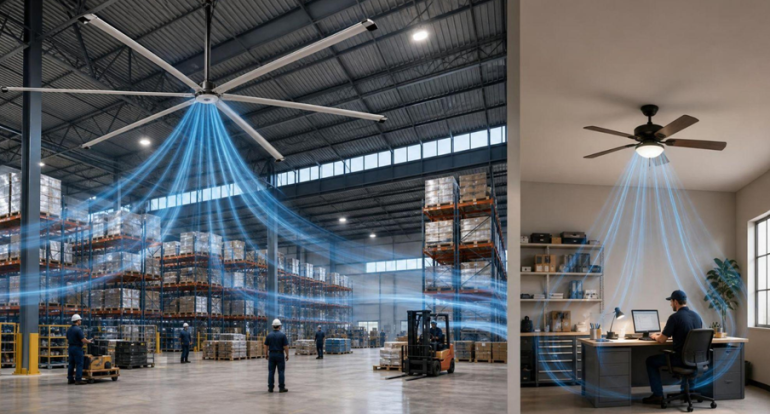
SHORT ANSWER HVLS fans are usually better for large, open, high-ceiling spaces because they move a broad mass of air at relatively low rotational speed. Traditional ceiling fans are usually better for small rooms, low ceilings, divided layouts, targeted airflow and projects that prioritize lower initial cost or integrated lighting. Neither type is universally better; the correct choice depends on the building and the airflow goal.
HVLS Fans vs. Traditional Ceiling Fans: The Short Answer
The question sounds simple, but it compares two tools designed for different jobs. An HVLS fan is itself a ceiling fan: it is a large-diameter, low-speed air-circulating fan intended to influence a broad area. A conventional ceiling fan is normally smaller and creates a more localized zone of air movement. The useful comparison is therefore not whether one technology wins in every situation, but which one produces the required airflow with the least practical complexity in a particular building.
In a warehouse, distribution center, gym or other wide-span building, an HVLS fan often has the advantage because one properly selected unit can influence a much larger area than a small fan. In a bedroom, office, compact retail unit or low-ceiling work area, a traditional fan is generally easier to justify. The table below summarizes the starting point; actual selection still requires model-specific data and a review of the installation site.
| Decision factor | HVLS fan | Traditional ceiling fan |
| Best-fit space | Large, open commercial or industrial areas | Small rooms and localized zones |
| Air-movement pattern | Broad, low-speed circulation across a wide area | More concentrated airflow near each fan |
| Typical ceiling context | Often selected for high or wide-span buildings | Common in lower-ceiling rooms |
| Number of fan locations | Potentially fewer, subject to layout and performance | Potentially more for a large floor plan |
| Initial cost | Usually higher per unit | Usually lower per unit |
| Installation planning | Structural, electrical and clearance review | Often simpler, but proper support is still required |
| Lighting and decor | Usually focused on airflow and facility operation | Integrated lights and decorative options are common |
| Best comparison basis | Whole-building airflow and total system cost | Room-level comfort and installed cost |
What Is the Difference Between an HVLS Fan and a Regular Ceiling Fan?
HVLS fans move a larger air mass at lower rotational speed
HVLS stands for High Volume, Low Speed. According to AMCA’s HVLS design and specification guidance, the concept combines a large diameter with low operating speed to circulate a high volume of air over a large area. Air is pushed downward, spreads outward near the floor and interacts with surrounding air and surfaces. This produces a broad circulation pattern rather than a narrow, high-speed blast.
Buyers researching large-space VLS Fans should therefore treat diameter as only one input. Mounting height, air velocity in occupied zones, airflow pattern, power input, controls and the conditions behind published performance data matter at least as much as blade span.
Traditional ceiling fans concentrate airflow in a smaller zone
A conventional ceiling fan generally serves a room or a specific work zone. Its smaller sweep means that the most noticeable air movement is usually closer to the fan. That can be exactly what a small room needs. It also makes traditional fans practical where partitions, low ceilings or limited structural space make a very large fan inappropriate. Many conventional models add lighting, decorative finishes and residential controls that are not the main priority of an industrial HVLS system.
Size alone does not determine effectiveness. Two fans with similar diameters can have different blade profiles, motors, speed ranges, controls and airflow patterns. A larger fan can also perform poorly if it is mounted in the wrong location or blocked by racks, beams, lights or equipment. Buyers should compare performance under relevant conditions rather than assume that the largest fan or the highest advertised airflow number is automatically better.
When Are HVLS Fans the Better Choice?
Large, open floor areas
The strongest case for HVLS appears in buildings that combine a wide floor area with relatively open air paths. Warehouses, manufacturing floors, distribution centers, aircraft hangars, agricultural buildings, sports facilities and event venues often fit this description. A broad air column can reach the occupied zone and then spread across the floor, allowing a smaller number of fan locations to influence a large area.
High-ceiling circulation
As mounting height increases, a small fan’s localized airflow may not provide the desired air speed where people actually work. An appropriately selected HVLS fan is designed to move a larger air mass through a tall space. That does not make every HVLS model suitable for every height, but it explains why these fans are often considered where a row of small ceiling fans would create many installation points without delivering uniform floor-level results.
More even airflow across occupied zones
HVLS fans can help reduce stagnant pockets and sharp differences between areas directly below a fan and areas farther away. Uniformity remains project-dependent: walls, tall racks, mezzanines, machinery and enclosed rooms can redirect or block airflow. In a complex layout, a hybrid design may work better than relying exclusively on one large fan.
Seasonal air mixing
In warm conditions, moving air across the skin can improve perceived comfort. During colder periods, low-speed circulation can help mix warm air that accumulates near a high ceiling with cooler air below, a process commonly called destratification. The appropriate speed and operating direction depend on the fan design, heating system, ceiling height and occupant comfort target. A fixed energy-saving percentage should not be assumed without a building-specific analysis.
Fewer fan locations to operate and service
If a design can meet its airflow objective with fewer large fans, it may reduce the number of motors, wiring runs, controls and routine inspection points. The tradeoff is that each HVLS installation is more specialized, and future service may require high-access equipment. This is why unit count, service access and operational continuity should be evaluated together.
When Is a Traditional Ceiling Fan the Better Choice?
Small rooms and low ceilings
Traditional ceiling fans are usually the practical choice for bedrooms, small offices, meeting rooms, compact shops and other spaces where one fan only needs to influence a limited area. The smaller footprint is easier to fit beneath a lower ceiling, and the product category offers many flush-mount and short-downrod configurations.
Localized comfort
A facility may need air movement at a packing station, service counter, workshop bay or other defined zone rather than across an entire building. In that case, a smaller fan can place airflow where it is needed without circulating air through unused areas. Several independently controlled fans may also be useful when work zones operate on different schedules.
Lower initial budget and simpler replacement
A conventional ceiling fan normally has a lower purchase price and a more familiar installation process. Replacement parts and installers may also be easier to source. However, that unit-price advantage can shrink when a large building needs many fans, multiple electrical runs and repeated maintenance. The fair comparison is between complete systems that aim to produce a similar result.
Lighting, appearance and room-level controls
For residential and customer-facing interiors, integrated LED lighting, color temperature, dimming, decorative style and smart-home controls may matter as much as airflow. Traditional ceiling fans offer more choices in these categories. Industrial HVLS fans are usually selected first for wide-area circulation, structural suitability and operational control.
Cost and Energy Use: Compare Systems, Not Individual Fans
HVLS fans usually cost more per unit than conventional ceiling fans, but one-to-one pricing can be misleading. A facility should compare the number of fans required, input power at the planned operating speed, yearly runtime, installation labor, structural work, wiring, controllers, access equipment and maintenance. The lower-priced fan is not necessarily the lower-cost system.
A simple first-pass energy calculation is total fan load equals input power per fan multiplied by the number of operating fans. Estimated annual energy use then equals total fan load multiplied by annual operating hours. The calculation should use documented input power at relevant settings, not only maximum ratings, and it should reflect zoning or schedules that may leave some fans off.
HVAC interaction deserves separate attention. Air circulation may allow a facility to adjust operating strategy or distribute conditioned air more evenly, but the outcome depends on climate, occupancy, controls, envelope performance and existing equipment. Energy savings should be modeled or measured for the individual building rather than borrowed from an unrelated case study.
What Are the Disadvantages of HVLS Fans?
Higher upfront and installation cost
A large fan, its controller, mounting hardware and professional installation can require a larger initial investment. The project may also need a structural review, electrical work, lift access and commissioning. These costs are not automatically excessive, but they should be identified before comparing the proposal with a multi-fan alternative.
Clearance and building coordination
An HVLS fan needs adequate separation from beams, racks, lights, ducts, cranes and other obstructions. Sprinklers and fire-protection requirements must also be coordinated with the applicable code, system design and authority having jurisdiction. A fan should not be positioned from floor area alone.
Limited fit in divided layouts
Broad horizontal circulation is less useful when walls, enclosed rooms or tall storage structures divide the floor into separate air zones. Several smaller fans, local air movers or a hybrid design may deliver better control. An oversized fan in the wrong layout can add cost without solving the actual comfort problem.
Specialized maintenance and operational concentration
Fewer fan units mean fewer routine service points, but they can also concentrate airflow responsibility in each unit. If one fan is offline, a large zone may lose circulation. Buyers should review warranty terms, parts availability, service access, controller support and the maintenance plan for the selected drive system.
Air movement is not mechanical cooling or ventilation
The U.S. Department of Energy’s cooling guidance explains the essential point that fans cool people rather than rooms. Air movement can improve comfort, but a circulation fan does not directly remove heat, introduce outdoor air, capture contaminants or replace an exhaust system. HVLS fans can complement HVAC and ventilation equipment; they do not automatically perform those systems’ functions.
Which Fan Is Better for Your Space?
The following application matrix is a starting point, not a substitute for project review. Mixed-use facilities may require different fan types in different zones.
| Application | Likely starting point | Why |
| Large warehouse | HVLS | Wide floor area and high mounting conditions often favor broad circulation. |
| Distribution center | HVLS | Open work zones and storage aisles may benefit from fewer, larger circulation points. |
| Manufacturing plant | HVLS or hybrid | Machinery, process heat and fixed workstations can require broad and targeted airflow. |
| Gym, church or event venue | HVLS | Large occupied areas often need gentle, wide-area air movement. |
| Small office or bedroom | Traditional ceiling fan | The room is compact and may also need integrated lighting or decorative options. |
| Partitioned shop or work cells | Traditional or hybrid | Walls and enclosures can block the horizontal spread of a large fan’s airflow. |
| Large mixed-use building | Project-specific combination | Different zones may have different heights, occupancy patterns and airflow targets. |
How to Choose the Right Fan for Your Building
The Best HVLS Fans are not automatically the largest or most powerful models. The best choice is the fan whose documented performance, mounting range, controls, electrical requirements and service plan match the building. A useful selection process includes the following steps.
- Measure the space. Record length, width, ceiling height, proposed mounting height and the dimensions of the occupied zones that need airflow.
- Map obstructions. Mark beams, racks, mezzanines, cranes, lights, ducts, sprinklers, machinery and enclosed rooms that may affect placement or airflow.
- Define the operating goal. Separate summer comfort, winter destratification, HVAC air distribution, hotspot relief and process requirements. One fan setting may not optimize every objective.
- Compare relevant performance. Review air speed in occupied areas, airflow pattern, input power, speed range, sound information and the conditions used to generate the published data.
- Estimate fan quantity and placement. Use the selected model’s performance information and the actual layout. Do not apply a universal square-foot or replacement ratio.
- Calculate total project cost. Include equipment, controls, structural work, wiring, installation, access equipment, shipping, energy use, maintenance and expected downtime.
- Confirm installation and support. Review structural suitability, electrical compatibility, safety clearances, code coordination, warranty coverage, replacement parts and qualified service access before purchase.
Final Verdict: Are HVLS Fans Better Than Ceiling Fans?
HVLS fans are generally the better option when the task is to circulate air across a large, open, high-ceiling building. Their large diameter and low-speed operating approach can support broad coverage, more consistent air movement and fewer fan locations. Traditional ceiling fans remain the better tool for small rooms, low ceilings, localized comfort, integrated lighting and projects where a large industrial installation is unnecessary.
The decision should be based on floor dimensions, mounting height, obstructions, target air speed, verified product data and total installed cost. A building with mixed conditions may benefit from a hybrid system rather than an all-or-nothing choice.
For buyers beginning a product search, manufacturers such as Breezary publish large-diameter fan ranges and project guidance that can serve as a starting point. The final selection should still be supported by model-specific performance, electrical, installation, warranty and service information.
Frequently Asked Questions
Are HVLS fans worth it?
They can be worth the higher initial cost in a large, open building when broad circulation allows the project to use fewer fan locations or better support occupied-zone comfort. They may not be worth it in a small, low-ceiling or heavily divided space.
What are the main disadvantages of HVLS fans?
The main disadvantages are higher per-unit cost, more demanding structural and electrical planning, clearance requirements, specialized installation and service, and limited effectiveness in some highly partitioned layouts.
Why are HVLS fans more expensive?
Their size, blade and hub structure, motor and control system, safety provisions, mounting hardware and project-specific installation requirements generally make them more expensive than a conventional room fan. Total system cost may still be competitive if fewer units are required.
Are bigger ceiling fans always better?
No. Diameter affects the area a fan can influence, but blade design, motor performance, mounting height, speed range, controls, obstacles and target air velocity also matter. A larger fan in the wrong location can perform worse than a properly selected smaller system.
How many traditional ceiling fans can one HVLS fan replace?
There is no universal replacement ratio. The answer depends on the models being compared, installation height, floor plan, obstructions, occupied zones, target air speed and the test conditions behind the performance data.
Do HVLS fans cool the air?
They do not operate like air conditioners and do not directly lower air temperature. They increase air movement, which can improve perceived comfort, and they can help mix temperature layers or distribute conditioned air when properly coordinated with the building’s systems.
How long do HVLS fans last?
Service life varies by motor and drive design, operating hours, environment, installation quality and maintenance. Buyers should compare model-specific warranty terms, inspection requirements, parts support and expected service access rather than rely on one universal lifespan figure.