



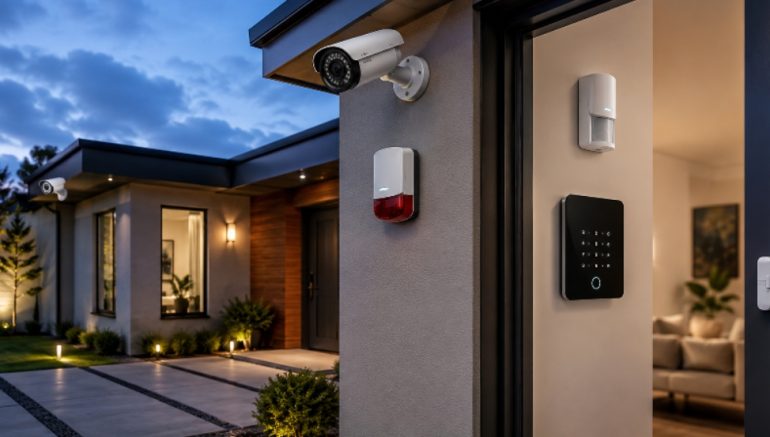
Many properties still rely on cameras or alarms as separate tools, which often creates gaps in protection. A camera may record an event but fail to warn in time, while an alarm may trigger without showing what actually happened. This lack of coordination can slow decisions and weaken response during a real security event. The experienced solution is to combine both systems into one planned setup. When cameras and alarms work together, owners gain faster detection, visual confirmation, stronger deterrence, and clearer evidence, which creates a more reliable security system for modern homes and businesses.
Security Camera System Installation With Alarms
Modern security works best when detection, verification, and response are connected. This section explains how cameras and alarms support the same protection goal and why professional integration creates better coverage and control.
A well-planned security camera system installation gives a property continuous visual coverage over entry points, driveways, hallways, storage areas, and vulnerable access zones. Cameras help owners see activity in real time and review footage later when an incident needs investigation.
A strong security alarm system installation adds instant warning when unauthorised access or suspicious movement occurs. It uses sensors, control panels, sirens, and alerts to notify occupants or managers as soon as a threat is detected.
When both systems are combined, the result is more than added hardware. It creates a layered security structure where cameras verify what alarms detect, and alarms give cameras a reason to focus attention on high-risk events.
This approach improves intrusion detection, motion verification, perimeter awareness, entry protection, remote monitoring, event recording, and response timing. Those are the practical security terms that matter most when choosing a modern protection system.
It also helps reduce one of the biggest weaknesses in property security, which is uncertainty. With separate systems, owners often spend valuable time trying to understand whether a triggered alert is serious or accidental. With a linked system, the answer is faster and clearer.
A combined setup works well because every device plays a specific role. Cameras provide visual evidence, alarm sensors detect movement or forced access, sirens create deterrence, and mobile notifications push the event directly to the user. That coordinated workflow is what makes the system stronger.
Why Combined Systems Detect Threats Faster?
Speed matters in security because the earlier a threat is identified, the better the chance of limiting loss, damage, or escalation. A combined system improves speed by reducing the delay between detection and decision-making.
A sensor inside an alarm system reacts immediately when a protected door opens, motion is detected, or a selected area is breached. That first signal is critical because it marks the beginning of the response process and sends attention exactly where it is needed.
At the same time, the linked camera covering that zone gives the user live or recorded visuals of the same event. Instead of checking every camera feed manually, the owner can focus directly on the affected area. This saves time and improves accuracy.
This faster chain of action is useful in homes, offices, warehouses, shops, and strata properties. A triggered back entrance sensor can instantly match with the camera watching that entrance, helping the user decide whether the event is a real threat or a harmless trigger.
The benefit is not only speed of detection. It is also speed of interpretation. A simple alarm can tell you something happened. A combined setup helps show what happened, where it happened, and how serious it is.
That extra clarity helps owners act with confidence. Instead of waiting, guessing, or ignoring the alert, they can take the next step based on real information. In modern security, faster understanding is just as important as faster warning.
How Video Verification Improves Response?
Many security failures happen after detection because the user cannot confirm what caused the alert. This section explains why visual confirmation improves response quality and reduces confusion during real events.
An alarm trigger without video often leaves several questions unanswered. Was it a real intrusion, a staff error, a delivery, a pet, or an environmental issue? Without visual evidence, the owner may hesitate or respond too late.
A connected camera solves this by showing the actual scene around the time of the alert. This is known as video verification, and it is one of the most valuable benefits of combining cameras and alarms for modern security.
Video verification helps the user understand the difference between a false alarm and a genuine threat. That matters because false alarms can lower trust in the system, waste time, and create frustration for occupants or managers.
It also improves the quality of response. If the camera shows an intruder entering a restricted area, the user knows that the event needs immediate action. If it shows a harmless cause, the owner can reset the system without unnecessary escalation.
This is why a second security camera system installation consideration should always be camera positioning for verification, not only recording. The right view must support the alarm zone and not simply provide a general scene.
When integrated correctly, video verification becomes a decision making tool. It reduces uncertainty, improves confidence, and helps the property owner respond with the right level of urgency. That makes the whole system more dependable in daily use.
Why Layered Security Reduces Blind Spots?
A single device rarely protects an entire property without leaving weak areas behind. Layered security reduces blind spots by placing different types of protection across the same risk path.
Exterior cameras watch approach routes, front boundaries, gates, and entry points. They help detect suspicious activity before a person even reaches the building. This creates early awareness and can discourage unwanted behaviour.
Alarm contacts on doors and windows then protect the exact points where unauthorised entry is most likely to happen. Internal motion sensors add another layer if someone gets past the external barrier.
Indoor cameras extend protection into hallways, staircases, offices, stock areas, and other sensitive spaces. If an intruder moves deeper into the property, the system continues to track and record that movement.
This layered arrangement creates perimeter protection, entry detection, internal coverage, and evidence capture in one continuous flow. If one element misses an event, another layer still has a chance to identify it.
That is why a quality security alarm system installation should never be treated as separate from camera placement. The sensor zones and camera views should support the same security design.
Blind spots often come from poor planning rather than poor equipment. Combined systems reduce that risk by making the security design more intentional. Each device supports the next step of protection, which creates stronger overall coverage.
How Integrated Alerts Support Smarter Action?
Security technology becomes far more useful when alerts are clear, relevant, and easy to act on. This section explains how integrated alerts improve decisions during a live event.
In a combined system, the alert can include the triggered zone, the time of the event, and access to the matching camera view. This gives the user meaningful information instead of a generic warning with no context.
That detail helps the owner decide what to do next. They may watch the live feed, contact a keyholder, activate a response plan, or review recordings before taking further action. The alert becomes practical, not just noisy.
Integrated alerts are especially useful after hours, when no one is present on site. They allow remote users to review the situation quickly from a phone or control interface without travelling to the property immediately.
They also support different response priorities for different areas. A front gate event may require simple observation, while a restricted storage room event may require urgent escalation. This flexibility makes the system more efficient.
Another benefit is better user confidence. Many people stop trusting alerts when they arrive too often or without context. When the system sends accurate and meaningful notifications, users are far more likely to stay engaged and respond properly.
A modern security strategy should aim for relevant alerts, fast access to footage, clear zone naming, and a predictable response process. When cameras and alarms are linked, those goals are easier to achieve and maintain.
Why Evidence Quality Matters After Incidents?
Security is not only about what happens during an incident. It is also about what happens after it. High-quality evidence helps with review, reporting, insurance, and understanding how the event took place.
An alarm log confirms that a sensor activated at a certain time. That is useful, but it does not fully explain the event. Camera footage adds visual proof, showing entry method, direction of movement, number of people, and duration of the activity.
This matters for both residential and commercial properties. Homeowners may need to understand how access occurred, while businesses may need to assess loss, verify staff access, or review suspicious behaviour around key assets.
Evidence quality depends on several factors. Camera placement, image clarity, low light performance, recording retention, and correct timestamps all affect whether the footage will be useful after the event.
A second security camera system installation benefit is that professional camera design improves not just coverage, but also evidence value. Wide views are useful, but key entry points need more detailed footage.
The same applies to security alarm system installation. Accurate zone naming, proper sensor placement, and reliable panel programming make event logs more meaningful and easier to match with footage.
When alarms and cameras work together, post-incident review becomes faster and more accurate. Instead of reviewing disconnected data, the owner sees a connected event timeline, which improves understanding and helps future security planning.
How Professional Planning Improves Long-Term Results?
Even the best equipment can perform poorly if the overall system is not planned correctly. Professional planning is what turns separate products into a dependable long-term security solution.
The first step is site assessment. This includes reviewing entry points, vulnerable sides of the building, lighting conditions, access patterns, internal movement areas, and the property’s most valuable assets. Good planning begins with real risk analysis.
The second step is matching camera views and alarm zones. If the back door is protected by a sensor, there should also be a camera that verifies that location. If a hallway is a key access route, the coverage and detection should support each other.
The third step is choosing the right equipment for the environment. Indoor sensors, outdoor detectors, fixed cameras, dome cameras, night vision capability, and remote access features must all suit the actual conditions of the property.
The fourth step is structured testing. Every sensor, alert, camera view, siren, and mobile notification should be checked in a live test so that the full response chain works exactly as intended.
The fifth step is maintenance. Cameras need cleaning and review, sensors need testing, and software settings need periodic checking. A combined system stays effective only when its connected parts remain aligned.
Professional planning delivers the real benefit of modern security. It creates a system that is clear, consistent, scalable, and easier to trust over time. That trust is essential because a security system is only valuable when people rely on it confidently.
Conclusion
The benefits of combining cameras and alarms for modern security come from one central advantage, which is coordination. Cameras provide vision, alarms provide immediate warning, and together they create a faster and more reliable protection process.
This combination improves threat detection, video verification, layered coverage, smarter alerts, stronger evidence, and long term system confidence. Those are the practical reasons experienced security professionals recommend integrated security rather than isolated devices.
For homes and businesses alike, the best result comes from matching camera coverage and alarm protection to the same risk areas. When both systems work together, the property gains not just more technology, but a much stronger security outcome.
Frequently Asked Questions
Can cameras and alarms work together on one app?
Yes, many modern systems can be configured so cameras and alarms work through one interface or connected platform. This makes it easier to arm the system, view live footage, receive alerts, and manage security settings from one place.
Are combined camera and alarm systems good for small homes?
Yes, small homes benefit because combined systems improve awareness without needing a large setup. A few well placed cameras and properly selected alarm sensors can provide strong entry protection, clear alerts, and easier remote monitoring.
Do combined systems help reduce false alarms?
Yes, they help reduce confusion around false alarms because video verification shows what triggered the event. This allows owners to identify harmless activity quickly and avoid unnecessary panic or delayed decisions.
Is professional installation better than DIY for combined systems?
Professional installation is usually better because it improves zone planning, camera positioning, sensor selection, and full system testing. Combined security works best when each device supports the same protection strategy.
Can combined systems improve business security after hours?
Yes, they are highly effective after hours because the alarm detects activity immediately and the linked camera provides visual confirmation. This helps owners or managers review incidents faster and decide on the right response.