



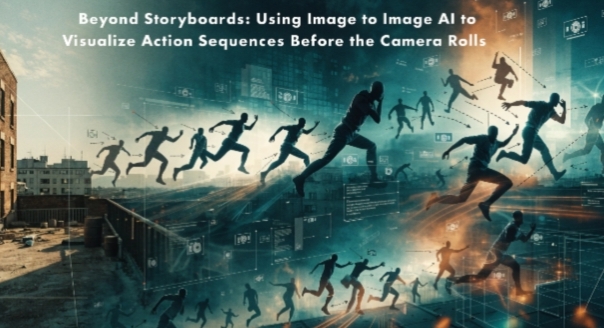
A director has an idea. A stunt coordinator needs to know exactly what that idea looks like in space. A cinematographer needs to know where the camera goes. Traditionally, all of that gets translated through storyboards, hand-drawn or digitally illustrated frames that approximate the action. Storyboards work, but they are slow to produce and limited by the artist’s speed and style. Image to image AI is now giving action sequence planning something storyboards never could on their own: fast, photorealistic visualization built from real reference photos, generated in the time it takes to describe what you want.
Why Action Sequences Are Especially Hard to Plan on Paper
Action choreography lives in three dimensions and involves timing, physical risk, and camera movement all at once. A storyboard artist can draw a punch landing or a car sliding sideways, but a drawing only communicates so much about actual staging, actual distances between performers, or how a shot will really read once lenses and lighting are involved. Stunt coordinators in particular need more than a rough sketch. They need to understand blocking, sightlines, and safety margins with enough clarity to plan rigging, padding, and camera positions around real bodies moving through real space. That gap between a hand-drawn board and the physical reality of a shoot is where a lot of pre-production time and money gets spent working things out on set instead of before it.
What Free Image to Image AI Actually Adds to This Process
A tool like EzEditor’s image to image generator takes an existing photo, whether that is a location scout photo, a reference still, or even a rough blocking photo taken during rehearsal, and transforms it based on a text prompt while preserving the underlying composition. For action sequence planning, this opens up a few specific uses that a static storyboard cannot match.
A location photo can be transformed to show where performers, props, or vehicles would actually be positioned during a sequence, without needing an illustrator to redraw the space from scratch. A rough rehearsal photo, even one with stand-ins instead of the actual cast, can be restyled to look closer to the intended final tone of the scene, whether that is a gritty nighttime chase or a high-contrast daylight confrontation. Multiple reference images, such as a location shot and a separate reference for lighting or mood, can be blended together into a single visualization that approximates what the final sequence might actually look like. And because generation only takes seconds, several different staging ideas or camera angles for the same beat of action can be tested and compared side by side before committing to one on the day of the shoot.
A Practical Way This Fits Into Pre-Production
The starting point is usually a real photo rather than a blank canvas. A location scout photo, a rehearsal still, or even a quick reference photo of performers roughly blocking out a sequence gives the AI something concrete to build from, which tends to produce far more useful results than trying to generate an action scene entirely from a text description alone.
From there, the actual sequence can be described in plain language, focused on staging and mood rather than technical camera language. Something like two figures fighting near a stairwell, dramatic side lighting, tense nighttime atmosphere communicates the intent clearly enough for the AI to generate a visual approximation of that beat.
Because iteration is fast, this becomes less about getting one perfect image and more about generating several variations of the same moment, different angles, different lighting choices, different spacing between performers, and reviewing them together with a stunt coordinator or cinematographer before the crew ever steps onto set.
Once a direction feels right, that generated image becomes a much richer reference than a hand-drawn board when explaining the sequence to the broader crew, since it carries lighting, mood, and spatial relationships that a sketch typically cannot convey as clearly.
Why This Matters for Safety and Budget, Not Just Creativity
Action sequences carry real physical risk, and any tool that improves communication before the cameras roll has a direct effect on safety planning. A stunt coordinator working from a clearer visual reference can plan rigging, padding, and fall zones with more confidence than working from a rough sketch alone, because the spatial relationships in a photorealistic image are simply easier to read accurately than an illustrated approximation.
There is also a real budget argument here. Time on set is expensive, and a lot of that time on action-heavy days goes toward working out blocking and camera positioning that could have been resolved during pre-production. Being able to visualize and compare several staging options quickly, before the crew and cast are standing around waiting, shifts some of that problem-solving to a cheaper, lower-pressure phase of the process.
And for smaller productions without the budget for a dedicated storyboard artist or a previs team, Free image to image AI offers a genuinely useful middle ground, providing visual clarity that would otherwise require either an illustrator’s time or simply going without and hoping the blocking works out on the day.
Where the Limits Still Show Up
It is worth being clear that this is not a substitute for professional storyboard artists or previsualization specialists on larger productions. Complex sequences with precise camera movement, timing, and choreography still benefit enormously from dedicated previs work that can show motion and sequence over time, which a single generated image cannot capture on its own.
AI generated images can also introduce small inconsistencies, an odd proportion, a strange shadow, a detail that does not quite match the intended geometry of a space, and these need to be reviewed carefully before anyone relies on them for actual safety planning. A generated image is a communication tool for planning conversations, not a technical blueprint that replaces a coordinator’s own assessment of a physical space.
And because these tools work from real reference photos, actual safety walkthroughs of a location still matter just as much as they always have. A visualization can suggest what a sequence might look like, but it cannot replace physically checking a space for hazards, sightlines, and structural realities that only become clear in person.
The Bigger Shift in Pre-Production Visualization
What is really changing here is how much visual clarity is available before a shoot, and how cheaply that clarity can be produced. Storyboards will not disappear, and dedicated previs will still matter enormously for complex, high-stakes sequences. But for a huge amount of pre-production work, particularly on smaller productions or for quickly testing an idea before committing an illustrator’s time to it, Free image to image AI offers a faster and more visually concrete way to get everyone on the same page before the camera ever rolls.
Getting Everyone on the Same Page Before Day One
The best action sequences are the ones where everyone involved, the director, the coordinator, the cinematographer, the performers, walked onto set already sharing the same picture in their heads. Free image to image AI does not replace the craft of choreographing action or the expertise of a stunt coordinator. What it does is close the gap between an idea in someone’s head and a visual the whole team can actually react to, days or weeks before that idea needs to survive contact with a real set.