


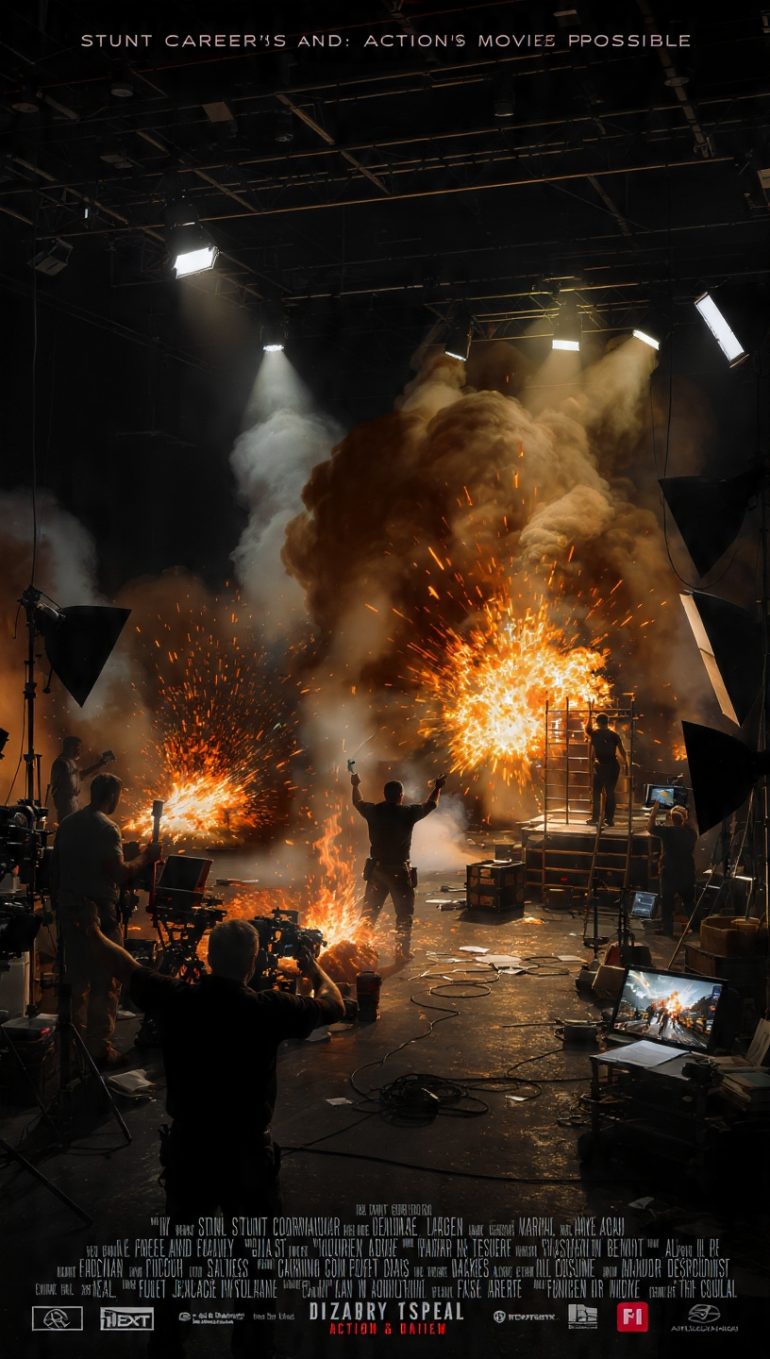
Every great fight, fall, explosion and car chase depends on a network of specialists whose names rarely appear above the title.
Action cinema sells the illusion that chaos can be controlled. A hero dives through a window, a vehicle rolls across a motorway and two performers exchange blows in a confined room. On screen, the sequence may last less than a minute. Behind it sits weeks of design, rehearsal, engineering and risk management.
The stunt performer is the most visible specialist in that process, but action filmmaking supports a much wider range of careers. Many combine physical ability with planning, technical knowledge and the discipline to repeat a complex movement safely for cameras that may capture only one usable angle.
Stunt coordinators and action designers
The stunt coordinator turns a director’s idea into a sequence that can actually be filmed. The role involves selecting performers, assessing locations, arranging rehearsals, planning equipment and communicating with camera teams, medical staff and production management. On larger projects, an action designer may shape the film’s physical language. The job is not simply about spectacle: a coordinator must know when an idea can be made safer, when a digital element should replace physical risk and when the schedule needs to change.
Fight choreographers
Fight choreography sits between performance and editing. Choreographers build exchanges around character, camera position, costume, environment and the abilities of the cast. A trained martial artist may still need to adjust timing and distance so movements read clearly on screen. The best work is not a random collection of strikes: it communicates who is confident, who is desperate and how the balance of a confrontation changes.
Riggers and precision drivers
Stunt riggers create the systems behind controlled falls, wire work, flying effects and moving platforms. They calculate loads, select equipment, inspect anchor points and coordinate cues with performers and camera teams. Their contribution should be invisible; the audience sees a body pulled by an impact, not the engineering that created the movement.
Precision drivers bring the same discipline to vehicles. They repeat marks at specific speeds, work around camera cars and other drivers, and help design chases that remain readable rather than becoming anonymous traffic. Specialist mechanics and vehicle fabricators may also modify steering, braking, suspension or safety cages for a particular shot.
Practical effects, armoury and props
Practical-effects crews handle breakaway scenery, smoke, weather, fire and controlled explosions. Prop makers and armoury specialists prepare objects that must survive close inspection while working safely in action. A weapon used for a wide shot may not be the version carried during a fight or fall. These departments coordinate closely with stunt and camera teams because the strength of a door, the timing of a squib or the weight of a prop can alter both the performance and the shot.
Previsualisation and visual effects
Modern action frequently begins in previsualisation, where artists create rough animated versions of a sequence before the production commits performers, vehicles and locations. This helps test camera positions, identify unnecessary risk and decide which elements should be practical or digital. Visual-effects teams can then extend environments, remove wires and complete shots that would be impossible or irresponsible to capture entirely in camera.
Finding a route into action production
- There is no single entry route. Some professionals begin in gymnastics, martial arts, driving or climbing. Others arrive through engineering, theatre rigging, special effects, editing, costume or production assistance. Recognised training, set experience and reliable safety habits matter more than performing dangerous tricks for a social-media reel. Nobody should attempt high-risk stunt work without qualified supervision and the correct environment.
Work is also scattered across studios, broadcasters, production companies, visual-effects houses, equipment suppliers and location-services firms. Candidates can monitor those employers directly and use an international job-search platform such as crawljobs to discover vacancies published across company career pages. Searching related titles is essential: a route into action production may appear under safety, fabrication, logistics, virtual production or technical operations rather than under the word ‘stunts’.
Action movies may be built around stars, but their credibility comes from specialists who make extreme images repeatable, readable and safe. For anyone considering the industry, the real opportunity is broader than becoming the person who takes the fall. It is joining the team that makes the fall possible in the first place.