



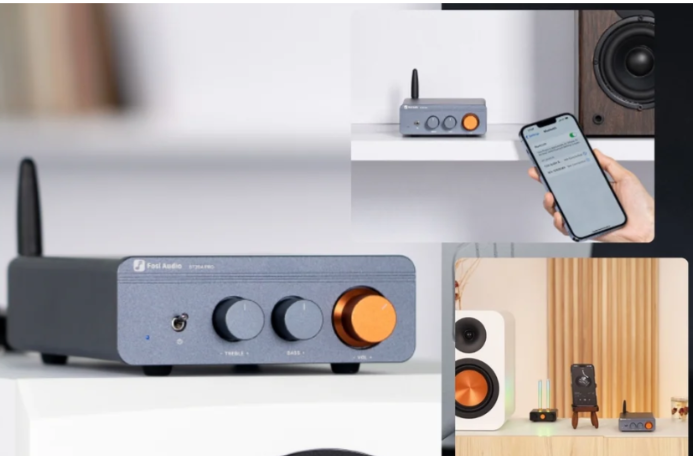
A Bluetooth amplifier for speakers combines wireless connectivity with audio amplification, making it easier to connect speakers to smartphones, tablets, computers, televisions, and other compatible devices. Instead of relying entirely on traditional wired audio connections, users can stream music and other audio content wirelessly while the amplifier provides the power needed to drive the speakers.
Bluetooth amplifiers are suitable for home audio systems, offices, restaurants, retail spaces, workshops, outdoor entertainment areas, and many other applications. Their combination of wireless convenience, compact design, and flexible speaker connectivity has made them a popular option for modern audio setups.
What Is a Bluetooth Amplifier for Speakers?
A Bluetooth amplifier for speakers is an audio amplification device that includes built-in Bluetooth connectivity. It receives an audio signal wirelessly from a compatible device and amplifies that signal before sending it to connected speakers.
The basic system typically consists of three elements:
- Bluetooth-enabled source device
- Bluetooth amplifier
- Passive speakers
For example, a smartphone can connect to the amplifier through Bluetooth. The amplifier receives the music signal, processes it, increases its power, and sends it to the connected speakers.
This arrangement can eliminate the need for a separate Bluetooth receiver and amplifier, simplifying the overall audio system.
How Does a Bluetooth Amplifier Work?
The operation of a Bluetooth amplifier is relatively straightforward. First, the user activates Bluetooth on a compatible source device and puts the amplifier into pairing mode.
After the devices connect, the source sends digital audio wirelessly to the amplifier. The amplifier converts and processes the received signal before increasing its power through the amplification stage.
The amplified signal is then delivered to the connected speakers.
A typical process looks like this:
- A smartphone or other device produces an audio signal.
- Bluetooth transmits the signal wirelessly.
- The amplifier receives the signal.
- Internal audio circuitry processes the signal.
- The amplifier increases the signal power.
- Connected speakers reproduce the sound.
The quality of the final audio depends on the amplifier, speakers, Bluetooth implementation, source device, and overall system configuration.
Benefits of a Bluetooth Amplifier for Speakers
One of the biggest advantages of a Bluetooth amplifier is convenience. Users can control music and audio content without physically connecting their devices to the amplifier.
Other benefits include:
Wireless Audio Streaming
Bluetooth allows users to stream audio without running an audio cable between the source device and amplifier.
This can make the system easier to install and more convenient for everyday use.
Easy Device Connectivity
Many Bluetooth amplifiers can connect with smartphones, tablets, laptops, and other compatible devices.
Users can switch between different sources depending on the amplifier’s design and supported features.
Reduced Cable Clutter
Traditional audio systems can require multiple cables for different sources. A Bluetooth connection reduces the need for some of these cables, resulting in a cleaner installation.
Compact Audio Setup
Many Bluetooth amplifiers are designed in relatively compact enclosures, making them suitable for areas where space is limited.
Flexible Applications
Bluetooth amplifiers can be used for home entertainment, background music, commercial audio, workshops, and other environments.
Bluetooth Amplifier Power Output
Power output is one of the most important specifications when selecting an amplifier for speakers.
Amplifier power is commonly expressed in watts. However, choosing an amplifier should not be based only on selecting the highest available wattage.
The amplifier should be compatible with the speakers’ power handling capabilities and impedance.
For example, connecting an amplifier that is poorly matched to the speakers can affect sound quality and may increase the risk of equipment damage when operated improperly.
A suitable system considers both amplifier output and speaker specifications.
Speaker Impedance Compatibility
Speaker impedance is another important factor when selecting a Bluetooth amplifier.
Impedance is commonly expressed in ohms, with common speaker ratings including 4 ohms, 6 ohms, and 8 ohms.
An amplifier should be designed to operate safely with the impedance range of the connected speakers.
Checking the manufacturer’s specifications before connecting speakers can help prevent overload and ensure stable operation.
Bluetooth Range
Bluetooth range can influence how convenient a wireless audio system is in practical use.
The effective range depends on the Bluetooth version, amplifier design, source device, obstacles, walls, interference, and surrounding environment.
For a small room, standard Bluetooth range may be more than sufficient. Larger spaces or installations with several walls between the source and amplifier may require additional planning.
Users should consider the actual environment rather than relying only on the maximum range stated by a manufacturer.
Audio Quality
Bluetooth audio quality depends on several factors, including the Bluetooth technology, supported codecs, source device, amplifier circuitry, and speakers.
A high-quality amplifier should provide clean signal processing and stable wireless performance.
The speakers also play a major role. Even an advanced amplifier cannot compensate completely for speakers that are poorly matched to the application.
For this reason, users should evaluate the amplifier and speakers as one complete audio system.
Inputs and Connectivity Options
Although Bluetooth is the main feature, many amplifiers also provide wired input options.
Depending on the model, inputs may include:
- RCA
- AUX
- USB
- Optical
- Microphone input
- Line input
- HDMI or other digital connections
Additional inputs can make the amplifier more flexible when users want to connect devices that do not support Bluetooth.
Having multiple connection options can also make it easier to integrate the amplifier into an existing audio system.
Bluetooth Amplifier for Home Audio
A Bluetooth amplifier for speakers can be a practical choice for home audio applications.
It can be connected to bookshelf speakers, ceiling speakers, wall-mounted speakers, or other passive speaker systems.
Users can stream music from smartphones or tablets without repeatedly connecting cables.
Depending on the amplifier’s power and features, it may be suitable for:
- Living rooms
- Bedrooms
- Home offices
- Kitchens
- Garages
- Entertainment rooms
- Outdoor areas
The amplifier should be selected according to room size, speaker type, listening preferences, and required volume.
Commercial Applications
Bluetooth amplifiers are also useful in commercial environments where background audio is required.
Restaurants, cafés, retail stores, salons, offices, and small hospitality businesses can use wireless audio systems to provide music or announcements.
For commercial installations, additional factors such as continuous operation, reliability, speaker distribution, control options, and installation requirements become particularly important.
Outdoor Audio Systems
Bluetooth amplifiers can also be used with outdoor speakers for patios, gardens, pool areas, events, and recreational spaces.
However, the amplifier itself should be installed in a suitable protected environment unless it is specifically designed for outdoor use.
Outdoor installations should also consider moisture, temperature changes, wireless range, and speaker placement.
Weather-resistant speakers paired with a properly protected amplifier can provide a more reliable outdoor audio solution.
Multi-Zone Audio
Some advanced Bluetooth amplifiers can support multiple speaker zones or multiple output channels.
This can be useful in larger homes and commercial spaces where different areas require separate audio control.
For example, a business may want background music in several rooms while maintaining centralized control.
Multi-zone functionality varies significantly between amplifier models, so users should review the technical specifications before selecting a system.
Stereo and Multi-Channel Systems
Bluetooth amplifiers are available in different channel configurations.
A stereo amplifier generally provides separate left and right channels for conventional music listening.
Other amplifiers may provide additional channels for multi-speaker or specialized applications.
The appropriate configuration depends on the number and arrangement of speakers.
For a simple two-speaker home system, a stereo Bluetooth amplifier may be sufficient. Larger installations may require a multi-channel solution.
Volume and Tone Controls
Many Bluetooth amplifiers include controls for volume, bass, and treble.
These controls allow users to adjust the audio according to the room and listening preferences.
Some models also include remote controls, digital displays, equalizer functions, or mobile application support.
Simple controls can be useful for casual home systems, while more advanced control features may be valuable in commercial or customized installations.
Energy Efficiency
Modern amplifier designs can focus on efficient power consumption while maintaining suitable audio performance.
Efficient amplifier technology can reduce unnecessary energy use, particularly in systems that operate for long periods.
For businesses and larger installations, energy efficiency can become an important consideration because audio equipment may remain active for many hours each day.
Choosing the Right Bluetooth Amplifier for Speakers
Several factors should be evaluated before purchasing or installing a Bluetooth amplifier.
Check Speaker Specifications
Start by checking the speakers’ impedance and recommended power range.
Consider Required Power
Choose an amplifier that provides suitable power for the intended speakers and listening environment.
Review Bluetooth Features
Check the supported Bluetooth technology, pairing capabilities, range, and compatibility with the devices that will be used.
Examine Wired Inputs
Additional inputs can provide greater flexibility for connecting televisions, computers, media players, and other equipment.
Consider Installation Space
Compact amplifiers can be useful when installation space is limited, while larger systems may provide additional power and connectivity.
Evaluate Protection Features
Protection against overheating, short circuits, overloading, and other operating conditions can improve equipment reliability.
Importance of Amplifier Protection
Protection circuits can help prevent damage caused by abnormal operating conditions.
Depending on the design, a Bluetooth amplifier may include protection against:
- Overheating
- Short circuits
- Excessive current
- Overloading
- Voltage fluctuations
These features can be particularly useful in commercial installations or systems that operate for extended periods.
Maintenance of a Bluetooth Amplifier
Bluetooth amplifiers generally require limited maintenance, but proper care can help extend their service life.
The amplifier should be kept clean and adequately ventilated. Dust should not be allowed to accumulate around ventilation openings.
Users should also avoid blocking cooling vents or placing the amplifier in areas with excessive heat or moisture unless the device is specifically designed for those conditions.
Cables and speaker connections should occasionally be checked to ensure they remain secure.
Bluetooth Amplifier for Professional Installations
For professional audio installations, choosing an amplifier involves more than wireless connectivity.
Installers may need to consider power requirements, speaker configuration, impedance, installation environment, cooling, control systems, and long-term reliability.
Commercial projects may also require rack mounting, multiple inputs, centralized control, or integration with other audio equipment.
Working with an experienced audio equipment supplier can help businesses select equipment that matches the requirements of the installation.
Future of Bluetooth Audio Amplification
Wireless audio technology continues to evolve as consumers and businesses look for simpler and more flexible audio systems.
Future Bluetooth amplifier designs may provide improved wireless stability, better energy efficiency, enhanced audio processing, smarter controls, and easier integration with connected devices.
Network connectivity and smart-home integration may also become increasingly common alongside traditional Bluetooth functionality.
Conclusion
A Bluetooth amplifier for speakers offers a practical combination of wireless connectivity and audio amplification. It allows users to stream music and other audio content from compatible devices while powering passive speakers through a single integrated system.
When choosing an amplifier, it is important to consider power output, speaker impedance, Bluetooth range, audio quality, connectivity, protection features, and the intended application. Whether used in a home, office, restaurant, retail environment, or outdoor entertainment area, the right Bluetooth amplifier can make a speaker system more convenient, flexible, and easier to manage.