



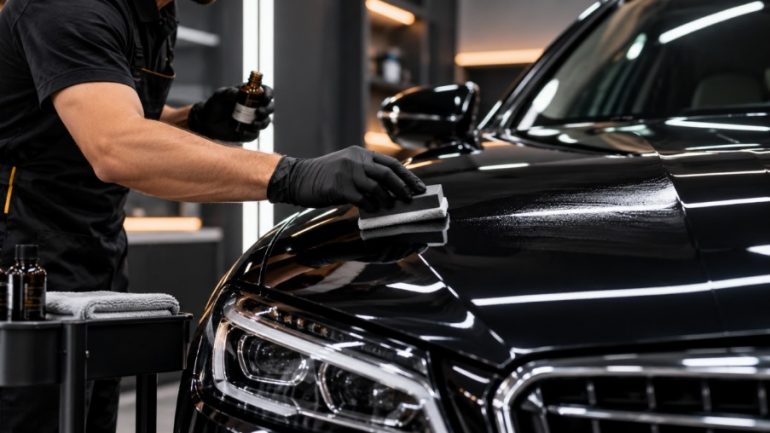
For years, automotive paint protection has continued to evolve. Traditional waxes gave way to synthetic sealants. Sealants were followed by advanced ceramic coatings. Then came graphene-enhanced coatings, introducing advanced material technology into the world of automotive paint protection.
Now, another material is beginning to attract attention in conversations around the next generation of surface protection: Borophene.
As car owners increasingly look for more comprehensive ways to protect their vehicles from heat, environmental contaminants, everyday surface damage and long-term wear, the technology behind ceramic coating for cars continues to move forward.
The latest development is the combination of Borophene + Graphene with advanced ceramic coating technology.
So, what exactly is Borophene, and what could it bring to automotive paint protection?
Let’s explore why borophene ceramic coating is being viewed as the next evolution in automotive surface protection.
Table of Contents
- What Is Borophene?
- How Borophene Differs from Graphene
- Benefits of Borophene Ceramic Coating
- Borophene Coatings vs Current Ceramic Coatings
- Why Choose a Borophene Ceramic Coating for Your Car?
- Concluding thoughts
What Is Borophene?
Borophene is a two-dimensional nanomaterial derived from boron atoms.
In simple terms, it belongs to the same family of advanced materials that generated excitement around graphene, but with a different atomic structure and unique material properties.
Researchers have explored borophene for applications ranging from electronics and energy storage to advanced protective surfaces because of its:
- High mechanical strength
- Lightweight structure
- Exceptional surface characteristics
- Strong chemical stability
- Advanced conductivity properties
Although borophene remains relatively new compared to graphene, ongoing research continues to uncover possibilities that could make it highly valuable across multiple industries. One of those industries is car paint protection.
How Borophene Differs from Graphene
Graphene is composed of carbon atoms arranged in a two-dimensional lattice. Borophene, on the other hand, is composed of boron atoms arranged in two-dimensional structures. The differences in their composition and structure result in different material characteristics and potential applications.
| Feature | Graphene | Borophene |
| Material Base | Carbon | Boron |
| Structure | Single-layer carbon lattice | Two-dimensional boron lattice |
| Research Maturity | Commercially established | Emerging |
| Automotive Adoption | Widely available | Early-stage |
| Future Potential | High | Extremely promising |
At present, graphene remains the more commercially proven technology. However, one of the best ceramic coating brands has already introduced a Borophene + Graphene coating called Apex in the Indian and other South Asian markets.
Benefits of Borophene Ceramic Coating
A Borophene + Graphene ceramic coating can bring together different characteristics within one advanced coating formulation.
Borophene contributes enhanced heat resistance and protection against daily use damage to paint. Graphene contributes surface smoothness and water repellency.
Together, these technologies can create a thicker and more advanced protective layer over automotive paint.
1. Enhanced Surface Durability
Durability remains one of the most important factors when evaluating any protective coating. Borophene-based coatings help create stronger protective layers capable of withstanding everyday environmental exposure more effectively.
2. Improved Contaminant Resistance
The advanced surface protection formulation prevents paint degradation from acidic and chemical reactions from exposure to bird droppings, tree sap, industrial fallout, road grime and water minerals.
3. Better Hydrophobicity
A highly hydrophobic surface allows water to bead and roll away more efficiently, helping reduce dirt accumulation and simplifying maintenance.
4. Higher Heat Threshold
Borophene’s material properties can withstand extreme heat up to 700 degrees, protecting the paint from environmental aggressors like heat, UV rays and pollution.
Borophene Coatings vs Current Ceramic Coatings
| Feature | Current Ceramic Coatings | Borophene + Graphene Coatings |
| Chemical formulation | SiO2 + Silica resins | Borophene + Graphene + SiO2 + Silica resins |
| Gloss enhancement | Improves shine | Enhances paint depth and gloss |
| Water repellency | Yes | Yes |
| Surface smoothness | Varies | Enhanced |
| Scratch & swirl resistance | No | Protects from hairline scratches |
| Heat resistance | Up to 200°C | Up to 700°C |
| Environmental protection | Prevents chemical reaction from droppings and sap | Prevents paint degradation from acidic reaction and chemical damage |
| Life expectancy | Up to 5 years | Up to 7 years |
Why Choose a Borophene Ceramic Coating for Your Car?
A borophene ceramic coating is designed for car owners looking for more comprehensive paint protection than conventional approaches. By combining advanced material technology with ceramic coating properties, it can offer benefits that matter in everyday car ownership.
- Better protection against intense heat:Cars parked outdoors are constantly exposed to harsh sunlight and high temperatures. Borophene adds an enhanced heat-resistant dimension to the coating, making it better suited for demanding conditions.
- Enhanced resistance against scratches and swirl marks:A harder and thicker protective layer helps improve resistance against everyday surface abrasions and the swirl marks that can develop during regular washing.
- A smoother, easier-to-clean surface:When combined with Graphene, the coating creates a smoother and slicker surface, making it harder for dirt and contaminants to cling to the paint.
- Improved water repellency:Water beads and rolls away more easily from the protected surface, helping reduce water retention and making routine washing and drying easier.
- Less effort to maintain your car’s appearance:With a smoother and more water-repellent surface, dust, dirt and everyday grime are easier to remove, helping keep the car looking cleaner for longer.
- Long-term protection for your paint:The advanced protective layer is designed to shield the paint from everyday environmental exposure while helping preserve its gloss, depth, and overall appearance over time.
- Protection designed for modern driving conditions:From harsh sunlight and pollution to dust, road grime and regular washing, Borophene + Graphene technology is designed to address multiple challenges that cars face every day.
In simple terms, a Borophene + Graphene ceramic coating aims to give car owners more protection, easier maintenance, better heat resistance and a smoother, glossier finish, all within one advanced coating system.
Concluding thoughts
Automotive paint protection has come a long way from traditional waxing and polishing. The industry has evolved through ceramic coatings, graphene-enhanced technologies and now discussions surrounding borophene-based protection systems.
While borophene ceramic coating remains an emerging innovation, its material properties have positioned it as one of the most exciting developments in advanced surface protection research. Whether it ultimately becomes the next breakthrough remains to be seen, but its potential is difficult to ignore.
As coating technology continues to evolve, vehicle owners will benefit from increasingly sophisticated protection systems designed to preserve appearance, simplify maintenance and enhance long-term vehicle care. For those exploring advanced paint protection today, staying informed about emerging technologies can be just as valuable as choosing the right protection solution itself.