



If you are studying with an online Chinese teacher or using a platform to learn Mandarin online, Chinese cities and architecture in general may be one of your most immediate encounters. Within the span of a single generation, Chinese cities have demolished the majority of their traditional building stock (!) and replaced it with an urban fabric of towers, highways and commercial infrastructure that bears little visual relationship to what preceded it.
To start with, the foundational unit of traditional Chinese architecture is not the individual building but the courtyard compound, known as sìhéyuàn (四合院) in its northern form. The siheyuan consists of a series of single-storey buildings arranged around a central open courtyard, enclosed by walls on all four sides and accessed through a gate that mediates between the private interior and the public street. The arrangement reflects a set of spatial principles derived from Confucian social organisation, that together produce a building type of considerable sophistication. The north-south orientation of the compound, with the principal hall facing south to receive maximum sunlight and the gate positioned to the southeast, reflects both cosmological preference and practical thermal logic. The hierarchy of buildings within the compound — principal hall for the family patriarch, side wings for sons and their families, southern buildings for servants or guests — maps the Confucian family structure directly onto spatial organisation. The courtyard itself functions as a shared social and environmental space, moderating temperature, providing light to surrounding rooms and creating a protected outdoor environment that extends the usable domestic space through most of the year.
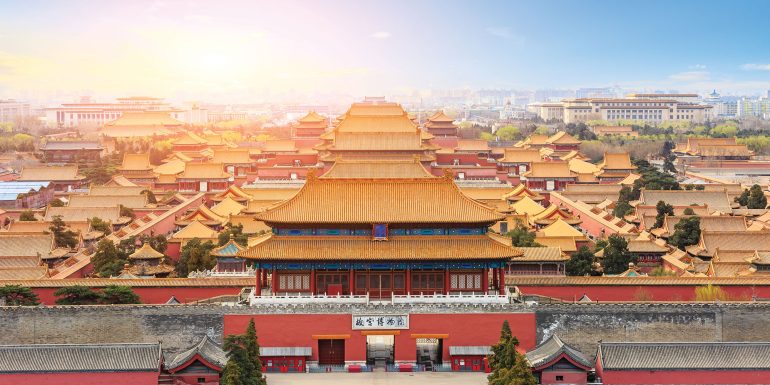
The principles underlying traditional Chinese architecture extended beyond the domestic scale to the design of temples, palaces, administrative complexes and city plans. The Forbidden City in Beijing, the best-preserved example of imperial Chinese architecture, demonstrates these principles at their most elaborated. Its organisation along a strict north-south axis, its hierarchical sequence of gates and courtyards through which visitors pass before reaching the throne halls, its colour coding of roofs — yellow for imperial buildings, green for gardens and secondary structures, grey for service buildings — and its calibration of building height and courtyard scale to produce specific psychological effects at each stage of the processional approach are all expressions of an architectural system in which spatial organisation is understood as a form of social and cosmological statement. The building is not merely a shelter. It is an argument about the order of the universe and the position of the emperor within it.
Then of course Geomancy, known in Chinese as fēngshuǐ (风水) and literally meaning wind and water, is the traditional practice of siting and orienting buildings in relation to the natural landscape in ways that are believed to maximise the flow of beneficial qi and minimise exposure to harmful influences. Fengshui principles governed the selection of sites for palaces, temples, tombs and cities across Chinese history, and their influence is visible in the consistent preference for south-facing orientations, as it avoids sites exposed to harsh northern winds.
The encounter between traditional Chinese architectural principles and Western building types and technologies that began in the 19th century produced a range of hybrid architectural forms that remain visible in the treaty port cities of Shanghai, Guangzhou, Tianjin and Xiamen. Shanghai’s Bund, the famous riverside promenade lined with European neoclassical and Art Deco buildings constructed by foreign commercial interests in the late 19th and early 20th centuries, represents the most internationally recognised expression of this encounter, though it reflects the architectural preferences of the foreign presence rather than any synthesis with Chinese tradition. More interesting architecturally are the buildings that attempted genuine synthesis — the Chinese Renaissance style promoted by certain architects in the Republican period, which applied traditional roof forms and decorative elements to reinforced concrete structures of Western plan — and the Lingnan style of southern China, which integrated Cantonese architectural traditions with colonial building technologies in ways that produced a genuinely regional hybrid.
Some Chinese language teaching institutions like GoEast Mandarin in Shanghai may also incorporate architectural vocabulary and the cultural principles underlying traditional Chinese building into their broader curriculum. It simply is very good for a student to know what fengshui means in practice, or to have some historical knowledge on why for example the demolition of Beijing’s hutongs was culturally significant.