



Consulta CNPJ is one of the simplest ways to verify a company registered in Brazil. The CNPJ, or Cadastro Nacional da Pessoa Jurídica, is the federal registration number assigned to companies and other legal entities by the Brazilian Federal Revenue Service.
A SOAT Por Placa can help you confirm whether a business exists, check its current registration status, identify its registered activities and address, and review information about its partners and administrators.
For businesses, customers, suppliers, accountants, banks, and anyone performing due diligence, checking a CNPJ can be an important first step before entering into a commercial relationship.
How to Check a CNPJ for Free
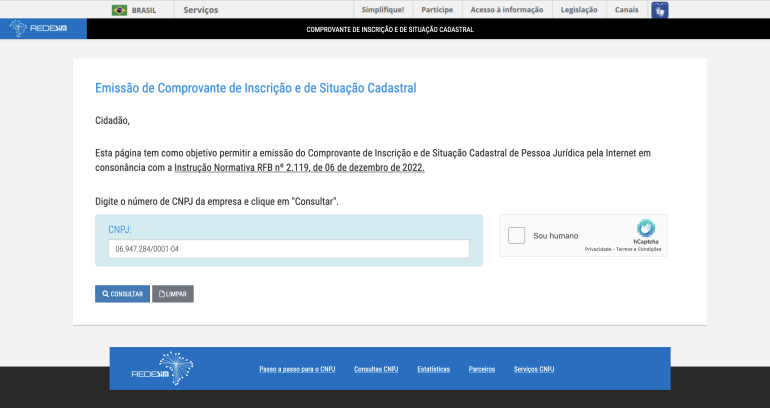
The official CNPJ lookup is available through the Brazilian Federal Revenue Service.
To perform a basic lookup:
- Access the official CNPJ consultation service.
- Enter the company’s 14-character CNPJ number.
- Complete the CAPTCHA verification.
- Select the option to consult the registration.
- Review the company’s registration information.
- If necessary, save or print the result as a PDF.
The consultation is generally free and provides the company’s official Proof of Registration and Registration Status, commonly known as the Cartão CNPJ.
The document contains important information such as the company’s legal name, trade name, opening date, registered address, economic activities, legal nature, company size, registration status, and information about its partners and administrators.
A CNPJ lookup, however, does not provide a complete financial or legal background check. Tax debts, lawsuits, protests, credit history, and other information must be checked through additional sources.
Other Ways to Verify a Brazilian Company
The Federal Revenue Service is the primary source for CNPJ registration information, but several other Brazilian systems can provide additional information.
Simples Nacional
The Simples Nacional system can be used to determine whether a company participates in Brazil’s simplified tax regime. It can also provide information about the company’s enrollment and, where applicable, its for Microentrepreneurs.
This can be useful when evaluating suppliers, invoices, tax treatment, or a company’s declared tax regime.
Sintegra and State Tax Authorities
Sintegra and the state tax authorities can provide information about a company’s state registration, known as the Inscrição Estadual.
This is particularly important for businesses involved in the sale or movement of physical goods. The information may include the state registration number, status, state, and economic activities.
Not every company needs a state registration. Certain service businesses and other entities may legitimately operate without one.
Commercial Registry
Brazil’s state Commercial Registries maintain corporate documents such as articles of association, amendments, and other corporate records.
More detailed corporate information may require obtaining an official certificate from the relevant Commercial Registry.
This can be useful when you need information that is not available through the basic CNPJ consultation, such as detailed ownership information or historical changes in the company’s corporate structure.
Understanding CNPJ Registration Status
One of the most important parts of a CNPJ lookup is the company’s registration status.
Active
An Active CNPJ means that the registration is currently in force.
This is the normal status for a company that remains registered with the Federal Revenue Service.
However, an Active CNPJ does not automatically mean that the company has no debts or legal problems. Registration status and overall financial or tax regularity are different concepts.
Suspended
A Suspended CNPJ indicates that there are issues requiring attention, such as inconsistencies or pending obligations.
A suspended registration may restrict the company’s ability to conduct certain activities and generally requires regularization.
Inapt
An Inapt CNPJ indicates a more serious registration problem, commonly associated with failures to comply with required tax or reporting obligations.
An inapt company should not be treated in the same way as an ordinary active business until its situation has been investigated and regularized.
Closed
A Closed, or Baixada, CNPJ indicates that the registration has been terminated.
A company with a closed CNPJ should not normally be treated as an active business.
Null
A Null registration indicates that the registration has been invalidated or annulled. It should not be treated as a valid active business registration.
Active Does Not Necessarily Mean Financially Regular
One of the most important distinctions when performing a CNPJ lookup is the difference between registration status and financial or tax regularity.
An organization can have an Active CNPJ while still having outstanding tax obligations.
Therefore, checking that a CNPJ is Active is only the first step. If you need to determine whether a company is financially or fiscally compliant, additional certificates and databases should be consulted.
What Information Does a CNPJ Lookup Show?
The Cartão CNPJ contains several categories of information.
Identification Information
The basic identification fields include:
- CNPJ: The company’s 14-character registration number.
- Legal name: The company’s official registered name.
- Trade name: The commercial name used by the business.
- Opening date: The date on which the registration was established.
Business Classification
The lookup can also show:
- Company size: Such as Microenterprise or Small Business.
- Legal nature: The company’s legal structure.
- Primary CNAE: The company’s main declared economic activity.
- Secondary CNAEs: Additional declared business activities.
The CNAE, or National Classification of Economic Activities, is particularly useful when determining whether a company’s registered activities correspond with what it claims to do.
Address and Contact Information
The CNPJ record may contain:
- Street address
- Number
- Complement
- Neighborhood
- Postal code
- Municipality
- State
- Telephone
Contact information can become outdated, so it should not automatically be considered proof that a company currently operates at a particular location.
Registration Information
The lookup also provides:
- Current registration status
- Date of the current status
- Reason for a non-active status, where applicable
- Special status
- Date of the special status
The special status field deserves particular attention because it can identify circumstances such as judicial recovery, extrajudicial recovery, bankruptcy, or liquidation.
A company can therefore have an Active registration while simultaneously having an important special legal situation.
Corporate and Tax Information
Depending on the registration, the CNPJ record may also show:
- Partners and administrators
- Capital stock
- Simples Nacional status
- SIMEI status
Understanding the QSA
The QSA, or Quadro de Sócios e Administradores, identifies the company’s registered partners and administrators.
It can provide information such as:
- Name of the partner or administrator
- Their official qualification
- Date they entered the company
- Partially masked CPF information
The QSA can be especially useful during due diligence because it allows you to understand who is officially connected to a business.
However, the public CNPJ consultation does not provide every detail of a company’s ownership structure.
For example, exact ownership percentages and complete corporate histories may require documents from the relevant Commercial Registry.
Partner vs. Administrator
A partner generally holds an ownership interest in the company.
An administrator, on the other hand, is responsible for management and legal representation.
One individual can be both a partner and an administrator, but the roles are legally different. A person can also serve as an administrator without being an owner.
How to Use a CNPJ Lookup for Due Diligence
A CNPJ lookup is much more useful when several pieces of information are considered together.
- Check the Address
Compare the company’s registered address with its actual business activity.
For example, a large logistics company registered at a small residential property may deserve additional investigation.
A virtual office or coworking address is not automatically suspicious, but it can be useful to understand the company’s actual operating structure.
- Compare the Opening Date
Consider how long the company has existed relative to the proposed transaction.
A newly established company can be completely legitimate, but a very new company proposing an unusually large transaction may justify additional verification.
- Examine the CNAE
Check whether SENA Sofia Plus declared economic activities match the services or products it is offering.
A significant mismatch between the registered CNAEs and the company’s actual business proposition can be a warning sign.
- Review the QSA
Look at the company’s partners and administrators.
If appropriate, investigate whether the same individuals are associated with multiple businesses, particularly businesses with problematic registration histories.
- Check the Registration Date
Look at when the current registration status became effective.
A recently suspended company may have a different risk profile from one that has remained inactive for years.
- Check the Special Status
Never stop at the word “Active.”
Review the special-status information to determine whether the company is undergoing judicial recovery, liquidation, bankruptcy, or another significant legal process.
- Consider the Capital Stock
Capital stock should be interpreted in context.
A company with very low registered capital is not automatically fraudulent, but unusually low capital compared with the size of a proposed transaction may justify additional due diligence.
- Perform a New Lookup Before Important Transactions
CNPJ information can change.
For significant contracts, financing arrangements, supplier relationships, or other important transactions, it is sensible to verify the company’s current registration information rather than relying on an old copy of its Cartão CNPJ.
Can You Search for a CNPJ by Company Name?
If you do not know the company’s CNPJ number, you may be able to identify the business using its legal name through appropriate official or commercial databases.
Searching by company name can be more difficult when many businesses have similar names.
When possible, use additional information such as:
- City
- State
- Trade name
- Opening date
- Business activity
These details can help distinguish the correct company from other businesses with similar names.
How to Find CNPJs Connected to Your CPF
Brazilian citizens can also check whether their CPF is associated with companies.
This can be particularly useful if you suspect that your personal information was used to create or register a company without your authorization.
After authenticating through the appropriate government service, the system can show CNPJs associated with your RUNT Por Placa in roles such as owner, partner, administrator, or legal representative.
If you discover an unfamiliar company connected to your CPF, investigate the situation promptly and consider reporting suspected identity misuse to the appropriate authorities.
How to Get a Cartão CNPJ
The Cartão CNPJ is the official proof of a company’s registration and current registration status.
To obtain it:
- Open the official Federal Revenue CNPJ consultation service.
- Enter the company’s CNPJ.
- Complete the CAPTCHA.
- Submit the consultation.
- Review the information.
- Print or save the result as a PDF.
The document can be useful for banks, contracts, supplier registration, accounting procedures, and other business activities.
The Cartão CNPJ does not have a simple expiration date in the same way as a driver’s license or passport. However, organizations often request a recently issued copy because company information can change.
What a CNPJ Lookup Does Not Show
A basic CNPJ consultation should not be confused with a complete company background check.
It generally does not provide a complete picture of:
- Tax debts
- State and municipal tax debts
- Labor debts
- Court cases
- Protest records
- Credit score
- Payment history
- Banking information
- Complete asset ownership
- Every historical change in company ownership
For more comprehensive due diligence, these areas should be checked separately.
Tax and Labor Certificates
Additional certificates can help verify tax and labor regularity, including federal, state, and municipal tax certificates, FGTS regularity, and labor debt certificates.
Protests
Commercial protests can provide information about certain unpaid obligations registered with notaries.
Court Cases
Civil, commercial, labor, tax, and other legal proceedings may need to be researched through the relevant courts.
Government Sanctions
Government databases can be checked for companies subject to sanctions or restrictions, including records relating to prohibited or punished companies.
Credit Information
Credit bureaus can provide information about payment history, credit risk, and other commercial indicators that are not included in the basic CNPJ record.
What Is a CNPJ?
CNPJ stands for Cadastro Nacional da Pessoa Jurídica, or National Registry of Legal Entities.
It is the federal identification system used for companies and various other legal entities in Brazil.
The CNPJ serves a role similar to the CPF, but for legal entities rather than individuals.
A CNPJ is used across many aspects of commercial activity, including taxation, invoicing, banking, contracts, government transactions, and business registration.
How Is a CNPJ Structured?
A traditional CNPJ contains 14 numerical characters and is commonly displayed in this format:
XX.XXX.XXX/XXXX-XX
The number has three main components:
- The first eight characters identify the company’s root registration.
- The next four characters identify the establishment.
- The final two characters are verification digits.
The SIMIT number is particularly useful for distinguishing a company’s headquarters from its branches.
A company can therefore have multiple CNPJs that share the same eight-character root.
CNPJ and the 2026 Alphanumeric Change
Brazil is transitioning to an alphanumeric CNPJ format for new registrations.
Under the new system, new CNPJs can contain both letters and numbers while retaining a total length of 14 characters.
Existing numerical CNPJs remain valid.
This means businesses and software systems that process CNPJs need to account for both traditional numerical registrations and newer alphanumeric registrations.
Companies using accounting software, ERP systems, SASSA Status, CRM platforms, invoicing systems, databases, or spreadsheets should ensure that their systems can store CNPJs as text and accept letters where required.
CNPJ by Company Type
The CNPJ system covers businesses with different legal structures.
MEI
The Microempreendedor Individual, or MEI, is a simplified business structure designed for qualifying individual entrepreneurs.
MEIs have specific eligibility requirements, permitted activities, and revenue limits.
ME
A Microenterprise, or ME, is a company classified according to Brazil’s applicable size and revenue rules.
EPP
An Empresa de Pequeno Porte, or EPP, is a small business classification with a higher revenue threshold than a microenterprise.
EI
An Empresário Individual operates a business as an individual entrepreneur and has a different legal structure from a limited company.
SLU
A Sociedade Limitada Unipessoal, or SLU, is a limited-liability company with a single owner.
Ltda.
A Sociedade Limitada, or Ltda., is a limited company structure commonly used by Brazilian businesses.
S.A.
A Sociedade Anônima, or S.A., has capital divided into shares and is commonly associated with larger corporate structures.
The company’s legal nature and size can affect its tax treatment, corporate documents, ownership structure, and legal responsibilities.
Frequently Asked Questions
Is a CNPJ lookup free?
Yes. Basic CNPJ registration information is available through official government services without a fee. Commercial databases may charge for additional reports, risk analysis, or bulk searches.
Can I search for a company by name?
Yes, depending on the database and service being used. Searching by the exact legal name generally produces better results than searching only by a trade name.
Does the CNPJ show all company owners?
The QSA provides registered partners and administrators, but the basic public consultation does not necessarily provide every detail of ownership, such as exact ownership percentages or the complete historical corporate structure.
Does an Active CNPJ mean the company has no debts?
No. Active refers to the company’s registration status. It does not prove that the company has no tax debts, lawsuits, protests, or credit problems.
Does the CNPJ consultation show lawsuits?
No. Court cases generally require separate searches through the relevant judicial databases.
Can a company operate without a CNPJ?
Businesses and legal entities subject to CNPJ registration must comply with the applicable registration requirements before operating formally.
Does the Cartão CNPJ expire?
The registration document does not have a conventional expiration date, but its information can become outdated when the company’s registration details change. For important transactions, a recent copy is usually preferable.
CNPJ Lookup Glossary
CNPJ: National Registry of Legal Entities.
Cartão CNPJ: Informal name for the official proof of CNPJ registration and registration status.
CNAE: Classification used to identify a company’s economic activities.
QSA: List of the company’s registered partners and administrators.
CPF: Brazilian individual taxpayer identification number.
MEI: Microentrepreneur Individual.
Ltda.: Limited company.
C.C.G: Consulta CURP Gratis
CNPJ Status: The current registration condition of the entity, such as Active, Suspended, Inapt, Closed, or Null.
Special Status: Information about special legal circumstances such as judicial recovery, liquidation, or bankruptcy.
Capital Stock: The capital officially registered for the company.
Commercial Registry: The state-level institution responsible for registering corporate documents and changes.
Conclusion
A CNPJ lookup is one of the fastest ways to establish the basic identity and registration status of a Brazilian company.
A basic consultation can tell you whether a CNPJ exists, whether its registration is Active, what business activities it has declared, where it is registered, what legal structure it uses, and which partners or administrators are officially associated with it.
However, an Active CNPJ should never be treated as proof that a company is financially healthy or completely trustworthy.
For important business decisions, combine the CNPJ lookup with tax and labor certificates, government sanction databases, court records, SIMIT Por Placa, protest searches, and credit information where appropriate.
In other words, the CNPJ consultation is the starting point for company verification, not the entire investigation. A few minutes of checking before signing a contract, paying a supplier, extending credit, or entering a partnership can provide valuable information and help identify potential problems before they become expensive ones.