



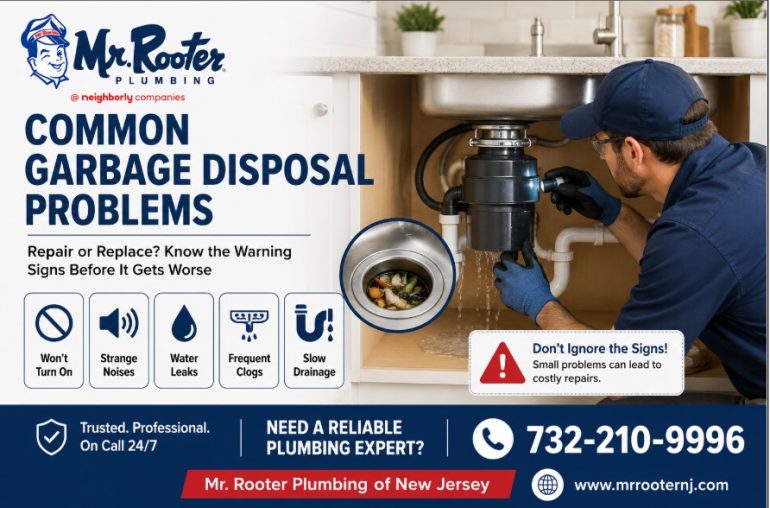
There’s a specific kind of quiet that happens when you flip the disposal switch, and nothing answers back. You probably already know it. Maybe you flipped it two or three more times, just in case, before giving up and typing trusted plumber in Freehold into your phone at the sink. Most people do that, actually flip it a bunch of extra times, like the disposal just needs convincing. It usually doesn’t work, but you try it anyway. A few days pass. It still doesn’t come back on its own, or it starts grinding in a way that makes you wince every time you use it, and somewhere in there, the easy, cheap fix turns into a bigger one because nobody wanted to deal with it right away. That’s the part worth avoiding. What follows is what’s usually going on under there, what you can check without making it worse, and where the line sits between fixing it and just paying to delay the inevitable.
Why Disposals Actually Break
It’s rarely just one thing. Usually it’s a small issue nobody dealt with for a few months.
Won’t turn on? Check the reset button first. It’s the little red button on the underside, and it trips whenever the motor overheats. Push it, wait a beat, try again. That’s the entire issue nine times out of ten. If not, you’re probably dealing with a tripped breaker, or less fun-a motor that’s actually burned out.
The reset button usually fixes the problem immediately. That’s a jam. Something got past the splash guard and wedged itself against the impeller: a peach pit, a piece of celery, occasionally a bone someone tried to sneak through. The motor’s straining against it and going nowhere.
Water showing up under the sink means a seal’s gone bad, or there’s a hairline crack somewhere in the housing, or the mounting bolts loosened over time. None of these are self-healing. The longer it sits, the more it eats into the cabinet floor underneath.
No matter how much you scrub, the smell won’t go away? There’s food trapped somewhere the scrubbing can’t reach, usually the splash guard or up under the grind chamber.
Rattling and grinding noises are worth paying attention to. Sometimes it’s just debris. Sometimes the grind components themselves are wearing out, and that’s a whole different conversation.
What’s Actually Safe to Try Yourself
A handful of things are worth attempting before you call anyone.
Start with the reset button. Always.
Go check the breaker panel too; disposals draw enough power that tripping one isn’t unusual.
Most units have a hex-shaped opening underneath. An Allen wrench fits right in and lets you manually rotate the motor to work a jam free by hand. Kill the power first. Every time.
If something’s visibly stuck, grab tongs. Do not put your hand down there, even with the power off. It’s just not worth the risk.
And once it’s running again, cold water helps flush waste through and keeps the motor from heating up as fast.
If you’ve done all that and it’s still dead, or the same problem keeps coming back every few weeks, stop troubleshooting. That’s the point where it’s worth having someone actually look at it.
When Repairing It Stops Making Sense
Some problems aren’t worth chasing anymore. A few things usually tip the decision toward replacement instead of another repair:
The unit’s somewhere around 8 to 12 years old that’s roughly the lifespan most are built for, and past that, parts start failing faster than they’re worth patching.
You’ve had it repaired more than once in the last year. That’s usually not bad luck. It’s a motor or an internal part on its way out for good.
There’s rust near the grind chamber. That’s not just a performance problem at that point; it’s a contamination one too.
The leak is coming from the disposal’s body itself, not the pipes around it. A cracked housing can’t really be sealed in a way that lasts.
It’s tripping your breaker repeatedly. That often points to the motor, and in some cases it’s genuinely a fire risk, not just an annoyance.
Something we see a lot: people who replace the unit around year 8 or 9, before it fully dies, usually end up spending less overall than the ones who keep nursing a dying disposal along one repair at a time. It feels unnecessary right up until you add up what’s already been spent avoiding it.
Getting the Right Solution for Your Garbage Disposal
We show up, tell you the truth, and avoid using technical terms. That’s not a tagline; it’s just how our licensed plumbers work every call, every time. Some visits, it’s a five-minute reset. Some it’s a new seal. And sometimes the unit really is finished and needs replacing with something that actually fits how your household uses it day to day. Either way, we check the motor, the seals, and the drain line before recommending anything, so you’re not paying to fix a problem that isn’t really there. After enough years on the job, we’ve seen the worst things we have found inside garbage disposals: wedding rings, spoons, even an AA battery once- and that experience is exactly why we know what to check before we ever recommend a repair or a replacement.
Ready to Get This Sorted?
If your disposal’s acting up, don’t wait for it to flood a cabinet or die completely at the worst possible time. Call Mr. Rooter Plumbing of New Jersey for a straight answer, whether that’s a quick fix today or a new unit that’ll actually hold up.
Frequently Asked Questions
How long should a garbage disposal last? Usually 8 to 12 years. Cheaper models, or ones running hard every day, tend to wear out sooner than that.
Can I replace a garbage disposal myself? You can. But wiring mistakes and seals that aren’t seated right are common, and they tend to show up as leaks or electrical trouble later, not immediately. A licensed plumber gets it right the first time, no callbacks needed.
Why does my new garbage disposal still smell? Almost always it’s food buildup in the splash guard. Ice cubes and citrus peels run through the unit usually clear it out. Still smells after that? Have someone check the drain line; the disposal itself might not even be the issue.
Is it worth repairing an old garbage disposal? Depends on how old. Under 6 years with a minor issue, repair it. Past that, the money’s often better spent on a replacement.