


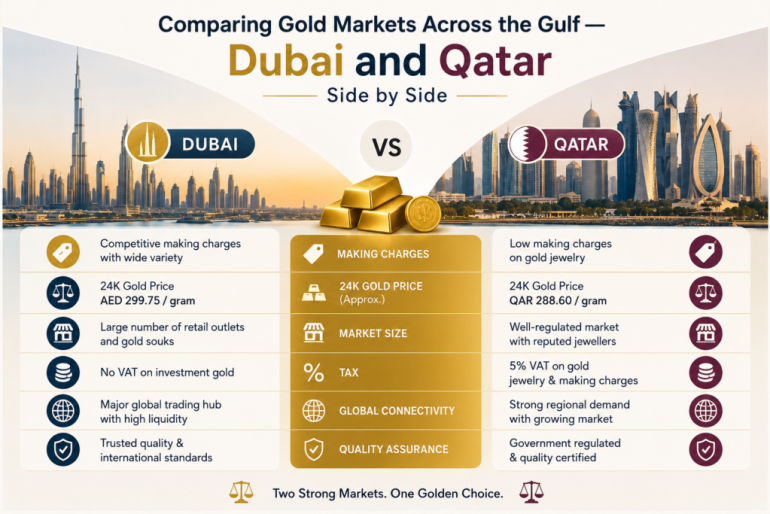
Buyers and investors tracking gold across the Gulf often default to checking a single market and assuming the picture is broadly similar everywhere else in the region. In practice, Dubai and Qatar’s gold markets, while both anchored to the same international spot price, differ enough in structure and pricing detail that a direct comparison is genuinely useful for anyone deciding where to buy.
Dubai’s Gold Market — Volume, Competition, and Transparency
Dubai’s identity as a global gold trading hub isn’t incidental branding — it reflects genuine market depth built over decades. Dubai gold rate tracking currently shows 24-karat gold trading in the low 530s per gram in AED terms, with the market having shown real volatility over the past month, swinging between the low 520s and above 560 dirhams per gram at various points.
What distinguishes Dubai’s market structure is the sheer competitive density of its retail gold sector. The Gold Souk alone hosts several hundred jewellers within a concentrated area, creating a genuinely competitive environment that keeps making charges in check — typically around 7.5 percent above spot for new jewellery, with gold sold back to dealers coming in around 2 percent below spot. This buy-sell spread, roughly 47 dirhams per gram at current prices, gives a clear picture of the actual transaction cost beyond the headline spot price.
Dubai also benefits from a favourable tax structure — investment-grade 24K bars and coins carry no VAT, while jewellery attracts a modest 5 percent rate, among the lowest jewellery tax rates in any major global gold market.
Qatar’s Gold Market — A Smaller but Genuinely Competitive Alternative
Qatar’s market operates at a smaller scale than Dubai’s but holds its own distinct advantages for buyers. Gold prices in Qatar benefit from the country’s decision not to levy any VAT on gold purchases at all — a structural advantage that keeps Qatar’s effective gold cost closer to the pure international spot price than most comparable Gulf markets, Dubai’s jewellery segment included.
Doha’s retail gold scene centers on Souq Waqif alongside major shopping destinations including City Center Doha and Mall of Qatar. Making charges in the Qatari market typically run between 2 and 5 percent above spot — competitive by regional standards and, in percentage terms, often lower than Dubai’s jewellery-specific charges once VAT is factored into the Dubai comparison.
Where the Two Markets Actually Differ
Since both the UAE dirham and Qatari riyal maintain fixed pegs to the US dollar, the underlying spot price driving both markets moves identically — there’s no currency arbitrage opportunity between the two on the metal price itself. The real differences buyers should weigh come down to three factors: Dubai’s larger selection and more intense retailer competition versus Qatar’s no-VAT structural advantage; the specific making charge a given retailer quotes on the day; and simple convenience based on where a buyer happens to be.
For investment-grade purchases specifically — 24K bars and coins where design and craftsmanship charges matter less — the no-VAT advantage in both Dubai’s investment segment and across the Qatari market generally makes either location reasonably comparable for pure bullion buying. For jewellery, Dubai’s sheer competitive density and its established, negotiation-friendly retail culture often gives buyers slightly more room to reduce making charges through simple back-and-forth, a dynamic less pronounced in Qatar’s somewhat more fixed-price retail environment.
What This Means for Buyers Comparing Both
Neither market is definitively cheaper in all circumstances — the right choice depends on what’s being purchased and in what quantity. A buyer prioritizing investment bullion with minimal tax drag might find Qatar’s blanket no-VAT policy simplest to reason about. A buyer purchasing jewellery, particularly with room to negotiate making charges across multiple pieces, often does better navigating Dubai’s larger and more competitive retail environment.
What both markets share is a level of pricing transparency that’s genuinely rare globally — live, continuously updated rates, clearly disclosed making-charge structures, and enough retail volume that prices stay honest through competition rather than requiring regulatory intervention. For Gulf-based buyers or anyone with access to either market, that transparency alone makes both worth checking before any significant purchase, regardless of which one ultimately gets chosen.