



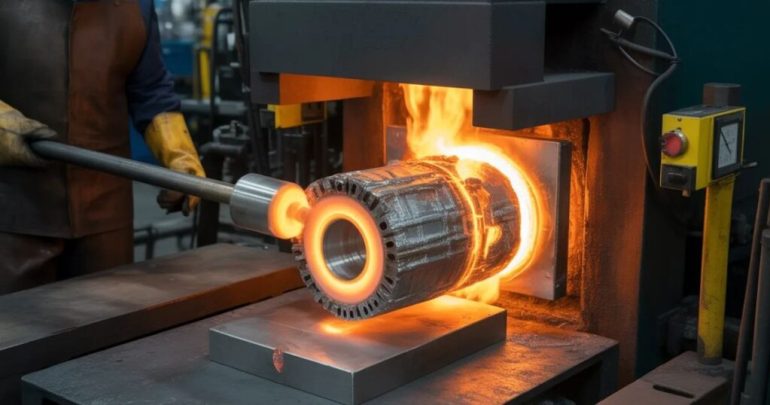
Case-hardened steel has important applications in modern engineering and manufacturing, as it features a hard, surface-hardened layer and a tough interior. Case hardening steel is used in industries where long-life mechanical parts with good wear resistance, fatigue strength and reliability are necessary. This material remains one of the most reliable engineering steels for a variety of applications, such as automotive assemblies and heavy industrial machinery.
Case hardened steel is especially attractive for parts that undergo cyclic stress, shock loading and continuous friction. The outer surface of the material is highly abrasion-resistant, and the inner is tough and ductile. This perfect combination enables manufacturers to create precision-engineered parts that operate longer in challenging environments.
What is Case Hardening Steel?
Case hardening steel refers to low-carbon alloy steel that undergoes a specialised heat treatment process designed to harden only the outer surface. The inner core is relatively soft yet tough, making it a perfect balance of strength and flexibility. Midland Special Steels says that these steels typically range from 0.10% to 0.25% carbon, making them very appropriate for carburising applications.
This process results in a hardened “case” around the component, enhancing the part’s wear resistance while maintaining high core toughness. The properties are required in transmission systems, shafts, gears, pinions, cams, and bearings.
How the Case Hardening Process Works
Case hardening is the process of diffusing carbon into the surface layer of steel under controlled heat treatment. The carbon-rich environment causes carbon atoms to diffuse into the surface of the steel component. After reaching the necessary case depth, the part is quenched and tempered.
Typically, it involves the following steps:
- Heating the steel to carburising temperature
- Carbon diffusion into the surface
- Rapid quenching to increase hardness
- Tempering for stress relief and toughness
A hardened surface can be provided in most cases with a thickness of 0.5mm to 2.5mm, depending on the steel grade and application.
Industrial Applications of Case Hardening Steel
The case hardened steel is widely used in multiple sectors where components must withstand repeated stress, friction and high loads.
Automotive Industry
Wear-resistant surfaces and long-lasting cores are necessary for vehicle gear systems, crankshafts, camshafts, and differential parts.
Aerospace Engineering
Fatigue strength and reliability of aircraft transmission assemblies and precision moving parts are improved.
Heavy Machinery
Case-hardened gears, shafts and bearings provide an extended lifespan for industrial equipment in extreme working conditions.
Manufacturing Equipment
Case-hardened steels are used in many conveyor systems, rollers, and tooling components to extend service life.
Agricultural Machinery
Tractor transmissions, rotating equipment and drive shafts require excellent wear resistance and impact strength.
Case-hardened steel is reliable in terms of service life in industrial applications due to its durability and mechanical stability.
Advantages of Using Case Hardening Steel
The operational efficiency and cost effectiveness are favoured by manufacturers when using case hardened steel.
Major benefits include:
- Increased wear resistance
- Longer component lifespan
- Reduced maintenance requirements
- Improved load-bearing performance
- Enhanced resistance to fatigue failure
- Better shock absorption
- Reliable mechanical performance
These benefits help reduce device downtime and enhance production efficiency in industrial settings.
Difference Between Case Hardening and Through Hardening
Both processes increase the hardness of the steel, but for different engineering applications.
Case Hardening
The outer layer is hardened and the inner layer is softer and tougher. This enhances wear resistance while maintaining flexibility.
Through Hardening
All of the steel cross-section is hardened. This leads to more strength but may affect ductility and impact resistance.
These parts are frequently made from case-hardened steel, which offers a combination of hardness and toughness, especially under repetitive loading and surface friction.
Machining and Heat Treatment Considerations
Case-hardened steel is typically machined before the hardening process begins. Because the untreated material has relatively low carbon content, it can be cut and shaped efficiently.
The following factors are important when manufacturing:
- Maintaining dimensional accuracy before carburising
- Selecting appropriate quenching methods
- Controlling carburising temperatures
- Managing case depth requirements
- Applying tempering after quenching
The proper heat treatment procedure is necessary to achieve optimal mechanical properties and prevent distortion during production.
Why Engineering Industries Prefer Case Hardening Steel
Engineering sectors continue to rely on case-hardening steel because it offers a dependable balance between strength, toughness, and wear resistance. Modern production environments demand materials capable of handling high rotational speeds, heavy torque, and constant friction.
These can be met in steel by:
- Delivering reliable operational performance
- Improving equipment durability
- Supporting precision engineering
- Reducing premature component failure
- Enhancing mechanical efficiency
It is one of the most versatile materials in industrial engineering, used across various manufacturing industries.
Choosing the Right Case Hardening Steel Supplier
It is essential to choose a reputable steel supplier to ensure quality and performance standards. Businesses should consider:
The availability of certified steel grades.Availability of certified steel grades.
- Material traceability
- Precision cutting services
- Heat treatment support
- Technical expertise
- Consistent stock availability
Conclusion
In many applications requiring surface hardness and internal toughness, case-hardened steel is one of the best types to use. It is known for its resistance to wear, fatigue, and impact, making it essential across sectors such as automotive, aerospace, manufacturing, and heavy engineering.
The case-hardened steel provides a combination of hardness on the surface and shock resistance in the core, making it a highly durable and dependable material. It remains a material choice that offers manufacturers an effective and reliable solution for use in gears, shafts, bearings and transmission systems in challenging industrial environments.