



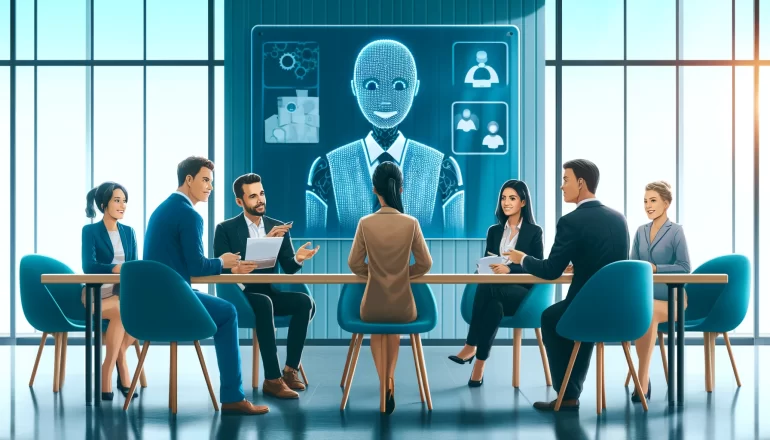
Hiring has never been simple, for every open position, recruiters may receive hundreds of applications and sometimes even thousands, every resume needs to be reviewed, every candidate needs to be evaluated and every hiring decision carries risk
Because of this, organizations are increasingly turning to AI. Artificial Intelligence can screen resumes, rank candidates, analyze skills, schedule interviews, reduce administrative work and in many cases, it can do these things much faster than humans.
The promise is attractive, including faster hiring, lower costs, and better efficiency, but there is another side to the conversation, which is fairness, because while AI can improve efficiency, hiring is still about people and people expect hiring decisions to be fair.
This creates an important question of how do organizations use AI to make hiring faster without making it less fair?That question sits at the center of modern talent acquisition.
Why AI Is Becoming Part of Hiring
The volume of hiring has changed dramatically, recruiters today deal with more applications than ever before, a single job posting can attract hundreds of resumes within days.
Reviewing every application manually takes a lot of time, this is where AI becomes valuable. AI systems can scan resumes quickly.
- Identify keywords
- Highlight relevant skills
- Sort candidates into categories
- Recommend potential matches
Tasks that once took hours can now take minutes, For busy recruitment teams, that efficiency is difficult to ignore.
The Efficiency Problem
Without technology, hiring can become slow, candidates wait for responses, managers wait for shortlists, positions remain vacant,teams become overloaded, business growth slows down.
Organizations want to move quickly, especially in competitive talent markets, if a hiring process takes too long, strong candidates often accept offers elsewhere.
AI helps solve part of that problem, It accelerates the early stages of recruitment and speed matters.
But Speed Is Not Everything
A faster hiring process with talent assessment tool is useful, but speed alone does not guarantee good hiring decisions. Imagine an AI system that reviews thousands of resumes in seconds, impressive.right?, but what if it consistently overlooks qualified candidates?, what if it favors certain profiles over others?, what if it learns biases from historical hiring data?
Now efficiency becomes a problem instead of a solution, because a fast decision is not valuable if it is unfair.
Understanding Bias in Hiring
Bias is not a new problem, it existed long before AI and humans have always carried unconscious preferences, sometimes recruiters prefer candidates from certain universities, sometimes managers prefer candidates who look similar to previous employees and sometimes assumptions influence decisions without anyone realizing it.
These biases are often unintentional, but they still affect outcomes. The hope was that AI might remove some of these biases, but reality turned out to be more complicated.
AI Learns From Data
AI systems learn from information, they study patterns, they analyze previous decisions, they identify trends, but there is a challenge. If historical hiring decisions contain bias, AI may learn those biases, not because it wants to, but because it sees those patterns as successful outcomes.
For example, if an organization historically hired candidates from a small group of universities, an AI system may begin favoring those profiles, the technology is simply repeating what it has learned, which means bias can become automated, and automation can make bias harder to notice.
The Risk of Over-Reliance
One mistake organizations sometimes make is trusting technology too much, AI provides recommendations, not perfect answers and that distinction matters. A resume screening tool might rank candidates, a matching algorithm might score applicants and an assessment platform might identify top performers. These insights are useful, but they should not become the only factor in decision-making.
Hiring is rarely black and white, people are more complex than data points.
What De-Biasing the Funnel Actually Means
When people talk about de-biasing the hiring funnel, they are talking about reducing unfair barriers throughout the recruitment process, the goal is not to remove human judgment entirely, the goal is to improve decision-making, In order to create a process where candidates are evaluated fairly.
- Regardless of background
- Regardless of demographics
- Regardless of factors unrelated to job performance
This requires both technology and human oversight, not one or the other, but both.
Skills Are Becoming More Important Than Background
One major shift in hiring is the move toward skills-based evaluation, instead of focusing heavily on degrees or previous employers, organizations are increasingly evaluating demonstrated skills.
- Can the candidate solve problems
- Can they perform the work
- Can they succeed in the role
This approach often reduces bias because it focuses on capability rather than assumptions, a coding assessment does not care where someone studied, a work simulation does not care about a candidate’s network.
The focus moves toward performance and performance is easier to evaluate objectively.
The Role of Structured Assessments
Structured assessments have become an important tool in de-biasing recruitment, every candidate completes the same evaluation, every candidate is measured against the same criteria and this creates consistency and consistency improves fairness.
When hiring decisions rely solely on interviews, outcomes can vary significantly between interviewers, structured assessments create a more standardized process that does not eliminate bias completely, but it reduces some of the variability.
Why Human Judgment Still Matters
Some people believe AI will eventually replace recruiters and that prediction appears unlikely, at least in the foreseeable future, recruitment involves more than matching skills.
It involves understanding motivation.
- Communication
- Collaboration
- Potential
- Context
These things are difficult to fully measure through algorithms, human judgment remains essential, the goal is not to remove people from hiring, the goal is to help people make better decisions.
Transparency Builds Trust
One challenge organizations face is candidate trust, people want to understand how hiring decisions are made and if AI plays a role, transparency becomes important.
Candidates should know how they are being evaluated, what factors matter, how assessments are used. The more transparent the process, the more confidence candidates have in its fairness. Opaque systems often create skepticism, especially when decisions appear unexplained.
The Best Approach Is Usually Hybrid
The most successful organizations rarely choose between AI and humans, they combine them.
AI handles repetitive tasks.
- Resume screening
- Scheduling
- Initial matching
- Data analysis
- Humans handle interpretation
- Decision-making
- Relationship building
- Final evaluation
This hybrid approach often delivers the best results, efficiency without losing fairness, and automation without losing judgment.
Measuring Fairness Matters Too
Organizations often measure hiring speed.
- Time-to-hire
- Cost-per-hire
- Application volume
These metrics matter, but fairness should also be measured, companies can analyze:
- Candidate diversity
- Assessment outcomes
- Interview conversion rates
- Hiring patterns
This helps identify potential issues before they become larger problems, what gets measured gets improved and fairness is no exception.
The Future of Talent Acquisition
AI will continue to play a larger role in hiring,that trend is already underway, recruitment technology is becoming more sophisticated, assessment platforms are becoming smarter, data analytics is becoming more powerful.
But fairness will remain a central concern, because organizations are not hiring data, they are hiring people and people expect equal opportunity.
The Bigger Shift
The conversation around AI in hiring is often framed as technology versus humanity, that is the wrong comparison, the real challenge is balance, using technology to improve efficiency, using human judgment to maintain fairness.
Neither is sufficient on its own, but together they create a stronger hiring process, one that is faster, more scalable and hopefully more equitable.
Final Thoughts
AI has transformed talent acquisition, it helps organizations process applications faster, manage larger candidate pools, and make recruitment more efficient, but efficiency is only part of the equation, hiring decisions affect careers, livelihoods and opportunities.
Which means fairness cannot be treated as an afterthought, the future of hiring will not belong entirely to algorithms, nor will it belong entirely to traditional methods, it will belong to organizations that successfully balance technology with human judgment.
Those that use AI to remove friction, but use people to provide context, because the goal is not simply to hire faster, the goal is to hire better and better hiring happens when efficiency and fairness work together, not against each other.