



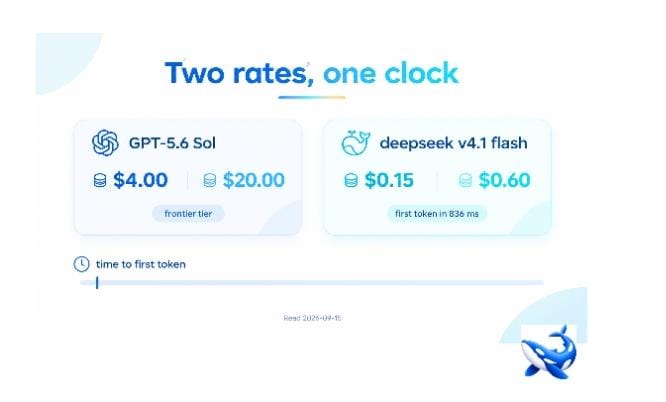
Ask a pricing table which model should run your production traffic and the answer is usually the name at the top of the frontier tier, because that is the one with the best benchmark rows and the safest reputation. On our catalog that name is GPT-5.6 Sol, listed at $4.00 per million input tokens and $20.00 per million output tokens. OrcaRouter hosts it, and the same catalog hosts a model listed at $0.15 in and $0.60 out that reaches its first token in 836 milliseconds and moves more tokens over its seven-day window than the other seven models on the table combined: deepseek v4.1 flash api. The two pages sit a few clicks apart, and the comparison between them is less obvious than the price columns suggest.
All prices and latency figures read 2026-09-15.
The price gap, stated plainly
DeepSeek’s official pricing page, read 2026-09-15, lists `deepseek-flash` — the canonical name for V4.1 Flash — at $0.15 per million input tokens and $0.60 per million output tokens, off-peak. GPT-5.6 Sol’s published list of $4.00 in and $20.00 out makes the gap 26.7x on input and 33.3x on output. The two gaps are different sizes because the models bill output differently relative to input, and that difference is where most cost estimates go wrong: a workload that mostly reads context sits near the 26.7x figure, while a workload that generates long completions drifts toward 33.3x. An agent loop that writes a page for every query, a summarizer that emits a third of its tokens, a chatbot with long answers — all of those land on the output side of the gap, where the multiple is steepest.
Two caveats keep the comparison honest. The DeepSeek column is the off-peak rate; DeepSeek charges double inside a peak window of 01:00–04:00 and 06:00–10:00 UTC, Monday through Friday, which is 35 hours of the 168-hour week. That means 79.2% of all hours are off-peak and weekends are off-peak entirely, so most traffic in most regions lands on the cheap side — but a batch job scheduled at 01:00 UTC pays twice as much for the same tokens, and a latency-sensitive workload that needs the peak window loses part of the discount. And both columns are list prices, which is precisely the point: they are the published, comparable starting point, which is why they deserve verification rather than trust.
The first-token gap, measured on one platform
Price columns answer what a request costs. The latency column answers when the user sees anything happen, and that is where the two models diverge more than either spec sheet admits. Our production telemetry — a 7-day rolling window, read 2026-09-15 — puts V4.1 Flash’s median time to first token at 836 ms. GPT-5.6 Sol, on the same table and the same window, sits at 6.67 s. Neither figure is a controlled benchmark; both reflect one platform’s traffic mix, regions and live provider load. But they are real observations of what a user behind the same API key experiences, and the ordering has been stable across the window.
For an interactive product the difference is not cosmetic. At 836 ms the stream starts while the user is still composing the next input; at 6.67 s there is a visible pause before every answer, and at conversational scale that pause is a product decision a whole team gets to defend. For batch work the latency gap matters little — a queue absorbs it. For chat, assistants, copilots and anything a human is waiting on, it is often the difference between a tool that feels fast and one that feels like it is thinking, and there are workloads where feeling slow is reason enough to change models.
Which workload each model actually wins
A fair comparison concedes the frontier case, because it is real. GPT-5.6 Sol is the model to reach for when the request is hard, the answer is load-bearing, and a single error costs more than the entire request: long-horizon reasoning, multi-step tool chains, tasks where being wrong is more expensive than being slow. Our telemetry shows a usage pattern that matches that description: GPT-5.6 Sol carried 240.4M tokens over the week against V4.1 Flash’s 47,198.3M. That is not a quality verdict — it is a usage verdict. Teams send a relatively small number of heavy, careful requests to the frontier model and a vast stream of interactive ones to the flash model, and both choices look rational in the numbers.
V4.1 Flash’s territory is the stream. At 836 ms it posts the fastest median first token in our telemetry table; at $0.15 in and $0.60 out it is cheap enough to call per-user without a cost review; it adds native vision — DeepSeek’s official feature table marks Vision as supported — a 1M context, and a 384K maximum output. Its off-peak cache-hit price of $0.003 per million input tokens is a 50x discount off the miss price, per DeepSeek’s own pricing page, which makes repeated system prompts nearly free — the exact economic shape of chat and agent workloads, where the same instructions ride along on every request.
The mistake is to frame this as a winner-takes-all contest. The useful framing is cost-per-outcome. If you run both models against your own eval set and the frontier model moves a metric the cheap model does not — conversion, correctness on a labeled set, acceptance of the generated text — then paying the multiple is the right business decision, and it should be made without embarrassment. If it does not move the metric, you are paying 26.7x on input or 33.3x on output for a row on a spec sheet, and that is a decision worth reversing.
What a like-for-like comparison requires
Three details make the comparison reproducible. First, use the right model name on the right day: `deepseek-flash` is the canonical identifier for V4.1 Flash, and its prices are the off-peak ones unless you are sending inside the Monday-to-Friday peak windows. Second, measure cost per task rather than cost per call — a task that needs ten cheap calls and one expensive call has a different shape from a task that needs one call on each, and the 33.3x output gap only applies when the outputs are the same size. Third, treat the latency column for what it is: a 7-day rolling median from one platform’s production traffic, not a benchmark, so the decimals drift while the ordering stays stable.
The takeaway
The comparison that matters is not flash-versus-frontier; it is cost-per-outcome. On input price the gap is 26.7x and on output price 33.3x, both computed from published rates read on the same day. On first token the gap is 836 ms against 6.67 s from our own telemetry. For the interactive, high-volume tail of your traffic, V4.1 Flash wins on every axis we can measure — price, first token, cache economics and vision. For the small number of requests where a wrong answer is the expensive outcome, GPT-5.6 Sol earns its premium. The two models are not interchangeable and they are not in competition; they are tiers, and the job is to route each request to the right tier instead of assuming the expensive one is right for everything.
Sourcing note: DeepSeek’s prices, peak/off-peak schedule and cache discounts come from DeepSeek’s official pricing page, read 2026-09-15 (vendor-published). GPT-5.6 Sol’s list price is the rate published on our catalog for that model, read the same day and carried from the vendor’s own listing (vendor-published). The 26.7x and 33.3x gaps are arithmetic on those two published rates. All latency, throughput and traffic figures are OrcaRouter’s own production telemetry — a 7-day rolling window, read 2026-09-15, reflecting one platform’s traffic mix, regions and live provider load rather than a controlled benchmark. No independent benchmarks are cited in this piece.