



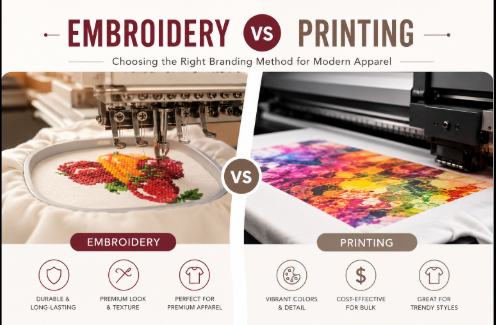
In today’s world of competition, apparel is not only about dressing but also a means of branding that speaks of identity, professionalism, and consistency. Organisations in every sector are spending huge sums of money on decorated apparel in order to increase their visibility and give them a consistent look. Of all the customising techniques, printing and embroidery services have emerged as the most common processes. Each technique has its own advantages depending on use and the fabric.
It is essential to understand the difference between these techniques to make a better branding choice.
Embroidery in Clothing Decoration Explained
Embroidery is an art whereby the images or words are made to appear in the fabric using computers. This method differs from screen printing, where ink is applied on the outer surface of the cloth. Embroidery requires the manufacture of texture from the thread that will be sewn inside the cloth.
Due to its ability to maintain its shape even after many washes and repeated wearing, embroidery becomes one of the most loved methods used when decorating polo shirts, jackets, caps, and other structured clothes. Therefore, embossed images are elegant and long-lasting.
Before the process begins, the artwork needs to be digitized.
Why Do Firms Prefer Embroidered Branding?
There are many benefits of embroidered designs in terms of appearance. The embossed pattern provides a professional look because of its dimensional presence on the surface of clothing, which adds to the quality of garments. It looks more polished and experienced than plain printed designs.
Another important aspect regarding the durability of the logo is also there. As embroidery involves stitching the logo, its longevity is more and it does not get affected even when the clothes are washed regularly. Thus, it serves to be very good for businesses who wear their uniform daily.
Besides, the best materials for embroidery include pique cotton, fleece, and twill.
Prints in Clothing Decoration
Print refers to the process of applying ink to fabric surfaces or transferring images on the fabric surfaces. Screen printing, direct-to-garment (DTG), and heat transfer are examples of techniques used in printing. As opposed to embroidery, printing allows various details, coloring, and shading.
Using prints is advantageous because it allows for a greater level of creativity when it comes to clothing decoration. Printing makes it easy to reproduce large prints, pictures, and images.
However, the drawback of using prints is that they are at the surface of the fabric and therefore they get worn out with time.
Embroidery versus Printing – Major Differing Factors
When it comes to choosing between embroidery and printing, there are usually three main aspects taken into consideration: durability, complexity of design, and application purposes.
First of all, embroidery is definitely preferable considering quality and professionalism. The best way to deal with logos and company identities which need to stay the same for many years whereas printing works better for complicated and colorful pictures.
Secondly, from the cost perspective, embroidery demands higher initial costs because of the more sophisticated digitizing process involved.
Lastly, embroidery perfectly fits structured clothes like suits or jackets whereas printing works better with light fabrics like T-shirts.
The Applications for Each Method
Embroidery tends to be applied in corporate settings, hospitality, retail uniform apparel, and corporate uniforms. This method is preferred when businesses need a credible and consistent brand identity to project.
On the other hand, printing is extensively utilized in marketing programs, sportswear, casual wear, and event merchandise. Printing’s ability to handle complicated designs makes it the preferred choice for innovative branding techniques.
In contemporary clothing lines, most companies use both embroidery and printing. The former is used to create a primary identity for employees’ uniforms, while the latter is used in promotional clothing and seasons’ collections.
Effect of Branding on Customer Perception
Use of attire plays a very crucial role in shaping the perception of the client. For instance, wearing a professionally made uniform will be an excellent representation of your professional character, reliability, and meticulousness. Embroidering can assist you in this because it can enable you to create an elegance and distinction in your attire when dealing directly with clients.
Although printing appears more vibrant and impressive, it seems unstructured, hence ideal for companies looking for innovative branding.
Ultimately, it is all about how you want to market your company to customers.
Longevity & Long-Term Investing
The next big benefit that comes with embroidery is its longevity. As the design is stitched on to the fabric of the garments, the design will not change even after many cycles of industrial washing.
Printed fabrics may be more diverse in terms of design variety but can require some extra effort to stay looking good over time. This applies especially in environments where uniforms undergo regular wash cycles.
Longevity becomes very important when considering investing big amounts of money in the company’s uniform for many years to come.
Conclusion
Both embroidery and printing techniques play a significant role in the process of contemporary custom apparel designing. The choice between them depends strongly on personal taste and branding considerations. Embroidery is considered more professional, and thus will help build the brand image. Printing, on the other hand, allows for creative freedom and can be used for advertising purposes.
It is important to know the pros of both options to build an effective clothing strategy.
FAQs
Q1. What is the main difference between embroidery and printing?
Embroidery uses stitched threads to create a textured design on fabric, while printing applies ink or transfers onto the surface of the garment. Embroidery is more durable, whereas printing allows more detailed and colourful designs.
Q2. Which method lasts longer on workwear?
Embroidery generally lasts longer because the design is stitched into the fabric. It can withstand frequent washing and heavy use, making it ideal for uniforms and long-term branding.
Q3. Is embroidery suitable for all types of fabrics?
Not all fabrics are ideal for embroidery. It works best on thicker, structured materials like cotton polos, jackets, and caps. Very thin or stretchy fabrics may not hold stitches well.
Q4. Can printed designs fade over time?
Yes, printed designs can fade or crack over time depending on the printing method, fabric quality, and washing conditions. Proper care can extend their lifespan.
Q5. Which option is more cost-effective for bulk orders?
Printing is often more cost-effective for large, design-heavy bulk orders, while embroidery may cost more initially due to setup but offers better long-term value.