



From the Big Screen to Every Screen
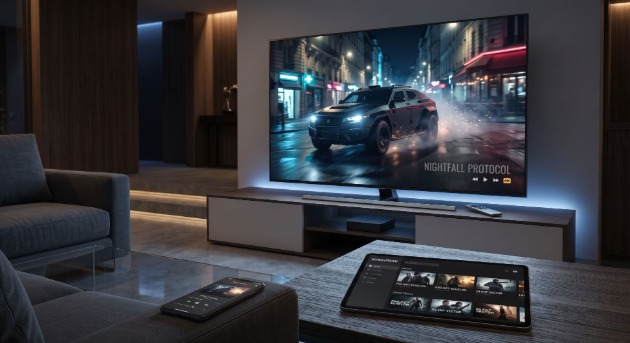
Action cinema has always benefited from scale. Car chases feel faster on a large display, practical explosions carry more impact, and carefully staged fight choreography is easier to appreciate when image detail and motion remain clear. What has changed is the way audiences reach that experience. The living-room television is still important, but it now sits inside a wider ecosystem of streaming boxes, laptops, tablets and phones.
That shift is changing expectations around home entertainment. Viewers increasingly want the freedom to start with a large-screen movie at home, check live programming on another device, or continue browsing on a smaller screen without treating each device as a separate entertainment world.
Why 4K Matters More for Action Than the Resolution Number Suggests
The appeal of 4K is often reduced to pixel count, but action movies expose the strengths and weaknesses of a playback setup in more obvious ways than many slower genres. Fast camera movement, smoke, rain, crowds, debris and rapid cuts can all make compression, motion handling and inconsistent playback easier to notice.
A strong home experience therefore depends on more than a television carrying a 4K badge. Source quality, available bandwidth, device decoding, the playback application, Wi-Fi conditions and the display itself all contribute to the final picture. Higher resolution is most useful when the rest of that chain can support it consistently.
The Streaming Box Is Becoming Part of the Home-Theater Equation
For many viewers, the television is no longer the only piece of hardware that determines the experience. Compact streaming devices and set-top boxes can extend the useful life of a display, provide access to different applications and offer a more familiar interface than the software built into an older Smart TV.
This is especially relevant for action fans who regularly move between new releases, older catalog titles, live events and episodic television. A flexible playback device can make that variety easier to navigate without requiring a completely new television.
Multi-Device Viewing Changes the Meaning of the Living Room
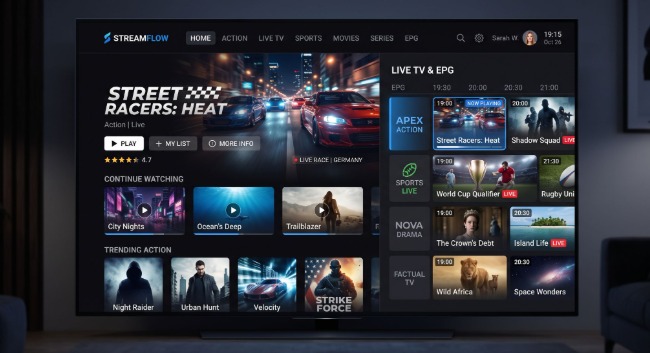
The modern living room is less isolated than it used to be. A television may be the main screen, while a laptop is used elsewhere in the house and a tablet or phone becomes the convenient option when the main display is occupied. Multi-device viewing is therefore less about replacing the television than extending the entertainment experience around it.
The practical challenge is consistency. Different operating systems, app stores, screen sizes and network conditions mean that the same household can have very different playback experiences from one device to another. Services designed for this environment need clear setup guidance and realistic compatibility expectations rather than assuming that every screen behaves identically.
Content Discovery Is Becoming as Important as Content Volume
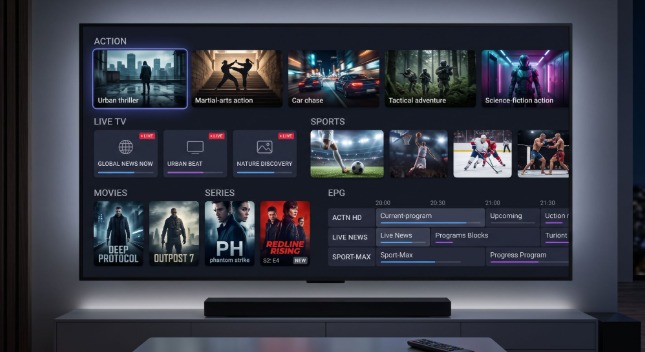
Large libraries create a different problem: finding something worth watching. For action fans, useful discovery can mean moving quickly between live channels, movies, series, sports or event programming and an electronic program guide without losing track of what is currently playing.
A clean interface matters because the viewer’s goal is not to admire a menu. It is to get from an idea—an old martial-arts film, a new thriller, a live event or a late-night action marathon—to playback with as little friction as possible.
Where Platforms Such as Flash4K IPTV Fit Into the Shift
The broader move toward flexible home viewing has also created demand for services built around multiple device types rather than a single proprietary receiver. Flash4K IPTV is one example of a platform positioned around live television, sports, movies and series across common streaming devices, with 4K-oriented viewing where the source and the viewer’s hardware and connection support it.
For consumers, the useful question is not simply how many categories a service advertises. It is whether the intended device, application and connection work together reliably. Testing the actual setup, checking regional availability and confirming the number of simultaneous devices before committing to a longer plan are more meaningful than relying on headline specifications alone.
The Network Still Sets the Ceiling
Even the best display cannot compensate for an unstable connection. Wi-Fi interference, weak signal strength, congestion elsewhere in the home and poor routing can all affect playback. Ethernet remains useful where practical, while well-positioned modern Wi-Fi can be sufficient for many households.
When troubleshooting, changing several variables at once can make the problem harder to identify. A more useful sequence is to test the same content on another device, compare Wi-Fi with Ethernet when available, restart the playback application, and check whether the issue affects one category or the entire service.
Action Fans Are Building More Flexible Home Cinemas
The home cinema of 2026 does not have to be a dedicated room filled with specialist hardware. For many people it is a good television, a capable streaming device, a stable connection and the freedom to use another screen when circumstances change.
That flexibility suits action entertainment particularly well. The genre ranges from catalog classics and martial-arts films to modern blockbusters, episodic thrillers and live sports or combat events. A multi-device setup makes it easier for those different forms of entertainment to coexist without tying the household to one screen.
The Next Upgrade May Be the Ecosystem, Not the Television
For years, home-entertainment upgrades were discussed mainly in terms of screen size. The next stage is broader. Viewers are paying more attention to how televisions, streaming hardware, applications, networks and secondary screens work together.
For action-movie enthusiasts, that can mean a better experience without turning the living room into a technology project. The most effective setup is ultimately the one that preserves the impact of the movie while making the technology disappear into the background.