



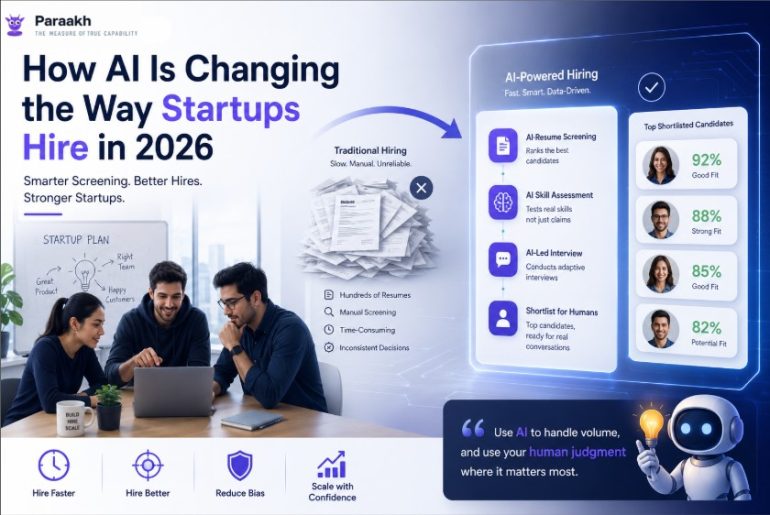
Most startups don’t have a hiring problem because they can’t find candidates. They have a hiring problem because they can’t tell, quickly and reliably, which candidate is actually good. A ten-person team doesn’t have a dedicated recruiter reading three hundred resumes line by line they have a founder or a single HR hire trying to fill five roles at once, usually while doing three other jobs too.
That’s the gap AI has quietly started to close in recruitment. Not by replacing human judgment, but by handling the parts of hiring that never needed a human in the first place: reading resumes at scale, scoring skills consistently, and surfacing the handful of candidates actually worth a founder’s time.
Why Traditional Hiring Breaks Down at Startup Speed
Traditional hiring was built for a world where one role got fifty applications and a recruiter had a week to sort through them. That math doesn’t hold anymore. A single decent job posting on LinkedIn or Naukri can pull in hundreds of applications within days, and most early-stage teams don’t have the headcount to read them properly.
The result is one of two failure modes: either the team spends weeks on manual screening and loses good candidates to faster-moving competitors, or they skim resumes in thirty seconds each and make decisions on keyword-matching rather than actual ability. Neither produces good hires.
What AI Actually Does in Recruitment (and What It Doesn’t)
There’s a lot of noise around “AI hiring,” so it’s worth being specific about what’s actually working right now, as of 2026:
Resume and application screening. AI models can now parse resumes against a role’s actual requirements not just keyword matching, but contextual relevance and rank candidates before a human looks at a single application.
Skill assessment generation. Instead of manually writing test questions, AI can generate role-specific assessments directly from a job description or a set of internal documents, so the test actually reflects what the job requires rather than a generic template.
AI-led interviews. Adaptive AI interviews can ask follow-up questions based on a candidate’s previous answer, score responses against a rubric, and produce a transcript useful as a structured first-round filter before a human interview, not a replacement for one.
Anti-cheating and integrity checks. For technical and remote hiring, AI-based proctoring flags suspicious behavior tab switching, plagiarism, impersonation that would be impossible to catch manually at scale.
What AI in recruitment does not reliably do yet: make final hiring calls, evaluate genuine culture fit, or replace a real conversation between a founder and a candidate about why they want the job. The technology is a filter, not a judge.
Where Startups Get the Most Value From AI Hiring Tools
Not every part of hiring benefits equally from AI. Based on how growing teams are actually using it in 2026, the highest-leverage applications are:
- Pre-interview skill screening. Filtering hundreds of applicants down to a shortlist of ten to twenty based on demonstrated ability, not just resume claims.
- Technical hiring at any scale. Coding assessments and technical evaluations are one of the clearest wins AI can grade objectively and instantly, something no founder has time to do manually.
- First-round interview automation. Using an AI-led interview to cover baseline screening questions, freeing up founder or hiring-manager time for candidates who’ve already cleared the bar.
- Reducing bias in early screening. Standardized, AI-scored assessments apply the same criteria to every candidate a meaningful improvement over resume screening, where unconscious bias creeps in easily.
Common Mistakes Startups Make With AI Hiring Tools
- Over-automating the final decision. AI should narrow the pool, not make the offer decision. Teams that let a score alone decide a hire often end up with technically competent but poorly-fitting employees.
- Using generic, off-the-shelf tests. A generic assessment template rarely maps well to what a specific startup role actually needs day to day. The best results come from assessments generated against the actual job description.
- Ignoring candidate experience. A slow, buggy, or overly long AI assessment can cost you strong candidates who have other offers in play. Keep it short, relevant, and fast to complete.
- Skipping the human follow-up entirely. AI screening works best as step one of a process, not the whole process.
What This Means for Founders Hiring Right Now
If you’re a founder or an early People hire trying to build a team without a full recruiting function behind you, the practical takeaway is simple: use AI to handle volume, and use your own time on the candidates who’ve already proven they can do the job.
That usually looks like a three-step funnel AI-generated skill assessment first, AI-led or structured first-round interview second, founder conversation last. It compresses a process that used to take three to four weeks down to a matter of days, without sacrificing the quality of the final hiring decision. Platforms like AI-powered assessment platforms like Paraakh are built specifically for this generating role-relevant tests directly from a job description or company documents, so early-stage teams don’t have to build assessment infrastructure from scratch.
The Bottom Line
AI in recruitment isn’t about removing people from hiring it’s about giving small teams the same screening capacity that larger companies get from dedicated recruiting departments. For startups operating with limited headcount and no time to spare, that’s not a nice-to-have. It’s increasingly the difference between hiring well and hiring fast, and in 2026, the best teams are figuring out how to do both at once.
About the Author
Paraakh is an AI-powered talent assessment and hiring platform that helps growing teams generate job-relevant skill assessments, run AI-led interviews, and screen candidates at scale built directly from a company’s own job descriptions and documents.