



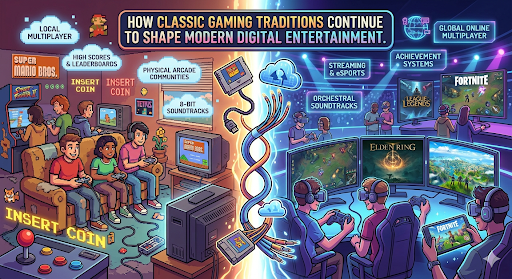
Every form of entertainment that exists today is built, in some way, on foundations laid by entertainment that came before it. Film learned from theater. Television learned from radio and film. And digital entertainment learned from all of them, plus something unique: the worlds of games that existed long before anyone thought about putting them on computers. This lineage matters because it explains something that might otherwise seem surprising: in a world of cutting-edge graphics, immersive virtual realities, and constantly updated game platforms, some of the most popular games people play are based on traditions that reach back decades, sometimes centuries. Understanding how this works — how ancient principles continue to drive modern engagement — offers insight into what people actually want from entertainment.
The question isn’t whether technology changes entertainment — clearly it does, fundamentally and continually. The question is what survives those changes, and why. The answer turns out to be surprisingly consistent: the elements of games that appeal to something basic in human nature tend to survive. Competition, strategy, social interaction, the chance to improve through practice — these aren’t new concepts. They’re as old as games themselves. But understanding why they’ve remained relevant despite technological revolutions tells us something important about what entertainment actually means.
The Core Elements That Never Change
Before smartphones, before computers, before most of modern technology existed, games served specific human needs. They provided entertainment, yes, but they also created opportunities for social bonding, intellectual challenge, and the satisfaction of competition. A group of people gathered around a table playing cards wasn’t just passing time — they were engaging in an activity that combined strategy, psychology, luck, and social ritual in ways that felt genuinely rewarding.
Those fundamental appeals haven’t changed. What’s changed is the delivery mechanism. The core elements remain constant: the challenge of making good decisions under uncertainty, the pleasure of competing against others, the social dimension of shared experiences, and the sense of progression that comes from improving your skills over time. These are features that work whether you’re playing at a physical table or through a smartphone app.
This is why games based on centuries-old traditions can remain popular in an age of advanced graphics and sophisticated systems. It’s not nostalgia, exactly. It’s that the underlying game mechanics address genuine human interests that don’t go out of style.
Technology Modernizes Without Replacing
One of the most important insights from looking at how classic games have survived into the digital era is this: modernization doesn’t require abandonment. The most successful examples of classic games adapting to digital platforms didn’t strip away what made those games appealing. Instead, they preserved the core mechanics while using technology to improve the experience.
Mobile technology, cloud connectivity, sophisticated matchmaking algorithms, real-time multiplayer infrastructure — these are all tools that make classic games more convenient and accessible. They remove friction. They make it easier to find opponents, to track your progress, to participate in a community of players. But they don’t change what makes the game itself engaging.
A good example is how dominoqq has adapted to digital platforms. The core gameplay remains unchanged from the physical version — the same domino combinations, the same strategic principles, the same flow of decision-making. What’s changed is the infrastructure: you can find an opponent instantly rather than needing to know someone who wants to play. The game provides real-time statistics so you can track your progress. You can participate in leaderboards and competitive events. The community aspects that used to happen through informal conversation now happen through the app itself.
Why Strategy Remains the Primary Driver of Engagement
One of the most consistent patterns in entertainment over the past several decades is this: games that reward thoughtful decision-making have longer lifespans than games that rely primarily on fast reactions or visual spectacle. Spectacle fades. Graphics improve, and what seemed cutting-edge five years ago looks dated today. But a game that challenges you to think, to plan ahead, to evaluate risks and make informed decisions — those dynamics remain engaging regardless of how the graphics evolve.
Classic games almost always emphasize strategy over spectacle. They were built around challenging players to make good decisions, not around impressive visual presentation. That emphasis has actually become an advantage in the modern era, because it means the games don’t depend on staying at the technological frontier. A game from the 1980s might have simple graphics, but if the underlying strategy is solid, it’s still engaging.
This explains why players continue to seek out games based on traditional formats. They’re not seeking novelty or the latest technological advancement. They’re seeking the experience of playing a game where their decisions matter, where skill and observation lead to improvement, and where competition against other humans creates unpredictability and tension.
Community as the Multiplier Effect
Classic games were traditionally social experiences. You didn’t play a card game alone — you played with others, and that social dimension was part of what made the experience rewarding. Winning mattered partly because you were winning against other people. The conversation, the friendly competition, the shared experience — all of that was integral to why the game was enjoyable.
Digital platforms have actually enhanced this aspect of traditional games, not diminished it. Mobile apps make it easier to stay connected to a community of players. You can see how you stack up against others through leaderboards. You can discuss strategies with other players. You can participate in group events and tournaments. The social elements that used to be geographically limited — you could only play with people nearby — are now global.
This community aspect turns out to be crucial for long-term retention. A game that’s engaging mechanically is more engaging when you’re playing against other humans than when you’re playing alone. And the community provides reasons to return that go beyond just the game itself — friendships, reputations, the sense of belonging to a group of people with shared interests.
The Challenge of Balancing Preservation and Improvement
For developers and platform operators managing traditional games, the central challenge is finding the right balance. Change too much, and you lose what made the original game appealing. Preserve too rigidly, and the game feels stuck in the past and fails to meet modern expectations for accessibility and user experience.
The successful adaptations understand that improvement and preservation aren’t opposed — they’re complementary. You can improve the user experience, make the game more accessible, add modern features like social connectivity and competitive rankings, without touching the core gameplay. That separation between the game itself and the infrastructure around it is what allows classic formats to remain relevant.
Games like domino qiu qiu demonstrate this principle in practice. The gameplay is recognizable to someone who learned the game from their parents or grandparents. The strategic principles are unchanged. But everything around the game — how you find opponents, how you track your progress, how you participate in the community — is fully modern and optimized for digital distribution.
Reaching Audiences Across Generations
One of the most important outcomes of classic games adapting to digital platforms is that they’ve become accessible to younger audiences who might never have encountered them otherwise. A game that only existed in physical form or on desktop computers would have gradually faded from public consciousness as older players aged out of the demographic.
But a game that’s available on smartphones, searchable in app stores, easy to try for free, reaches people who simply wouldn’t have looked for it elsewhere. This has created a situation where multi-generational audiences can coexist in the same game. Someone who learned to play from their grandfather and a teenager discovering the game for the first time on their phone are playing the same game, with the same mechanics, and can compete against each other in real-time.
This cross-generational appeal is rare and valuable. It means the game doesn’t have to constantly chase trends to stay relevant. It means there’s a built-in community that spans age groups and backgrounds. And it means the cultural tradition around the game is being passed on naturally, without requiring deliberate effort to preserve it.
What This Tells Us About Entertainment’s Future
Looking at how classic games have survived and thrived in the digital era offers insights into what entertainment will look like going forward. It suggests that the most sustainable forms of entertainment aren’t those chasing the latest technological frontier or the newest visual effects. Instead, they’re the ones based on solid mechanics and genuine appeal.
Technology will continue to evolve. New platforms will emerge. Graphics will improve. But the games that people return to year after year, the ones that build lasting communities and create meaningful experiences, tend to be the ones that understood something fundamental: what makes a game engaging is rarely about the technology. It’s about the core experience — the challenge, the competition, the social dimension, and the chance to improve.
Classic gaming traditions have proven their resilience not by refusing to change, but by adapting thoughtfully while preserving what made them valuable in the first place. That formula is likely to remain relevant for as long as people play games.