



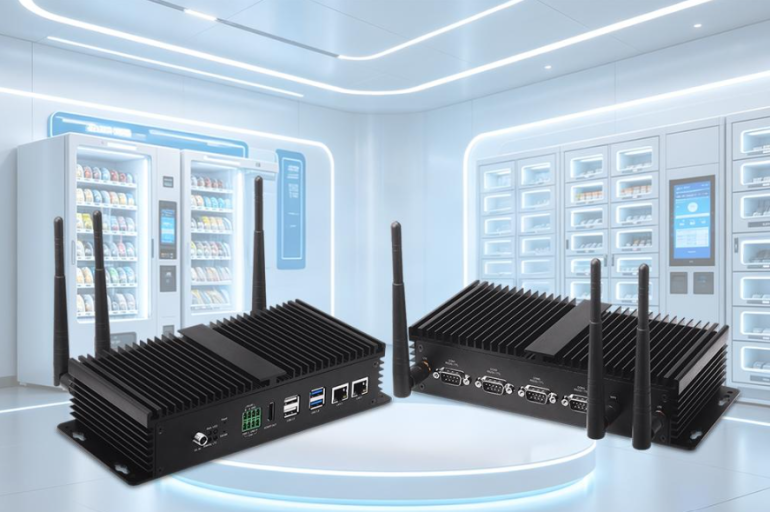
As edge AI continues to evolve from pilot projects into real production deployments, enterprises are running into a very practical problem: not all AI belongs in the cloud or in traditional server rooms.
More and more AI workloads are now running directly in factories, retail stores, transportation systems, healthcare facilities, and smart buildings. These environments are very different from data centers. They are distributed, space-constrained, and often lack ideal cooling or infrastructure conditions.
In this shift, the question is no longer just about AI performance. It is about how AI can be deployed reliably in the real world.
This is where compact edge AI box PCs are starting to play a key role.
Why Traditional Infrastructure Doesn’t Fit the Edge
Conventional enterprise servers were designed for centralized computing environments. They assume stable power, controlled temperature, rack space, and dedicated maintenance.
But edge environments don’t look like that.
On the edge, systems are often installed inside control cabinets, kiosks, machines, or even transportation infrastructure. Space is limited, conditions are variable, and maintenance access is not always easy.
Because of this, enterprises are increasingly looking for hardware that is smaller, simpler, and easier to deploy without changing the environment around it.
Compact edge AI box PCs solve this problem by bringing computing, AI acceleration, and system control into a single integrated device designed specifically for edge scenarios.
Companies such as Geniatech are building these kinds of edge AI box platforms to help bridge the gap between cloud AI and real-world industrial deployment.
Compact Hardware Makes Real Deployment Possible
One of the most important advantages of edge AI box PCs is simply their size.
Because they are compact, they can be deployed in places where traditional servers would never fit. Instead of requiring dedicated rooms or racks, they can be embedded directly into existing systems or installed inside equipment.
This makes it much easier to bring AI capabilities closer to where data is actually generated.
In practice, this means AI is no longer something that sits in the background of an IT system. It becomes part of the physical environment—inside machines, kiosks, cameras, and industrial devices.
The smaller form factor also makes deployment more flexible. Systems can be mounted in different orientations and integrated into a wide range of industrial and commercial setups without major redesign.
Fanless Design Improves Real-World Reliability
Another important factor is how these systems handle heat and dust.
Many compact edge AI box PCs use fanless designs, which remove moving parts from the cooling system entirely.
In real-world environments, this has a noticeable impact. Without fans, there is less dust accumulation, fewer mechanical failures, and reduced maintenance requirements over time.
This is especially important in industrial settings, where systems often need to run continuously for years with minimal intervention.
Fanless design also enables silent operation, which is useful in environments such as retail spaces, hospitals, and smart buildings where noise can be a concern.
In short, removing the fan is not just a design choice—it is a reliability decision.
AI Is Now Processed Where Data Is Generated
A major reason edge AI box PCs are gaining traction is that they enable local AI processing instead of relying on constant cloud communication.
Modern edge systems can run AI workloads such as vision analysis, object detection, industrial inspection, and real-time analytics directly on-device.
In some cases, they can even support lightweight local language model inference for interactive applications.
The key benefit is simple: data does not need to travel to the cloud to be useful.
This reduces latency, improves responsiveness, and allows systems to continue operating even when network connectivity is limited or unstable.
For many industrial applications, this shift is critical. Decisions need to happen in milliseconds, not seconds.
Lower Power Means Easier Scaling
As enterprises move from single deployments to large-scale edge AI networks, power consumption becomes a system-level concern rather than just a technical detail.
Compact ARM-based edge AI box PCs typically consume significantly less power than traditional server-based setups. This has a direct impact on deployment economics.
Lower power consumption reduces heat output, simplifies cooling requirements, and allows systems to be deployed in locations where energy resources are limited.
Over time, this also lowers total cost of ownership, especially when hundreds or thousands of devices are deployed across multiple sites.
This is one of the main reasons ARM-based edge platforms are becoming more common in industrial AI infrastructure.
Scaling AI Across Real Environments Becomes Simpler
Another key advantage of edge AI box PCs is how easily they scale.
Instead of relying on centralized data centers, enterprises can deploy AI capabilities incrementally across different locations. Each device operates independently while still contributing to a larger intelligent system.
This makes it easier to expand AI adoption gradually, without major infrastructure changes.
In practice, this architecture is being used in areas such as smart manufacturing, intelligent retail systems, transportation monitoring, and security applications.
Rather than building one large AI system, enterprises are building many small AI nodes distributed across real-world environments.
The Direction of AI Infrastructure Is Becoming Clear
While cloud computing remains essential for training large models and managing centralized data systems, most real-time AI inference is gradually moving toward the edge.
This shift is driven by practical needs: faster response times, better privacy control, improved reliability, and lower operational cost.
Compact edge AI box PCs are becoming one of the key enablers of this transition because they make edge deployment physically and operationally practical.
As the ecosystem continues to mature, companies like Geniatech are helping accelerate this shift by providing integrated edge AI platforms designed specifically for industrial and commercial deployment scenarios.
The future of AI infrastructure is not purely centralized or purely distributed. It is a hybrid model where intelligence is embedded directly into the environments where decisions need to be made.