



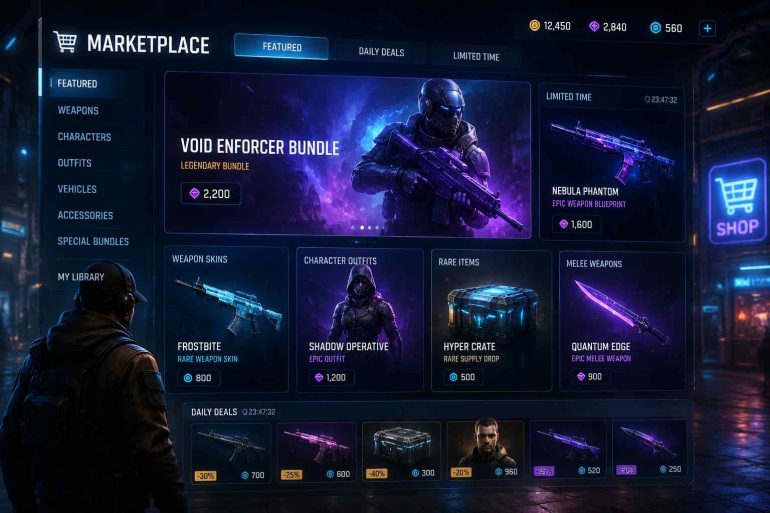
If you’ve ever bought a weapon skin, grabbed a battle pass, or traded items with another player, you’ve already participated in an in-game marketplace. These digital storefronts have grown from a side feature into one of the biggest forces shaping modern multiplayer games. They’ve changed how games are built, how developers earn money, and how players spend their time.
This guide covers everything you need to know — from how virtual economies work to the legal issues now catching up with them.
What Are In-Game Marketplaces and How Do They Work
In-game marketplaces are digital platforms, built inside or alongside video games, where players buy, sell, or trade virtual items. Items range from cosmetics like character skins and weapon wraps to functional goods like crafting materials or gear. There are two main types: developer-run stores (like the Fortnite Item Shop) where the studio sells directly to players, and player-to-player platforms (like Steam’s Community Market) where users trade among themselves. Many games now combine both.
What makes these markets interesting is the real supply-and-demand economy that forms around rare items. Players browse, compare prices, and make purchasing decisions just like they would in any marketplace — except the goods are entirely digital and sometimes worth hundreds of real dollars.
The Rise of Player-Driven Economies in Multiplayer Games
Player trading existed long before developers built official systems for it. Early MMORPGs like EverQuest and Ultima Online had informal barter systems that were unregulated and prone to scams, but they proved players genuinely wanted to exchange virtual goods. Developers eventually stopped fighting that instinct and started building around it.
When Valve introduced CS:GO weapon skins in 2013, the Steam Community Market exploded. Rare skins now sell for thousands of dollars. Today, player-driven economies span every major genre: battle royale games use rotating limited-time shops, MMORPGs run auction houses that work like mini stock markets, and survival games tie item value directly to gameplay utility. For many players, tracking prices and spotting market trends has become a core part of the experience.
How In-Game Marketplaces Generate Revenue for Developers
The traditional $60 game sale has largely given way to ongoing revenue built around virtual storefronts. Developers earn through transaction fees on player trades (Valve takes 15% on every Steam Market sale), direct item sales where they keep 100% of revenue, and battle passes that lock players into seasonal spending. Premium currency is often sold in bundles that don’t divide evenly, so players always have a small amount left over and are nudged to buy more.
Scarcity-based sales are another major driver. Items available for only 24–48 hours create urgency, and when they disappear, secondary market prices climb — reinforcing their perceived value. The results speak for themselves: Fortnite reportedly generated over $5 billion in a single peak year, entirely through microtransactions.
Real Money Trading and Its Impact on Game Balance
Real Money Trading (RMT) — exchanging real currency for in-game items or advantages — is one of the most contested areas in gaming. Some RMT is officially supported, like in Path of Exile, where player-driven item trading is a core mechanic. Others, like Diablo 4, removed auction houses entirely after backlash from an earlier title.
The balance impact depends on what’s being sold. Cosmetics have no effect on gameplay and are widely accepted. Convenience items like XP boosts give paying players a speed edge — controversial but tolerated. Power items that directly improve performance create pay-to-win dynamics, which erode the skill-based competition that keeps multiplayer games worth playing. When paying wins games, non-paying players leave, and the market loses its audience.
Cosmetic Items vs. Pay-to-Win: Where Marketplaces Draw the Line
The cosmetics-only model has become the industry standard for good reason. Games like Valorant, League of Legends, and Fortnite sell skins, emotes, and visual effects exclusively — players who spend money look different, not better. This preserves competitive integrity, keeps free-to-play players engaged, and creates genuine emotional investment in how characters look.
The line isn’t always clean, though. Some “cosmetic” items offer subtle edges — a high-contrast skin might be easier to spot in certain maps, or a weapon effect might be visually cleaner to aim with. These soft advantages are a constant debate in competitive communities. The marketplaces that handle this well earn player trust, and trusted players actually spend more on cosmetics.
Top Games With the Most Successful In-Game Marketplaces
A few games stand out for building genuinely thriving virtual economies. CS2 (formerly CS:GO) has one of the most mature player-driven markets in gaming — rare StatTrak knife skins regularly sell for thousands of dollars, and the community has built its own price trackers and investment forums around it. Fortnite’s rotating Item Shop, with its Marvel and Star Wars collaborations, has turned limited-time availability into a cultural event. Roblox runs a user-generated item economy where “Limiteds” with fixed supply resell for real thousands of dollars. Genshin Impact proved that gacha mechanics can generate billions — though the randomized spending model has also attracted significant regulatory attention.
Path of Exile takes a different approach: its barter-based player economy is so complex that external trading sites and currency tools have formed just to navigate it, while the developer monetizes mostly through cosmetic microtransactions. Each of these games shows a different viable path for in-game marketplace design.
How Virtual Goods Pricing Works in Online Marketplaces
Digital items have near-zero production cost, so pricing is almost entirely psychological. Developers use anchor pricing (showing expensive items first to make others seem reasonable), artificial scarcity (limited-time availability), and premium currency bundles designed to leave small amounts unspent. Items tied to popular IP — Marvel, music artists, athletes — carry an emotional premium that purely in-game cosmetics don’t.
In player-to-player markets, pricing follows supply and demand with gaming-specific twists. Low drop rates push prices up. Items absent for years trade at a premium. Skins associated with high-level play gain prestige value that goes beyond rarity alone. Some players treat item acquisition as investment, buying early and selling when demand spikes. Games like the Rainbow Six Siege item marketplace show how even tactical shooters have built thriving virtual economies around this behavior. That’s why a digital CS2 knife skin can be worth more than a real-world one — it’s about status, scarcity, and community perception.
The Role of Blockchain and NFTs in Digital Game Markets
Blockchain gaming promised players true ownership of virtual items that could be traded freely or used across games. The idea was compelling — items you own at the infrastructure level, not just by permission of a game publisher. In practice, it mostly failed. Cross-game interoperability is technically very hard to implement, NFT markets were flooded with speculation and fraud, managing crypto wallets added friction most players didn’t want, and environmental concerns pushed developers and audiences away.
EA, Ubisoft, and Square Enix all experimented with NFT features between 2021 and 2023. Most projects were quietly dropped after player backlash. Blockchain hasn’t disappeared from gaming entirely, but traditional developer-run marketplaces remain dominant because they’re simpler and, frankly, more trustworthy. Players who want to buy a skin don’t want to think about gas fees. For broader coverage of how the gaming industry is evolving, Laser Magazine tracks these shifts across all major titles.
Player Trust, Scams, and Security in Game Marketplaces
Real money attracts fraud. Common scams include phishing sites that mimic legitimate trading platforms to steal credentials, item-switching during manual trades where a valuable item is swapped for a worthless lookalike at the last second, fake middlemen who disappear with traded goods, and fake payment screenshots used to trick sellers into releasing items.
Most platforms now fight back with trade holds (up to 15 days for suspicious activity), two-factor authentication on high-value trades, anti-bot systems, and community reporting tools. These protections help, but they’re not foolproof. Players using third-party trading sites should apply the same caution they’d give to any real financial transaction — because that’s what it is.
How In-Game Trading Shapes Long-Term Player Engagement
When players invest real money into a game’s ecosystem, they stay longer. Owning rare items or a large cosmetic collection gives players a reason to log in beyond the core gameplay. This isn’t just sunk-cost psychology — it creates genuine community investment. Players with notable inventories discuss them on Reddit, flex them in Discord servers, and bring friends in to see what they’ve collected.
Marketplaces also create a reinforcing cycle: more players means more economic activity, which makes the market more interesting, which attracts more players. CS2 has maintained an active player base for over a decade partly because the skin economy always gives players something to pursue. For developers, this translates directly into daily active users, session length, and organic word-of-mouth growth.
Legal and Regulatory Challenges Facing Virtual Marketplaces
Loot boxes — randomized item containers — have become the biggest legal flashpoint. Belgium and the Netherlands have banned paid loot boxes outright under gambling laws. The UK, several US states, and the EU have all considered or enacted similar measures. Games operating in regulated markets have responded with pity systems (guaranteed drops after a set number of purchases) and direct purchase alternatives. Genshin Impact, for example, now must disclose odds in most markets.
Beyond gambling, marketplaces that allow real-money cashout face financial compliance requirements including anti-money laundering (AML) checks and Know Your Customer (KYC) rules. Consumer protection agencies are also scrutinizing dark patterns — obscuring real costs behind premium currency, misleading “value” bundles, and high-pressure mechanics targeted at younger players. Regulatory pressure on this space will keep increasing as these economies continue to grow.
The Future of In-Game Marketplaces in Multiplayer Gaming
Several trends are worth watching. AI-assisted cosmetic tools are letting some developers offer player-customized or generated items for sale, which could expand virtual economies significantly. Cross-universe cosmetics — items that work across multiple games from the same publisher — are being explored, with Bungie testing this in Destiny 2. Subscription-based cosmetic access, similar to Game Pass for software, could shift players away from one-off purchases toward predictable monthly spending.
Regulation will also reshape the market. Clearer odds disclosure, stricter age verification, and more transparent pricing are likely to become baseline requirements across major markets. The in-game marketplaces that survive long-term will be the ones players trust — and trust is built by keeping competition fair, pricing honest, and the experience genuinely fun.
Conclusion
In-game marketplaces have become a defining feature of modern multiplayer games — shaping how developers earn, how players engage, and how virtual economies function at scale. The model works best when it’s built on fairness: cosmetics over power, transparency over manipulation, and community trust over short-term revenue grabs.
As regulations tighten and player expectations grow, the games that treat their marketplaces as genuine community assets will outlast the ones that treat them as extraction tools. That’s good news for players — and for the long-term health of the industry.