



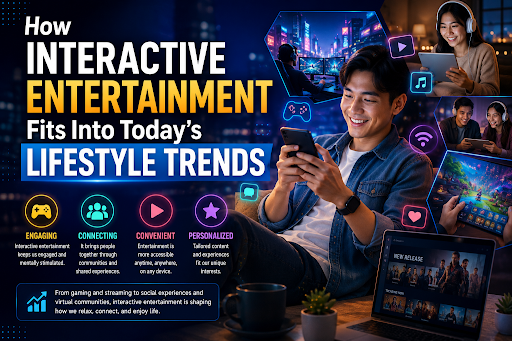
There’s a particular kind of tiredness that shows up after a long day of decisions. It’s not the tiredness that comes from physical effort, and rest, oddly enough, doesn’t always fix it. A growing number of people have started noticing this gap between “being off work” and “actually feeling recovered,” and it’s reshaping how they choose to spend the hours they have to themselves. Interactive entertainment, in all its modern forms, has quietly stepped into that gap.
Streaming queues, mobile apps, online communities, multiplayer games — none of these are new ideas on their own, but the way they’ve woven themselves into daily routines is. What used to be an occasional treat (a movie night, a weekend hobby) has become something far more continuous: a steady backdrop of small, chosen moments of engagement scattered across an otherwise demanding week.
From Watching to Participating
The biggest shift isn’t really about screens getting bigger or internet getting faster, though both help. It’s about the posture people take toward their own downtime. Traditional entertainment asked very little of the viewer beyond attention. You sat, you watched, you absorbed whatever the program decided to give you next.
Interactive formats flip that arrangement. A game asks for a decision. A live chat asks for a reply. A fitness app asks you to log, choose, adjust. None of this is exhausting in the way work is exhausting — if anything, people report the opposite. There’s something restorative about engagement you actually control, especially after a day spent responding to other people’s demands and deadlines.
This is part of why so many people now describe their evenings not as “winding down” in the old sense of doing less, but as shifting into a different kind of doing — one with lower stakes, more autonomy, and an built-in sense of pacing they get to set themselves.
Why It Keeps Growing
A few forces seem to be driving this particular shift in how people spend their time, and they tend to reinforce each other rather than operate in isolation.
Accessibility That Fits Real Schedules
Not everyone has a free evening, but almost everyone has five minutes between meetings, or a commute, or a stretch of time waiting for something else to start. Mobile-first entertainment was practically built for these in-between moments. It doesn’t ask for a block of dedicated time the way a film or a sport practice might; it simply asks to be picked up and put down as life allows.
Personalization That Feels Less Like Noise
Recommendation systems have gotten quietly better at understanding what someone actually wants versus what’s simply popular. The result is less scrolling and more landing — people find something that fits their mood faster, which matters more than it sounds like it should when the whole point of the activity is to relax rather than to search.
Connection Without the Logistics
Interactive platforms have also become unlikely social spaces. A multiplayer match, a shared playlist, a comment thread — these let people stay in touch with friends and strangers alike without coordinating schedules or leaving the house. For people whose social circles are spread across cities or time zones, this isn’t a lesser substitute for in-person connection; it’s often the only practical version of it available on a Tuesday night.
Constant, Incremental Innovation
None of this stands still. Interfaces get smoother, load times shrink, graphics improve, and entirely new formats appear every year or two. Each small improvement removes a bit more friction between wanting to relax and actually being able to, which keeps people coming back even as their tastes evolve.
Rethinking What Downtime Is For
As work schedules grow more demanding and the boundary between “on” and “off” keeps blurring, the question of what genuinely counts as rest has become surprisingly complicated. Simply being unoccupied isn’t always enough — plenty of people report finishing a passive evening of scrolling and feeling just as drained as before it started.
This is where the idea of intentional, digital downtime experiences comes into focus. Rather than treating screen time as an undifferentiated block of “not working,” more people are starting to distinguish between activities that genuinely recharge them and ones that simply fill time. A short, engaging game session or a conversation in an online community can leave someone feeling more present than an hour of passive content ever did, simply because it asked something of them — attention, creativity, a decision — and gave something back in return.
That distinction matters because it reframes rest itself. Rest isn’t only the absence of activity; sometimes it’s the presence of the right kind of activity, chosen deliberately rather than defaulted into. Recent conversations about how people are redefining rest in an always-busy world have picked up on exactly this point: that meaningful breaks often look more like engagement than emptiness.
Entertainment as Part of a Balanced Routine
The relationship between entertainment and well-being is getting more attention than it used to, and for good reason. Used thoughtfully, interactive platforms can offer real benefits that go beyond simple distraction:
- Mental stimulation that keeps the mind active without adding pressure
- Low-friction opportunities for social interaction
- Convenient access that fits around unpredictable schedules
- Personalized experiences that match individual moods and interests
- Flexible engagement, from a few minutes to a full evening
None of this works as a replacement for sleep, movement, or face-to-face time with people who matter — nothing claims it should. But as one piece of a varied routine, interactive entertainment increasingly earns its place alongside the more traditional ways people unwind.
Where Things Seem to Be Headed
Looking forward, it’s hard to imagine this trend reversing. Artificial intelligence, augmented reality, and increasingly capable mobile devices are already starting to blur the line between entertainment, communication, and everyday lifestyle management. The platforms shaping how people relax today are likely to look quite different in just a few years, but the underlying pull — toward engagement that’s personal, flexible, and genuinely felt — isn’t going anywhere.
If anything, the broader interactive lifestyle trends taking hold right now suggest that people are getting more deliberate, not less, about how they spend their free hours. The casual, anything-will-do approach to downtime is gradually giving way to something more curated: people actively choosing experiences that match their energy, their schedule, and what they actually need from a break, rather than settling for whatever’s easiest to default into.
A Closer Look at How People Actually Use Their Downtime
It’s worth pausing on what this looks like in practice, because the broad strokes can make it sound more abstract than it actually is. Picture someone finishing a long workday, the kind where every hour was scheduled by someone else’s priorities. They don’t necessarily want total silence — they want something that feels like theirs. For one person that might be twenty minutes in a story-driven game, picking the path no one else would choose. For another, it’s a quiet group chat with friends scattered across three time zones, trading messages between other tasks all evening. For someone else, it’s a fitness app turning a routine workout into something closer to a game, complete with streaks and small rewards that make consistency feel less like a chore.
None of these examples look alike on the surface, but they share a common thread: each one gives the person a measure of control that a passive evening rarely does. That sense of agency, even in something as small as choosing a dialogue option or picking a teammate, appears to be doing real psychological work. It signals to the brain that this time belongs to the person using it, rather than to whoever scheduled the last eight hours of their day.
The Generational Picture Is More Blended Than People Assume
There’s a common assumption that interactive entertainment is mostly a younger person’s domain, but the data on actual usage tells a more blended story. Older adults have become some of the fastest-growing users of mobile games, social apps, and streaming communities, often drawn in by the same appeal that hooks younger users: low barriers to entry, flexible time commitment, and a genuine sense of connection with people who share specific interests.
Parents juggling childcare and work have gravitated toward formats that can be paused and resumed without losing progress or momentum. Retirees looking to stay mentally sharp have found that puzzle-based apps and strategy games offer exactly the kind of light cognitive challenge that doctors and wellness experts often recommend. The picture that emerges isn’t of one generation dominating digital leisure, but of nearly every age group finding its own version of the same underlying need: engagement that fits around a life already in motion, rather than demanding the life be rearranged around it.
Setting Reasonable Boundaries
None of this is an argument for unlimited screen time, and most people instinctively understand that. The same flexibility that makes interactive entertainment so appealing can just as easily tip into overuse if there’s no intention behind it. The difference between a restorative half hour and a draining three hours often comes down to whether the activity was chosen on purpose or simply fallen into out of habit.
Simple boundaries tend to work better than strict rules. Some people set a rough time window rather than a hard limit, giving themselves permission to stop early if they’re not actually enjoying it anymore. Others pair interactive time with something physical — a walk, a stretch, a few minutes outside — so digital engagement becomes a complement to movement rather than a replacement for it. The goal isn’t to treat entertainment with suspicion, but to stay honest about whether a given session is actually serving its purpose.
Conclusion
Interactive entertainment has moved well past its origins as a niche hobby or an occasional indulgence. By offering convenience, personalization, and a kind of engagement that traditional media never quite managed, it has become a genuine part of how people structure rest, connection, and enjoyment in their daily lives. As technology keeps advancing and people keep refining what relaxation actually means to them, this shift toward interactive, intentional downtime looks less like a passing trend and more like a lasting redefinition of what it means to truly unwind.