



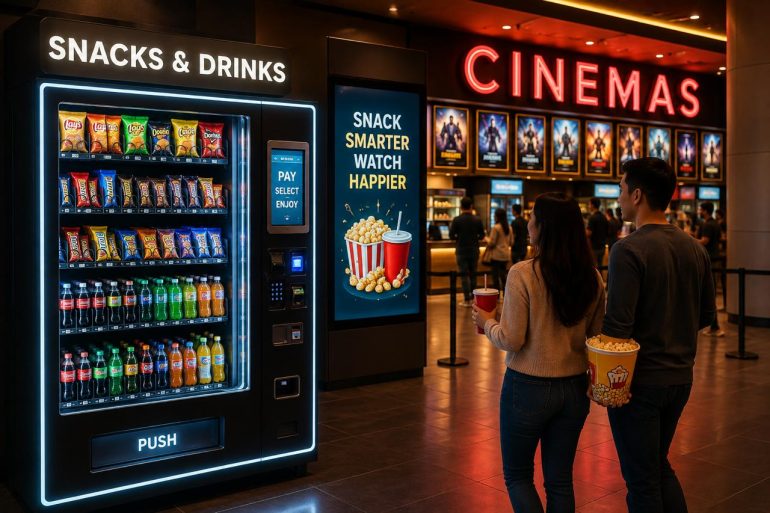
Concessions already do the heavy lifting for theater profitability — industry data cited by CNBC shows some chains pull more than 40% of total revenue from food and beverage, since theaters keep the bulk of that margin while ticket sales get split with studios. Vending machines don’t replace that engine. They fill the gaps around it: the late show with no concession staff on the floor, the preview-night line that’s ten deep, the guest who just wants a bottled water on the way to their seat. Done right, that’s how movie theaters can boost revenue with vending machine add-ons without adding a single payroll hour.
Why Movie Theaters Are Adding Vending Machines to Their Revenue Mix
Movie theaters boost revenue with vending machines by capturing sales during hours the concession stand can’t cover — late showings, staff shortages, and long preview lines — while adding high-margin snack, hot food, and specialty drink options that increase spend per visit without adding payroll.
Concession stands are staffed to a schedule. Vending machines aren’t. That distinction matters more in a cinema than almost anywhere else, because moviegoer traffic is naturally uneven — a rush right before showtime, dead air during the film, another burst at intermission or the credits. A concession counter built to handle the pre-show rush is either overstaffed or understaffed for every other part of the night. A vending machine in the lobby, hallway, or near a second exit sells at 11 p.m. the same as it does at 6 p.m., with no shift to schedule and no line to manage.
There’s also a line-management angle industry operators point to directly: strategically placed machines near entrances, exits, or lounge areas spread out customer flow and shorten the wait at the main counter during previews and intermissions, which reduces the number of guests who skip concessions entirely because the line looked too long.
How Much Extra Revenue Can a Vending Machine Add to a Theater?
Exact numbers depend on the theater — screen count, seating capacity, and how much foot traffic passes the machine’s location. Across the broader vending industry, operators commonly report a single well-placed machine grossing somewhere between $500 and $3000 per month, with the top of that range reserved for high-traffic spots and the right product mix. Once you have a machine running is the most reliable way to refine that estimate for your own location.
| Machine Type | Typical Monthly Gross* | Best Suited For | Added Staffing |
| Snack & drink combo | $300–$800 | Lobby, hallway, near restrooms | None |
| Hot food (pretzels, mozzarella sticks, mini pizzas) | $500–$1,200 | High-traffic lobby, near seating areas | Periodic restock only |
| Specialty beverage (boba tea, iced coffee) | $400–$1,000 | Lobby, concourse, younger-demographic screens | Periodic restock only |
| Combo/multi-category unit | $600–$1,500 | Large multiplex lobbies with steady all-day traffic | Periodic restock only |
*Ranges reflect general vending industry benchmarks across high-traffic venues, not theater-specific audited data. Actual performance varies by location, pricing, and product mix.
A useful way to frame it for ownership: a machine doesn’t need to outperform the concession stand to be worth installing. It needs to cover its placement cost and generate incremental revenue from traffic the concession stand was never going to capture in the first place — the late-night crowd, the guest in a hurry, the person who wants something the counter doesn’t sell.
Where to Place Vending Machines in a Movie Theater for Maximum Sales
Placement decides more of a machine’s performance than the equipment itself. A few principles hold up across most theater layouts:
- Map guest movement before you pick a spot. Entry points, the path to restrooms, and the concourse outside auditoriums see the most repeat foot traffic per visit.
- Put smaller units near exits. Guests leaving a screening are more likely to grab something quick on the way out than to backtrack to the main counter.
- Position near — not directly in front of — the staffed concession stand. This gives guests in a hurry an alternative without visually competing with counter sales.
- Never block emergency routes. Vending placement has to respect fire code and egress clearance in every configuration, no exceptions.
- Use off-peak zones. A hallway that’s empty during the film but full during intermission is exactly where a machine earns its keep — it’s covering a shift no employee is standing.
What Products Sell Best in Movie Theater Vending Machines?
Not every product category performs the same way in a cinema lobby as it does in an office break room. Moviegoers are buying for a specific occasion — before a film, during intermission, or on the way out — and the product mix should match that.
Grab-and-go snacks and drinks cover the largest share of transactions simply because they’re the fastest purchase decision. A Vending Machine to sell food stocked with theater-friendly snacks, candy, and bottled beverages handles this segment without competing directly with the concession counter’s popcorn-and-soda combo.
Hot food fills a gap most concession menus leave open outside of peak hours. A Hot Food vending machine stocked with pretzels, mozzarella sticks, or mini pizzas gives guests a real food option during a late show or a matinee gap when the kitchen line isn’t staffed.
Specialty beverages are where theaters can differentiate rather than compete. Boba tea and similar drinks skew toward the younger demographic that makes up a large share of opening-weekend and weekend-matinee crowds, and they’re not something the standard soda fountain offers. A turns that into an on-demand purchase instead of a missed opportunity.
Vending Machines vs. Expanding the Concession Stand: Which Makes More Sense?
For many theaters, this isn’t an either/or decision — vending fills a role the concession stand structurally can’t. But when ownership is weighing where to put the next capital dollar, the comparison is worth laying out plainly.
| Vending Machine Add-On | Expanded Concession Stand | |
| Upfront cost | Lower — single unit or small cluster | Higher — construction, equipment, permitting |
| Staffing | None to minimal | Additional shifts required |
| Hours of coverage | 24/7, including closed hours | Limited to staffed hours |
| Footprint needed | Small — hallway, lobby corner | Larger — counter and back-of-house space |
| Time to revenue | Weeks | Months (construction/permitting lead time) |
| Best for | Off-hours sales, line relief, new product categories | Core menu growth, dine-in style offerings |
The two aren’t competing for the same dollar. A vending program is typically the faster, lower-cost move to test new categories — like hot food or specialty drinks — before committing to a counter buildout for the same items.
Compliance Considerations: Labeling, Health Codes, and Accessibility
Vending machines that sell food are subject to real regulatory requirements, and skipping this step is one of the more common — and avoidable — mistakes theaters make.
Operators who own or operate 20 or more vending machines are required by the FDA’s vending machine labeling rule to disclose calorie information for the food sold, either on the packaging itself or on a sign at or near the machine. Multiplex chains running vending across several locations should check whether their combined machine count crosses that threshold; independent single-screen theaters with only a machine or two typically fall outside it, but it’s worth confirming.
Beyond labeling, local health department rules on food handling and storage still apply to hot food and perishable items sold through vending, and fire marshals will flag any unit placed in a path of egress regardless of how much revenue it generates. Building compliance into the placement plan up front avoids a costly relocation later.
How to Get Started: Steps to Add Vending Machines to Your Theater
- Audit your lobby and concourse traffic. Identify the times and locations where guests are moving but no staffed point of sale exists.
- Estimate potential revenue against those traffic patterns. Use industry benchmarks as a starting range, then adjust once real sales data comes in.
- Decide on ownership structure. Buying outright gives you full margin; a revenue-share or leased arrangement with an operator lowers upfront cost in exchange for a cut of sales.
- Choose a product mix suited to moviegoers, not a generic office snack lineup — grab-and-go, hot food, and specialty drinks each cover a different part of the visit.
- Place the unit where it won’t block egress, ideally near — not directly competing with — the concession counter.
- Add cashless payment and remote monitoring so stock levels and sales data are visible without a manual walkthrough.
- Review performance after 60–90 days and adjust product mix or add a second unit in a proven high-traffic spot before scaling further.
Key Takeaways
- Vending machines capture sales during hours or moments the concession stand can’t — late screenings, staff breaks, and pre-show rushes.
- Industry benchmarks put a well-placed machine at roughly $300–$1,500 in monthly gross revenue, with high-traffic lobbies trending toward the top of that range.
- Product mix matters more in a theater than almost any other venue type — snack and drink combos, hot food, and specialty drinks each serve a different moment in the guest’s visit.
- Machines over a certain footprint or count trigger FDA calorie-labeling requirements, so compliance should be part of the planning stage, not an afterthought.
- The lowest-risk way to start is one or two machines in a proven dead zone, not a full vending program on day one.
FAQ
Do vending machines take sales away from the concession stand?
Generally, no — vending machines mostly capture sales the concession stand wasn’t positioned to make in the first place, such as during closed hours, staff shortages, or long preview-night lines. Placing the machine near, not directly competing with, the main counter helps preserve that separation.
How much revenue can a vending machine generate in a movie theater?
Industry benchmarks put a single well-placed machine at roughly $300 to $1,500 in monthly gross revenue, with higher numbers typical in high-traffic lobbies and lower numbers in low-traffic corners. A theater’s own foot traffic and product mix will move that estimate up or down.
What snacks and food items sell best in movie theater vending machines?
Grab-and-go snacks and bottled drinks cover the bulk of transactions, while hot food items like pretzels and mozzarella sticks perform well during off-peak hours when the kitchen line isn’t staffed. Specialty drinks such as boba tea tend to do well with younger, weekend-matinee crowds.
Are movie theaters required to post calorie information on vending machine snacks?
Operators who own or operate 20 or more vending machines are required under FDA rules to disclose calorie information for food sold through them. Independent theaters with only one or two units typically fall below that threshold but should confirm with local guidance.
Can a movie theater install a hot food vending machine?
Yes. Hot food vending units are commonly used to cover food service during hours or areas the concession counter doesn’t reach, and they don’t require additional staffing beyond periodic restocking.
Is it better to buy or lease a vending machine for a theater?
Buying outright keeps full margin on every sale but requires more upfront capital and in-house restocking. A leased or revenue-share arrangement lowers the initial cost and shifts servicing to the vendor in exchange for a percentage of sales — often the lower-risk starting point for a theater testing vending for the first time.