



Watch any fight scene with the sound muted and something strange happens: the punches stop landing. The choreography might be flawless, the stunt work committed and precise, but without sound, a fist connecting with a jaw reads as two actors standing near each other. Sound is what turns motion into impact. It’s the part of action filmmaking audiences never think about because, when it’s done right, they’re not supposed to notice it at all.
The Punch That Isn’t a Punch
Here’s the part that surprises most people the first time they hear it: the sound of a punch almost never comes from a punch. Foley artists build that impact from something else entirely — a leather jacket slapped against a table, a stalk of celery snapped near the mic, a wet towel hitting concrete. The actual physical contact on set is usually quiet, controlled, and safe. Everything the audience feels gets added afterward, layer by layer, in a studio built for exactly this kind of work.
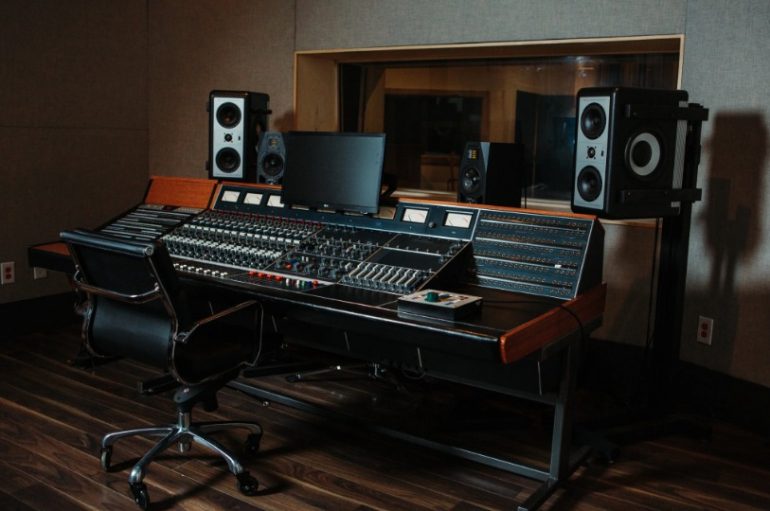
This is where a facility like Encounter Studios earns its keep on an action production. Foley recording needs an isolated space, the right surfaces to perform on, and someone who understands timing well enough to match a footstep or a body hit to the frame it belongs to. Get the sync half a beat off and the whole sequence feels loose, even if viewers can’t say why.
Layering: Why One Sound Never Sells a Hit
A single sound effect almost never carries an action beat on its own. A gunshot in a finished film is typically five or six elements stacked together: the mechanical clack of the weapon, a low-end thump that hits the chest, a sharp crack for the transient, a tail of reverb that sells the size of the room, and often a subtle whip-crack layered on top for aggression. Strip any one of those out and the shot sounds thinner, cheaper, less dangerous.
The same logic applies to hand-to-hand combat. A convincing hit combines a body impact, a cloth movement, a breath or grunt, and sometimes a low sub-bass hit that the audience feels more than hears. Building that stack takes a sound editor working out of a proper Toronto recording studio, with a deep, well-organized library and the ear to know which combinations sell weight versus which just sound loud. This is craft, not volume — a common misconception that shows up constantly in lower-budget action work, where every hit gets cranked up instead of built out.
Guns, Explosions, and the Myth of “Just Turn It Up”
Explosions expose this problem the fastest. A raw explosion recording, on its own, sounds surprisingly unimpressive — mostly noise, with none of the low-end pressure a theater or a good pair of speakers can deliver. Sound designers build a screen-ready explosion from multiple recordings: a sharp initial crack, a sub-bass layer for the physical push, debris and rubble for texture, and a decaying rumble tail that tells the audience how big the blast actually was.
Distance changes everything, too. An explosion heard from fifty feet needs a different frequency balance and delay than one heard from five. Get that wrong and even a well-shot, well-edited sequence feels like it’s happening on a stage rather than in a real space. This is one of the clearest signs of a rushed sound pass — action beats that all sound the same regardless of how close the camera is.
Space and Perspective: Mixing for Chaos That Still Makes Sense
A busy action sequence — a car chase through a crowded street, a firefight across multiple rooms — asks a mix to do something genuinely difficult: stay chaotic enough to feel dangerous while staying clear enough that the audience can track what’s happening. That balance comes down to perspective. Sounds close to the camera get more detail and presence; background elements get pushed back, filtered, and softened so they read as environment rather than competing for attention.
Dialogue makes this harder. An actor delivering a line while an engine roars in the background still needs to be understood, which means the mix has to duck and shape everything around that voice without making the rest of the scene feel muted or artificial. This is usually where ADR comes in — dialogue re-recorded in a controlled studio environment and blended back into the noisy on-set audio so it sits naturally in the mix. Done well, nobody notices a line was replaced. Done poorly, it’s the first thing anyone hears.
Why This Craft Rarely Gets Credit
Good sound design is largely invisible by design. Audiences remember a fight choreographer’s work, a stunt coordinator’s rig, a director’s shot composition. They rarely walk out talking about the Foley team or the re-recording mixer, even though those choices shape how every physical moment in the film actually lands emotionally. A punch with weak sound design reads as fake no matter how well it was performed and shot. A punch with strong sound design can sell a hit that barely made contact at all.
This is exactly why independent and mid-budget action productions increasingly treat sound as a dedicated line item rather than an afterthought handled in a rush during the final mix. A production stage with the right acoustic treatment, isolated recording rooms for Foley and ADR, and editors who specialize in action-specific sound design can be the difference between a sequence that feels expensive and one that doesn’t, regardless of the actual production budget behind it.
The choreography gets people to watch a trailer. The sound is what makes them believe the hit.