



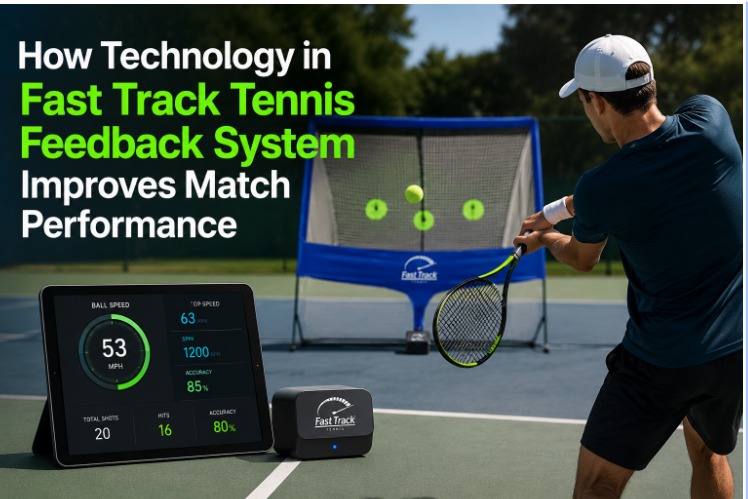
We have all been there. You walk off the tennis court after a frustrating match, scratching your head. Your groundstrokes felt “off,” your timing was a split-second late, and you couldn’t quite pinpoint why your cross-court forehand kept sailing wide.
In the past, correcting these errors meant booking an expensive session with a coach or aimlessly hitting against a traditional tennis rebounder wall. While a wall is great for getting your heart rate up, it has one major flaw: it doesn’t talk back.
It can’t tell you how fast you hit the ball, what your launch angle was, or whether your spin is actually improving. Enter the fast track tennis feedback system. This modern setup completely redefines solo practice by merging physical training with real-time digital analytics.
If you want to transform your messy practice sessions into structured, match-winning performances, changing how you get feedback is the ultimate shortcut.
The Repetition Machine: Upgrading the Classic Feed
To build reliable muscle memory, you need consistency in your practice environment. A standard tennis training ball machine is excellent for covering a full court, but they are often bulky, expensive, and require a dedicated court trip.
The Fast Track Tennis Feedback System scales this experience down into a highly efficient, space-saving format you can use right at home. The automated feeder delivers a live ball every three seconds into a specialised compact net.
Because the net captures and channels the ball directly back into the feeder loop, you can hit hundreds of continuous shots without ever bending down to empty a basket.
This high-frequency loop is exactly how you dial in your footwork and swing mechanics. You aren’t wasting energy chasing stray balls; you are strictly focused on clean contact, body rotation, and finding a rhythmic groove.
Turning Data into On-Court Dominance
What truly elevates this setup above standard tennis practice gear is its smartphone integration. By positioning your phone on the included tripod, the system uses advanced computer vision to track uniquely marked, high-visibility practice balls.
Instead of guessing if your swing is getting faster, the companion app tracks your metrics instantly.
[Your Stroke] ➔ [Computer Vision Tracking] ➔ [Instant App Feedback]
├── Racket Head Speed
├── Target Accuracy
└── Launch Angle
When you see how a minor adjustment to your racket face changes your ball trajectory, your brain maps that connection instantly. This objective data strips away the emotion of a bad hit.
You stop worrying about feeling bad and start focusing on the numbers. When you step onto a real court for a match, that data-backed confidence translates directly into deeper, more aggressive shots and fewer unforced errors.
Final Thoughts
Ultimately, bridging the gap between practice and match-day victory comes down to data. Relying on guesswork will only take your game so far.
By integrating the fast track tennis feedback system into your routine, you replace empty repetitions with precise, actionable insights that directly sharpen your reflexes, accuracy, and confidence.
Ready to elevate your training? For those looking to see the system in action, this Fast Track Tennis Review Video provides an excellent look at how the physical net, ball return feeder, and solo training loop come together in a compact home setup.
FAQs
How does a fast track tennis feedback system differ from a regular tennis rebounder wall?
A rebounder wall just bounces the ball back blindly. A feedback system uses an automated feeder and a smartphone app to measure your shot accuracy, ball speed, and hit consistency actively in real time.
Can I use standard balls with the Fast Track Tennis Feedback System?
The feeder handles standard balls easily for rhythm practice, but to unlock the digital tracking and app feedback, you need to use the system’s specially marked, high-contrast practice balls.
Is this gear portable enough to use indoors?
Yes. The 7×7-foot net and compact feeder can easily be set up in a garage, basement, or driveway, making it ideal for rainy days or late-night practice when courts are closed.
How does this compare to a commercial tennis training ball machine?
Commercial machines are built to sweep the entire length of a real tennis court. This feedback system is a compact, short-range simulator designed for high-repetition stroke refinement in small spaces.
Will practicing at close range translate to full-court match performance?
Absolutely. By isolating your swing mechanics and footwork layout at close range without the distraction of a full court, you build cleaner muscle memory that automatically transfers to real matches.