



Entertainment has always followed technology around like a shadow. The printing press gave us mass-produced stories. Radio put voices in the living room. Television turned families toward a glowing box every evening. Each leap felt enormous at the time, and each one quietly reshaped how people spent their free hours. The smartphone belongs in that same lineage, except its reach might be the widest of them all.
What sits in your pocket right now is a cinema, a record store, a stadium, an arcade, and a social club at once. That combination didn’t exist twenty years ago in any form. And the way it has blurred the lines between watching, listening, playing, and talking has changed not just where we find entertainment, but what we expect entertainment to feel like.
When Every Screen Collapsed Into One
Not long ago, different types of entertainment lived on different devices. Films belonged to the television. Games needed a console or a decent computer. Music came from a stereo, then an iPod, then something else. Each experience had its own hardware and its own ritual.
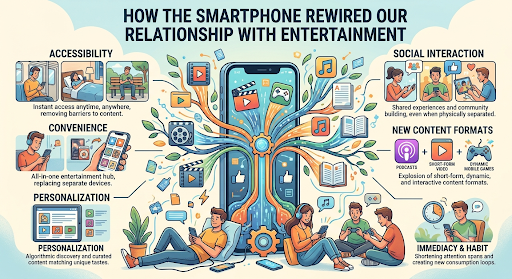
The phone erased those boundaries almost overnight. Now a single device carries all of it, and people move between forms without thinking twice. Someone might watch ten minutes of a show, switch to a quick game, answer a few messages, then queue up a playlist, all within the same half hour on the same screen.
This blending has consequences most of us never stop to consider. When everything competes for attention on one device, patience gets shorter, and expectations climb. A slow load or a clumsy interface no longer reads as a minor annoyance. It reads as a reason to leave.
For anyone building digital products, that pressure is relentless. You’re not just competing with rival platforms in your own category. You’re competing with every other thing a person could tap instead.
The Shift From Watching to Doing
Traditional media asked very little of its audience. You sat, you watched, you absorbed. The relationship ran in one direction, and that was fine for decades.
Interactive entertainment broke that pattern. It invites people to make choices, take risks, compete, and shape the outcome themselves. That participation changes the emotional stakes entirely. A film can move you, but a game that responds to your decisions pulls you in a different way, because part of the story becomes yours.
Younger audiences especially gravitate toward experiences where they hold some control. They want to influence what happens rather than sit back and receive it. This appetite for agency explains a lot about why interactive formats keep gaining ground while some passive formats struggle to hold attention.
The genius of mobile is that it made this participation effortless. You don’t need to set anything up. You reach into your pocket, tap once, and you’re already inside the experience.
The Machinery That Makes It Feel Easy
None of this convenience happens by accident. A tremendous amount of engineering goes into making a phone feel instant, and most of it stays invisible to the person holding the device.
Mobile processors have grown powerful enough to handle graphics that would have needed a dedicated machine a decade ago. Cloud infrastructure lets platforms absorb sudden surges of users without buckling. High-speed networks shrink the wait between wanting something and having it. And HTML5 technology lets games run smoothly across wildly different devices without asking anyone to download anything extra.
As platforms sharpened their focus on mobile, entire categories reshaped themselves to fit smaller screens and shorter attention spans. Interactive formats such as slot online rebuilt their interfaces around speed, clean navigation, and sessions that suit a quick break rather than a long sit-down.
What’s telling is where developers now spend their energy. The obsession has shifted away from raw visual spectacle toward usability. A platform that looks stunning but frustrates the user tends to lose to one that feels effortless, even if the second is plainer. People remember how something felt to use far longer than they remember how it looked.
Community Became Half the Experience
Here’s something that would have puzzled an entertainment executive from the 1990s. For many people today, talking about the content is nearly as enjoyable as consuming it.
Online communities have turned solitary activities into shared ones. Forums, group chats, video creators, and social feeds all shape how people discover, judge, and stick with digital experiences. A recommendation from someone you trust carries more weight than any advertisement, and word travels through these networks at a speed marketers can only envy.
Consider how this plays out in practice:
- Creators stream themselves playing, and their audiences follow the games they showcase
- Forums become living archives of strategies, tips, and shared history
- Social feeds turn a memorable moment into something thousands of strangers experience secondhand
- Group chats keep friends coming back to the same platforms just to stay in the conversation
For the businesses behind these products, an engaged community can matter as much as the product itself. Communities build loyalty, surface honest feedback, and keep a name alive in daily conversation long after the initial buzz fades. They also protect against a hard truth of digital life, which is that attention is fickle and moves on quickly unless something keeps pulling it back.
Old Ideas That Refuse to Die
For all the talk of innovation, a surprising amount of what makes modern entertainment work is ancient.
Competition, progression, reward, mastery. These ideas are older than any screen. They powered board games, card games, and playground contests long before anyone dreamed of a smartphone. What changes is the packaging, not the core.
Smart developers understand this instinctively. They don’t try to reinvent human psychology. They take the mechanics that have always hooked people and dress them in modern technology. The satisfaction of leveling up, the tension of a close contest, the small thrill of an unexpected reward, all of it draws on instincts that have been with us forever.
This is why interactive experiences appeal across generations. A grandparent and a teenager might play completely different things, but the underlying pull is the same. Recognizing this lets designers build for a broad audience without chasing every passing fad.
Familiar Comfort in a Fast-Moving World
There’s also comfort in the familiar. When technology moves this fast, recognizable structures give people something steady to hold onto. A new interface can feel intimidating, but a familiar goal- beat the level, top the leaderboard, unlock the next thing- feels welcoming. That balance between novelty and familiarity is one of the quieter reasons digital entertainment keeps expanding rather than fragmenting.
How the Business Changed Shape
The money side of entertainment has transformed just as dramatically as the experiences themselves.
The old model was a single transaction. You bought a game, a film, an album, and the relationship ended at the register. Mobile turned that logic inside out. Now the dominant approach centers on free or cheap entry, with revenue arriving later through in-app purchases, subscriptions, cosmetic extras, or premium tiers.
This forces a different mindset on operators. Instead of chasing one sale, they have to keep people engaged over months and years. That only works when the experience genuinely delivers, because nobody stays out of obligation. If a product bores or frustrates them, they’re gone, and the exit is never more than a swipe away.
The upshot is an industry that must earn attention again and again rather than buy it once and relax. It’s a demanding model, but it tends to reward quality, since the platforms that survive are usually the ones people actually want to return to.
Where This All Points Next
Guessing the future of technology is a reliable way to embarrass yourself later, but a few currents feel strong enough to name.
Artificial intelligence will keep making experiences more responsive and more personal, tuning itself to how each individual behaves. Cloud computing will let modest phones run things that once demanded serious hardware. Augmented reality, still finding its footing, could eventually fold digital layers into the physical world in ways we’re only starting to imagine.
Audiences will grow pickier too. As choice expands, tolerance for mediocrity shrinks. People increasingly favor platforms that combine sharp design, dependable performance, and a community worth belonging to. The middle of the pack gets squeezed, while the best and the most distinctive pull ahead.
Regional habits will shape global design more than they used to. Across many markets, mobile is the first and only computer people own, and their preferences ripple outward. Formats built around quick, mobile-friendly play, including slot gacor communities that thrive on short sessions and constant social buzz, show how accessibility and community can push participation far beyond what older models ever reached.
Final Thoughts
The smartphone didn’t just move entertainment onto a new device. It changed the whole relationship. Watching became doing. Consuming became participating. Solitary pastimes became social ones. And a thousand separate experiences collapsed into a single rectangle we carry everywhere.
That’s a bigger shift than it first appears. We now expect entertainment to be instant, interactive, and connected to other people, and those expectations aren’t going anywhere. As phones continue to sit at the center of how we work, shop, talk, and unwind, they’ll keep defining how we play as well. The culture that has grown up around mobile entertainment isn’t a passing phase. It’s the new normal, and it’s still only getting started.