



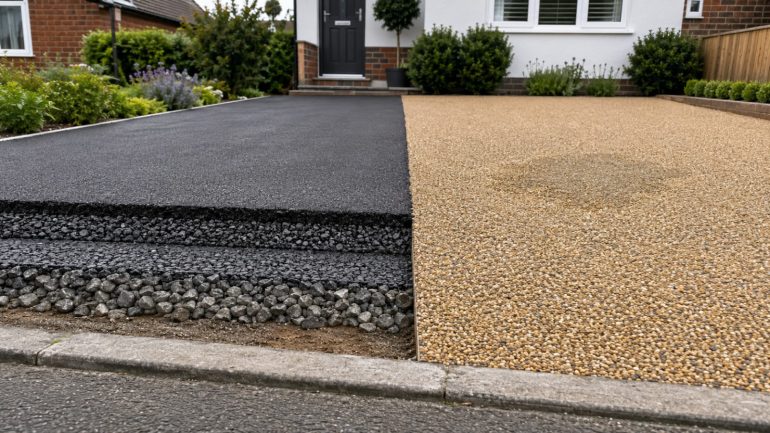
Choosing the wrong tarmac driveway thickness can leave a new surface vulnerable to sinking, cracking, and edge failure. The problem often begins when a quotation states only the loose-laying depth, without confirming the final compacted depth or separating the binder and surface courses.
Resin-bound owners face a different uncertainty: whether fading, blocked drainage or loose stones mean the driveway needs resealing. The correct answer depends on the cause, not a fixed maintenance calendar. Here is how to specify the tarmac layers correctly, recognise genuine resin deterioration and avoid paying for a coating that will not solve the underlying problem.
Tarmac Driveway Thickness: Layer Breakdown
Tarmac driveway thickness must be assessed as a complete construction rather than one measurement. A domestic driveway normally combines stable ground, compacted aggregate, a structural binder course and a finer surface course, with every depth measured after compaction.
Tarmac Driveway Layer Depths
| Driveway component | Typical compacted depth | Main purpose |
| Prepared subgrade | Site-dependent | Supports the complete driveway |
| MOT Type 1 sub-base | Approximately 100–150mm | Spreads vehicle loads and provides stability |
| Asphalt binder course | Approximately 40–50mm | Provides structural asphalt strength |
| Asphalt surface course | Approximately 20–30mm | Creates the finished driving surface |
| Combined asphalt layers | Approximately 60–80mm | Supports normal domestic vehicle use |
These figures provide a practical starting point, not a universal specification. Weak ground, frequent van traffic, motorhomes, skips or regular heavy deliveries may require a site-specific design with a deeper sub-base or thicker asphalt construction.
A typical domestic build may use a 50mm compacted binder course and a 25mm compacted surface course. This produces approximately 75mm of asphalt over a properly prepared sub-base, which is considerably more meaningful than a quotation that simply promises “three inches of tarmac.”
Homeowners comparing estimates should ask each contractor to state the depth of tarmac for driveway construction after rolling. Without the word compacted, two quotations showing the same nominal depth may provide substantially different quantities of finished material.
Tarmac Compacted Depth Versus Loose Depth
Hot asphalt is laid thicker than its final measurement because rolling reduces its depth and removes excessive air voids. If a contractor quotes 75mm of loose material, the completed layer will be thinner after compaction, so the contract must identify which measurement is being promised.
This distinction causes genuine disputes between customers and installers. A homeowner may believe that “75mm of asphalt” means 75mm in the completed driveway, while the contractor may mean the loose depth before the roller passes over it.
The safest wording is “minimum finished compacted thickness.” The quotation should apply that wording separately to the binder course, surface course and aggregate sub-base instead of presenting one combined excavation figure.
Tarmac Binder and Surface Courses
The binder course contains larger aggregate and forms the main structural asphalt layer. It distributes vehicle loads into the sub-base and provides a stable platform for the smaller, denser aggregate used in the finished surface.
The surface course provides the appearance, texture and weather-resistant finish that vehicles contact. A thin surface layer cannot replace a missing binder course where the driveway construction requires two asphalt layers.
Some small or lightly used areas may be designed with a single suitable asphalt mixture. However, a two-course construction normally makes the specification easier to control and allows the structural and finishing layers to perform their separate functions.
Tarmac Thickness for Heavy Vehicles
A driveway used only by family cars has different loading requirements from one carrying work vans, motorhomes or delivery vehicles. Vehicle weight, turning movements, parking duration and frequency all influence the required tarmac driveway thickness.
Heavy vehicles can expose weak areas around entrances, turning points and parking bays. Static loads may cause depressions where the asphalt structure or underlying base was not designed for prolonged loading.
Owners should describe the heaviest expected vehicle before accepting a specification. Increasing only the surface-course depth may not solve the problem if the subgrade is soft or the aggregate sub-base is too shallow.
Resin Resealing: Maintenance or Repair?
Resin resealing should begin with a proper surface diagnosis. A genuine resin-bound driveway does not automatically need resealing every few years, and applying an unsuitable coating may obstruct its pores without correcting cracks, loose aggregate or base movement.
Resin Resealing Decision Table
| Surface condition | Likely issue | Appropriate response |
| Light dirt or leaf debris | Routine contamination | Sweep and wash carefully |
| Moss or algae in shaded areas | Organic growth | Use a compatible treatment and gentle cleaning |
| Dull but structurally sound finish | Normal wear or UV exposure | Consider an approved rejuvenator |
| Minor isolated aggregate loss | Local wear or surface damage | Arrange an installer inspection |
| Widespread loose stones | Mix, depth or binder failure | Diagnose before applying any coating |
| Standing water | Blocked pores, incorrect base or poor levels | Restore drainage before considering treatment |
| Widening or moving cracks | Base movement or reflective cracking | Repair the underlying defect |
| Yellow or uneven colour | Non-UV-stable resin or contamination | Obtain product-specific advice |
A sound resin-bound surface primarily needs sweeping, stain removal and controlled washing. Leaves and fine sediment should not be allowed to accumulate because they can encourage moss growth and gradually obstruct the open spaces between the aggregates.
Resealing should not be used as a generic response to every visual change. Cleaning may restore a dirty surface, while cracks, delamination and widespread stone loss normally require repair or replacement rather than a cosmetic coating.
Resin-Bound Versus Resin-Bonded Surfaces
A resin-bound driveway is made by mixing dried aggregate with resin before the material is spread and trowelled. Each stone is coated, and small interconnected spaces allow water to pass through when the complete construction is designed to be permeable.
A resin-bonded surface is produced by applying resin to a base and scattering aggregate over it. The resulting finish resembles loose gravel but is generally not permeable in the same way as a correctly installed resin-bound system.
This difference matters when discussing resealing. A coating suitable for one system may be inappropriate for another, so the original product, base and installation method should be identified before maintenance begins.
Resin Fading and Loss of Gloss
A resin-bound driveway may gradually lose some of its original shine without suffering structural failure. Dirt, traffic, sunlight and natural weathering can change its appearance while the aggregate remains firmly held and the surface continues to drain.
Cleaning should be the first step because embedded dirt can make the surface appear faded. If the cleaned driveway remains sound but looks tired, a compatible UV-stable rejuvenation product may improve its finish.
Owners planning to reseal resin driveway surfaces should confirm that the proposed product is approved for their system. The treatment must not create an impermeable film over a surface intended to remain porous.
Resin Loose Stones and Surface Wear
A few loose stones at an exposed edge do not necessarily mean the complete driveway has failed. Local damage may result from an unsupported boundary, impact, aggressive pressure washing or concentrated vehicle turning.
Widespread aggregate loss is more serious. Possible causes include insufficient resin, an incorrect aggregate-to-resin ratio, contamination during installation, inadequate mixing, laying in unsuitable weather or applying the surface too thinly.
A topcoat may temporarily hold lightly worn aggregate, but it cannot rebuild a seriously defective layer. The installer should determine whether local repair, a compatible overlay or complete resurfacing is required.
Resin Permeability and Standing Water
Standing water on a resin-bound driveway is not automatic evidence that resealing is required. The pores may be blocked by fine sediment, or the resin may have been installed over an impermeable base without suitable drainage.
Gentle cleaning may restore permeability when surface contamination is responsible. Excessive pressure, a narrow jet nozzle or holding the lance too close can dislodge stones and turn a maintenance task into surface damage.
If cleaning does not restore drainage, the levels and base construction need inspection. Applying another coating before finding the cause could make the ponding worse by closing more of the surface voids.
Tarmac and Resin Design: Preventing Failure
Correct tarmac driveway thickness and responsible resin maintenance both depend on what lies beneath the visible finish. Drainage, edge support, expected traffic and installation quality frequently determine performance more than appearance alone.
Driveway Failure Factors and Solutions
| Real failure factor | Tarmac response | Resin-bound response |
| Weak or moving ground | Excavate and stabilise the subgrade | Install a stable, compatible base |
| Inadequate sub-base | Increase and compact the aggregate depth | Correct the base before applying resin |
| Poor edge support | Add kerbs, blocks or compacted shoulders | Install secure perimeter edging |
| Standing water | Correct the fall and drainage outlet | Clear pores and inspect the underlying drainage |
| Heavy turning traffic | Use suitable asphalt and structural depth | Use the correct resin system and laying depth |
| Unclear quotation | Specify each compacted layer | Specify system, mix ratio, depth and base |
| Existing cracks | Repair before resurfacing | Treat cracks and movement before overlaying |
Tarmac Drainage and Edge Support
Tarmac is flexible, but an unsupported edge can spread under vehicle weight and begin to crumble. Kerbs, block edging, concrete haunching or a properly compacted shoulder help retain the asphalt and protect the most vulnerable part of the driveway.
The surface must also direct rainwater towards an approved drainage point or permeable area. A fall of around 1:80 is often treated as a practical minimum, although a steeper gradient may drain more reliably where the site allows it.
Poor drainage can weaken the supporting layers and create edge erosion, depressions or surface deterioration. Adding extra asphalt over trapped water or unstable material delays the problem rather than resolving it.
Tarmac Compaction and Layer Control
Compaction must suit the asphalt mixture, aggregate size, layer depth, temperature and equipment available. Material that is too cold, too thin or excessively thick for the chosen roller may not achieve a consistent finished density.
Thicker constructions may need to be installed in separate lifts. This allows each layer to be levelled and compacted correctly before the next course is placed.
Customers do not need to operate testing equipment, but they should retain a written specification and photograph the exposed layers. Measurements taken before each course is covered provide better evidence than trying to determine the complete construction after completion.
Resin Installation Depth and Base Stability
A resin-bound driveway used by vehicles is commonly installed at approximately 18mm, subject to the manufacturer’s complete system specification. Footpaths may use a thinner application, but a pedestrian depth should not automatically be transferred to vehicle areas.
The resin finish is only as stable as its supporting base. Soil, loose gravel and moving block paving are unsuitable direct bases because movement underneath can cause cracking or delamination above.
Existing concrete or asphalt must be inspected before an overlay is approved. Cracks, movement, contamination and failed areas should be repaired, while expansion joints may need to continue through the new surface.
Choosing the Correct Maintenance Response
A maintenance contractor should first identify whether the problem is cosmetic, environmental or structural. Dirt and algae require cleaning, fading may justify rejuvenation, and loose stones or cracks require investigation.
Ask which product will be applied, whether it is compatible with the original resin system and how permeability will be protected. Generic concrete or block-paving sealers should not be assumed suitable for resin-bound aggregate.
The most reliable decision is based on the actual defect rather than the age of the driveway. A sound ten-year-old surface may only need cleaning, while a recently installed surface with widespread aggregate loss may already require corrective work.
Tarmac Thickness and Resin Resealing FAQs
Does a Quote Show Compacted Tarmac Thickness?
A quotation should explicitly use the words finished compacted tarmac driveway thickness. If it only states that a certain depth will be “laid,” ask whether that figure applies before or after rolling. Require separate measurements for the sub-base, binder and surface course so the completed construction can be checked against the agreement.
Can Tarmac Thickness Be Checked After Completion?
Finished tarmac driveway thickness can be confirmed accurately by taking a core sample, but coring leaves a hole that must be repaired and is rarely needed for an ordinary project. A better approach is to document the exposed layers during construction using measurements and photographs before the next course covers them.
Can New Tarmac Cover an Existing Driveway?
An overlay may be possible when the existing driveway is stable, correctly drained and free from serious movement. The proposed tarmac driveway thickness must still work with thresholds, kerbs, garage entrances and drainage levels. Covering cracks, depressions or a failed base can allow the same defects to return through the new surface.
Does Weather Affect Tarmac Compacted Thickness?
Cold, wind and rain can reduce the working time available to place and compact hot asphalt. Although the specified tarmac driveway thickness does not change simply because the weather is cooler, poor temperature control may prevent the mixture from reaching consistent density. Installation should follow the asphalt supplier’s temperature and weather requirements.
Can One Resin Area Be Resealed Separately?
A small resin resealing treatment may create a visible difference in colour or gloss between the repaired section and the surrounding driveway. Spot treatment can still be suitable for a defined panel or isolated repair, but the contractor should test compatibility and appearance before applying a rejuvenator to a prominent area.
Does Resin Resealing Affect the Warranty?
Resin resealing with an unapproved product may affect an installer or manufacturer warranty, particularly if the coating changes permeability or reacts with the original binder. Check the warranty terms and identify the installed resin system first. Obtain written approval for the proposed cleaning chemical, repair resin or rejuvenation coating before work begins.
Should Resin Be Resealed Before Selling a Home?
Resin resealing should not be treated as an automatic pre-sale improvement. Start with cleaning and repair any genuine safety or drainage defects. If the resin-bound surface is structurally sound but noticeably dull, an approved rejuvenator may improve presentation, but coating a failing surface could conceal problems without providing a durable correction.
Final Tarmac and Resin Decision
The correct tarmac driveway thickness is normally defined by its finished layers, not a single loose measurement. Approximately 100–150mm of compacted sub-base, 40–50mm of binder and 20–30mm of surface course provide a useful domestic reference, but the final design must reflect the ground and expected traffic.
Resin-bound driveways follow a different maintenance logic. They do not automatically need resealing on a fixed schedule, and standing water, cracking or widespread stone loss should be diagnosed before any coating is applied.
For both surfaces, the best protection is a clear written specification. Confirm compacted depths, base preparation, drainage, edging, materials and the correct response to future wear before installation begins.
Links Inserted
| Anchor text | Destination URL | Section |
| depth of tarmac for driveway | https://totalsurfacingsolutions.co.uk/how-thick-is-a-tarmac-driveway/ | Tarmac Compacted Depth Versus Loose Depth |
| reseal resin driveway | https://totalsurfacingsolutions.co.uk/how-to-seal-a-resin-driveway/ | Resin Fading and Loss of Gloss |
SEO Metadata
Control: Keyword-First
SEO title: Tarmac Driveway Thickness and Resin Resealing Guide
Meta description: Tarmac driveway thickness explained with compacted layer depths, base requirements and clear signs that resin needs maintenance. Read the full guide today.
Alternate 1: Specificity
SEO title: Tarmac Driveway Thickness: 4 Layers Explained
Meta description: Tarmac driveway thickness covers more than the surface. Compare four key layers and learn when resin needs cleaning, repair or resealing. Read now.
Alternate 2: Practical Outcome
SEO title: Tarmac Driveway Thickness: Avoid Surface Failure
Meta description: Tarmac driveway thickness affects cracking, sinking and wear. Check the correct compacted depths and when resin resealing is appropriate. Learn more today.
Image Prompts and Alt Tags
Feature Image
Prompt: Photorealistic cutaway of a British residential tarmac driveway showing compacted sub-base, binder course and smooth surface layer beside a resin-bound section, no people, logos or text, natural daylight, 16:9.
Alt tag: Tarmac driveway thickness layers beside resin-bound surfacing
Tarmac Layer Infographic
Prompt: Clean technical infographic showing a driveway cross-section with four visually distinct layers and proportional depths, aggregate texture, asphalt binder and wearing surface, neutral background, no logos or decorative text.
Alt tag: Tarmac driveway thickness and compacted layer breakdown
Compaction Problem
Prompt: Close-up construction scene showing partially rolled asphalt beside a depth gauge and compacted stone base, clear difference between loose and finished material, no workers, branding or readable text.
Alt tag: Loose and compacted tarmac driveway thickness comparison
Resin Drainage Problem
Prompt: Split-view resin-bound driveway showing clear drainage on one side and standing water over sediment-blocked pores on the other, realistic aggregate detail, no people, logos or text.
Alt tag: Blocked resin driveway permeability before resealing
Resin Surface Inspection
Prompt: Detailed resin-bound driveway surface with one sound area, one faded patch and one small section of loose aggregate, inspection-focused composition, natural UK exterior setting, no people or text.
Alt tag: Resin driveway signs requiring cleaning repair or resealing