



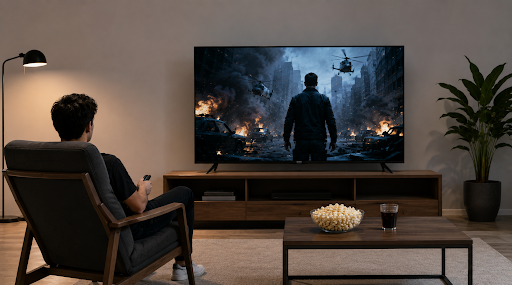
You may have experienced it before! You’ve cleared your Saturday, queued up the whole John Wick trilogy or every Mission Impossible film, and you are ready to disappear for six hours. But here is the thing most people get wrong. The movies aren’t the hard part. What separates a decent movie night from one you are still talking about a week later is everything happening around the screen. Below is what actually matters if you want to spend your movie pack night the right way.
The Screen Sets the Tone for Everything Else
Action movies are built on visuals including quick cuts, huge set pieces, camera work that moves fast and doesn’t apologize for it. A laptop balanced on a coffee table just isn’t going to do it justice. If you are going the TV route, look for good contrast and solid motion handling, cheaper screens tend to blur or smear during fast scenes, and once you notice it, you can’t unsee it. If you have got the space for a projector and pull-down screen, it’s worth the extra effort. It genuinely changes how a room feels, especially with friends over.
Where you put the screen matters almost as much as the screen itself. Aim for eye level when you are seated, and cut as much glare as you can. Blackout curtains might be the cheapest upgrade on this whole list, and they punch above their price.
Sound Is Where Most People Cheap Out
Most people forget that action films aren’t really selling dialogue. They are selling impact. Explosions, gunfire, that low rumble under a car chase, none of it lands through flat TV speakers. Even a modest 5.1 setup or a decent soundbar with a real subwoofer will make you feel like you upgraded to a different movie.
If you are stacking multiple films back to back, look for a system with a night mode or some kind of dynamic range control. Otherwise you’ll spend half the marathon reaching for the remote every time a scene gets loud.
Lighting and Snacks, Because Nobody Talks About This Enough
A dark room helps, but pitch black isn’t the goal, your eyes get tired faster with zero ambient light. A cheap LED strip behind the TV gives you just enough glow to take the edge off without washing out the picture.
And don’t make people get up every twenty minutes. Set up a table or a rolling cart near the seating with popcorn, drinks, whatever your group likes. It sounds minor until you’re pausing during the best fight scene of the movie to grab a soda.
Comfort Wins Marathons
This is the part people skip, and it always catches up with them by hour three. A couch is fine for one movie. Somewhere around the second or third film in a trilogy, your back starts sending complaints. It’s not that the couch is bad. It’s just not built for that many consecutive hours.
That’s why more home theater setups are moving toward proper seating instead of a sofa that was never built for five straight hours of sitting. HBADA ergonomic office chairs come up a lot in these conversations for good reason; lumbar support, adjustable height, breathable material, the stuff that matters once you’re past hour two. Add a small side table for drinks and the remote, and you have basically built a command center.
The Small Stuff That Quietly Ruins Everything
A universal remote so you are not juggling three of them. A surge protector, because long sessions and cheap power strips don’t mix well. A streaming box that doesn’t lag between films, nothing kills momentum faster than a thirty-second buffering wheel right after a cliffhanger ending.
None of this is glamorous. But it either disappears into the background or becomes the thing you’re fighting with all night. If your setup includes a shared media room, or a space where more than one or two people will be parked for hours, it’s worth looking beyond a single chair. HBADA’s broader lineup of ergonomic office chairs has enough range that you can usually find something that fits, compact for a tighter den, or closer to recliner-sized if you’ve got the room for it.
Final Thoughts
None of this requires a huge budget or a dedicated home theater room. What it requires is paying attention to the parts people usually ignore; the screen, the sound, the lighting, and yes, what you’re actually sitting on for five hours straight. Nail those, and your next marathon stops being something you sat through and starts being something you actually remember.