



As a people manager, sometimes you have no choice but to place some of your employees on performance improvement plans (PIPs). Assuming you have given your new hires structured, detailed onboarding with lots of training, they are still not meeting expectations even after several months. In situations like this, you would probably want to start drafting a PIP.
However, building a performance improvement plan can be challenging for managers, especially new ones. Sometimes, drafting a PIP can feel pointless to most managers because they don’t know what to assign them.
Also, most performance improvement plans fail because the plan itself is unworkable and not because the employee can’t improve. A well-built PIP gives managers a clear roadmap, protects the organisation legally, and gives employees a genuine opportunity to succeed. Modern HR platforms like the HR Docket guide you through exactly how to create a performance improvement plan with clear gaps, measurable goals, support commitments, timelines, and review criteria.
What is a Performance Improvement Plan (PIP)?
A Performance Improvement Plan is a formal, written document that clearly outlines performance concerns and the specific actions an employee must take to meet established expectations. It typically outlines a set timeline (usually 30 to 90 days), required resources, and regular check-ins to track progress.
A PIP is often co-developed by the employee, their manager, and human resources outlining how a performance issue is going to be resolved. They come with significant emotional weight and risk for both managers and employees. As soon as a PIP is mentioned, most employees fear being disciplined or even let go, while some managers worry about potential conflict as they put their expectations on the table.
The goal of a PIP is to give the employee a fair chance to improve while allowing their manager to document performance issues and next steps, and not to make employees feel like they’re on thin ice. PIP is meant to identify a gap between an employee’s performance and what’s expected of them while giving them a path to follow to close that gap.
When should you use a PIP?
There are many ways to resolve performance issues apart from using a performance improvement plan. Some of the continuous feedback, formal performance discussions, and surveys. So, when should you use a PIP?
A PIP is often the last option used by most organisations after trying to address their performance issues using other means. In some cases, organisations also start a replacement search while the employee is placed on PIP.
What Makes a PIP “Workable” for Managers?
Effective HR document management starts with recognising that a PIP is a tool for managers, not just a formality for HR files. It is important for managers to understand what they actually need from a PIP.
Managers need to know exactly what they are measuring and when. A good PIP leaves room for judgment, not just checkbox compliance. For a PIP to achieve its purpose, it must have a realistic timeline. Setting up goals for 30 days that would take 90 to achieve set everyone up for failure.
Core Components of an Effective PIP
- Employee and manager information
A PIP must contain basic details about the employee and the manager, dates, and context for the plan.
- Clear description of the performance gap
A workable PIP names the specific behaviours, outputs, or results that are below standard. It gives the employee something concrete to work towards. It also provides the manager with a concrete measurement, eliminating subjectivity and the possibility of future disputes.
- SMART goals with defined metrics
Every goal in a PIP should be specific, measurable, achievable, relevant, and time-bound (SMART). Vague goals produce vague outcomes and give employees legitimate grounds to dispute their evaluation.
- Realistic timeline
PIP timelines vary. The common ones include 30, 60, and 90 days. The right length depends on the nature of the performance gap. A 30-day PIP is appropriate for clear, measurable deficiencies where the employee has the skills but needs to apply them consistently.
60–90 days is more appropriate for skill-based gaps, where the employee needs time to learn, practise, and demonstrate improvement. If the expected behaviour change realistically requires 90 days and the PIP only gives 30, the manager will either extend it (undermining the document) or terminate it based on an unfair standard.
- Support and resources
The plan should document what resources the organisation is providing to help the employee succeed. These may include additional training or coaching, increased check-in frequency with the manager, access to tools, materials, or mentorship, and any accommodations that have been considered or offered.
This practice demonstrates a good-faith effort and makes it much harder for a former employee to claim they were set up to fail. It also protects the company from legal actions.
- Consequences stated clearly
The employee should understand what happens if they do not meet the goals of the PIP by the end of the review period. Typically, this means termination of employment, but it could also include demotion, role change, or transfer depending on the organisation’s policies.
- Signatures and acknowledgement
The PIP should be signed by the employee, the manager, and typically, an HR representative. The employee’s signature may not mean they agree with the PIP. It signifies they have received and reviewed it. Including a line to that effect on the signature block prevents later disputes.
Common Mistakes That Make PIPs Unworkable
Performance Improvement Plans often have a bad reputation because they are not used the right way. These are some of the common mistakes that make PIPs unworkable:
- Setting unmeasurable goals.
- Writing the PIP as a termination prelude
- Leaving managers without support
- Making the PIP too long or overwhelming
- Ignoring positive progress or moving goalposts
How to Build a Manager-Friendly PIP
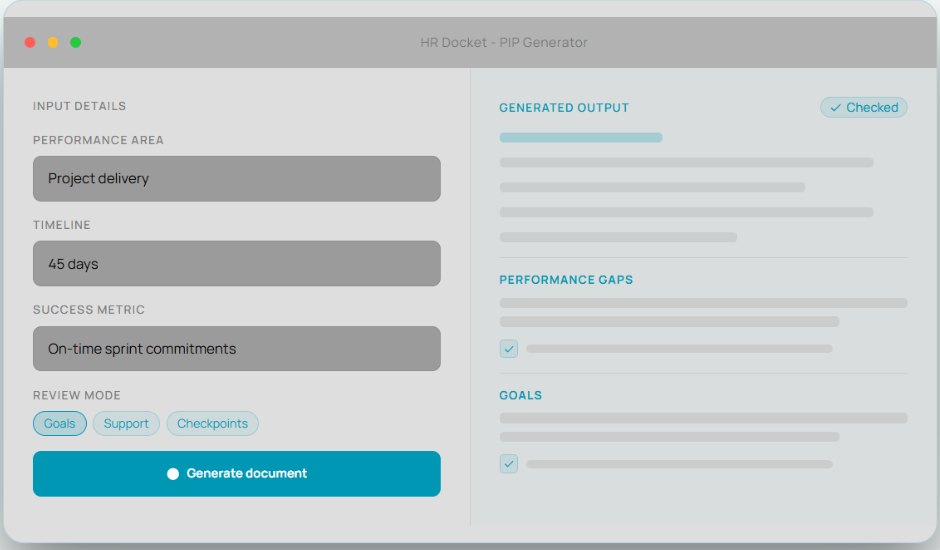
Building a compliant, well-structured PIP from scratch is time-consuming. The HR Docket Performance Improvement Plan Generator is designed to help HR professionals and managers create customised, legally sound PIPs quickly without sacrificing the specificity that makes them effective. The platform guides users through each component and produces a document that managers can actually use.
Having the right tools in place means less time on paperwork and more time on the conversations that actually drive performance. With HR Docket, you just need to enter your essentials and generate your PIP. You can check for missing fields and keep the output aligned to your workspace defaults. You can refine the document and export your signature-ready file in Word or PDF form.
The platform is designed for HR teams who care about quality, compliance, consistency and speed. The PIP generator has many features, including guided AI drafting, risk-aware review, employee-linked records and many others.
What are possible outcomes after a PIP concludes?
At the end of the PIP period, there are three realistic outcomes:
- The employee meets all goals: The aim of a well-crafted Performance Improvement Plan is to ensure that the employee improves their performance. When the employee meets all goals, the PIP is successfully completed. It also determines whether any ongoing monitoring or support is appropriate.
- The employee shows partial improvement: In case of a partial improvement, HR and the manager need to assess whether the remaining gaps are significant, whether an extension is warranted, and what the path forward looks like.
- The employee does not meet the goals: If the employee fails to meet goals, they are either demoted or terminated. With a well-documented PIP, the path to termination is clear and legally defensible. The documentation from the PIP period, such as check-in notes, progress records, and the signed PIP itself, provides the paper trail needed to proceed with confidence.
Build a structured PIP and make your expectations measurable.
HR Docket’s Performance Improvement Plan Generator helps create a structured, legally sound PIP without starting from scratch. The platform also provides broader HR document management needs and easy access that helps you build a stronger performance process across your organisation.