



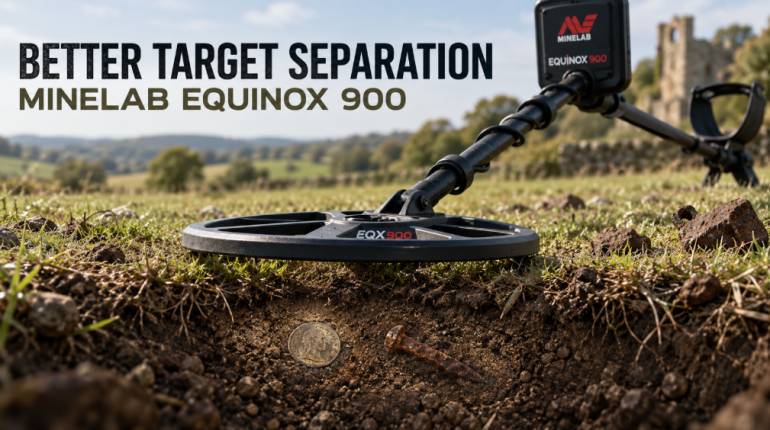
Target separation can make a major difference when hunting in parks, old properties, fields, and other areas where multiple objects are buried close together. A detector may identify a clean target easily, but separating a coin from nearby iron or trash requires the right combination of settings, coil control, and technique.
The Minelab Equinox 900 gives detectorists several adjustments for adapting to different hunting conditions. However, there isn’t one setting that automatically provides perfect target separation. The best results usually come from balancing recovery speed, sensitivity, coil selection, and sweep technique.
What Is Target Separation?
Target separation refers to a detector’s ability to respond to individual targets that are located close together.
For example, imagine a coin buried only a short distance from an iron nail. Their electromagnetic responses can overlap, making it difficult to identify the coin. This is commonly associated with target masking.
The challenge becomes more noticeable in locations containing:
- Iron debris
- Bottle caps
- Pull tabs
- Aluminum trash
- Multiple coins
- Old construction debris
Target separation is therefore an important feature to understand when comparing different metal detecting machines.
Choose the Right Search Coil
Coil selection can have a significant impact on how well you separate nearby targets.
A larger coil can cover more ground and may provide advantages in relatively clean areas. However, its larger detection footprint can make closely spaced targets more difficult to isolate.
A smaller coil can be useful when hunting:
- Iron-heavy sites
- Old house sites
- Trashy parks
- Areas around foundations
- Narrow spaces
Its smaller detection footprint can make it easier to work between nearby targets.
The goal isn’t always to use the largest coil available. Choose the coil according to the site and the type of targets you expect to encounter.
Adjust Recovery Speed
Recovery speed is one of the most important settings to understand when working in heavy trash.
A faster recovery speed allows the detector to respond more quickly as the coil passes over multiple nearby targets. This can make it easier to distinguish separate objects when several targets are close together.
For example, if a coin and nail are buried close to each other, a faster recovery response may help you hear more distinct responses as you sweep across them.
However, there is a trade-off.
Using a very fast recovery speed can affect the detector’s response to deeper targets. In relatively clean ground, a slower setting may provide advantages when depth is more important than separation.
The best approach is to adjust recovery speed according to the amount of trash you’re dealing with.
Control Your Sweep Speed
Detectorists sometimes focus heavily on settings and overlook one of the simplest factors: sweep speed.
When hunting a heavily contaminated site, slow and controlled sweeps can make it easier to understand what the detector is telling you.
Instead of quickly swinging the coil across the ground, try shorter and more deliberate movements.
Pay attention to:
- Changes in audio tone
- Short target responses
- Inconsistent target IDs
- Responses that disappear from certain angles
- Signals that appear between obvious iron targets
Slowing down gives you more opportunities to investigate subtle responses.
Keep the Coil Close to the Ground
Maintaining consistent coil height is another simple way to improve performance.
The search coil should normally remain close to the ground while maintaining a controlled sweep. Raising the coil significantly at the end of each swing can reduce the detector’s ability to respond consistently to deeper or weaker targets.
Keeping the coil relatively level with the ground also helps maintain a predictable detection pattern.
Small improvements in coil control can become especially noticeable when working through areas with closely spaced targets.
Adjust Sensitivity for Stability
Higher sensitivity isn’t automatically better for target separation.
Sensitivity controls how responsive the detector is to targets and surrounding electromagnetic conditions. Increasing it too far can introduce excessive noise, particularly in difficult ground or areas with electromagnetic interference.
A noisy detector can make subtle target responses harder to interpret.
Instead, look for the highest sensitivity level that still allows the detector to operate reliably in your environment.
If reducing sensitivity makes the audio cleaner and helps you distinguish individual responses, the lower setting may actually produce better practical results.
Understand Iron Bias
Iron Bias can influence how the detector handles responses associated with iron.
This setting becomes particularly relevant when hunting old sites where desirable targets may be located close to rusty nails and other iron objects.
A detectorist should avoid assuming that one Iron Bias setting is ideal for every location. The appropriate adjustment depends on the ground, amount of iron, target type, and how you want to balance iron rejection with the investigation of questionable signals.
If a site contains valuable targets mixed heavily with iron, spend some time testing different settings before committing to one approach.
Don’t Overuse Discrimination
Discrimination can be useful for reducing unwanted target responses, but excessive discrimination can also make certain questionable signals easier to overlook.
This matters when searching locations where good targets may be partially masked by trash.
Instead of immediately rejecting every broken or unusual response, consider investigating signals that show some repeatability.
A questionable signal can sometimes become more understandable when you:
- Sweep over it slowly.
- Change your sweep direction.
- Reduce your discrimination.
- Check the target from a different angle.
- Listen carefully to the audio response.
This approach can help reveal targets that aren’t producing a perfect signal.
Sweep From Multiple Directions
One of the simplest ways to investigate a difficult target is to approach it from another direction.
A target’s response can change depending on its orientation and the position of nearby objects.
If a signal appears questionable from one direction, rotate around the target and sweep it again.
For example, a response may be weak when sweeping north to south but become more noticeable when sweeping east to west.
This is particularly useful when searching for coins close to iron.
Learn to Recognize Inconsistent Signals
Not every unstable signal should be ignored.
Deep or partially masked targets can produce:
- Broken audio
- Short tones
- Jumping target IDs
- Weak responses
- Signals that only appear from certain directions
Experience helps detectorists distinguish between random noise and a potentially interesting target.
When working in an old or heavily contaminated location, it can be worthwhile to investigate unusual responses rather than relying exclusively on perfect target IDs.
Practice With Test Targets
Before changing multiple settings at once, create a simple test in a controlled environment.
For example, place a coin and an iron nail a short distance apart and bury them at different depths. Then experiment with:
- Recovery speed
- Sensitivity
- Iron Bias
- Sweep speed
- Different coil sizes
This allows you to hear how individual adjustments affect target responses without the distractions of a real hunting site.
You can gradually increase the distance between the targets and repeat the test to understand how your setup behaves.
A Good Approach for Trashy Sites
When hunting an area containing significant amounts of metal debris, focus on controlled operation rather than simply trying to maximize depth.
A practical starting approach is to:
- Use a suitable smaller coil when available.
- Increase recovery speed when target density requires better separation.
- Keep sensitivity at a stable level.
- Maintain a slow, controlled sweep.
- Investigate questionable signals from multiple directions.
- Avoid excessive discrimination.
- Listen carefully for short or partially masked responses.
Once you understand how the detector behaves in that particular ground, you can fine-tune the settings further.
Target Separation vs. Maximum Depth
There is often a trade-off between separation and depth.
A setup optimized for relatively clean ground may prioritize depth and coverage. A setup designed for heavily contaminated ground may prioritize faster target response and separation.
Neither approach is appropriate for every location.
For an open field with few targets, you may want to focus more heavily on coverage and depth. In an old park filled with nails and aluminum, separating individual targets can become much more important.
This is one of the reasons detectorists have to consider more than advertised specifications when choosing between metal detectors. Real-world performance depends heavily on the site, target density, soil, and how the detector is configured.
Final Tips for Better Target Separation
Getting better target separation isn’t about finding one perfect setting and using it everywhere.
Instead, learn how the detector responds when you change one variable at a time.
Start with your coil choice, adjust recovery speed according to target density, keep sensitivity stable, control your sweep, and investigate questionable signals from multiple directions.
Most importantly, give yourself time to learn the detector’s audio and target responses. As you become familiar with those subtle differences, you’ll be better prepared to investigate targets that initially appear weak, broken, or inconsistent.
Frequently Asked Questions
What is the best recovery speed for target separation?
A faster recovery speed can be useful in areas with many closely spaced targets, but the ideal setting depends on ground conditions and the balance you want between separation and depth.
Does a smaller coil improve target separation?
A smaller coil can make it easier to isolate closely spaced targets, particularly in trashy or iron-heavy locations.
Can the Equinox 900 separate coins next to iron?
It can be used to investigate targets located close to iron, but the result depends on target spacing, depth, soil conditions, coil choice, and detector settings.
Does increasing sensitivity improve target separation?
Not necessarily. Excessive sensitivity can increase noise and make individual target responses harder to interpret. A stable setting is often more useful.
Should I use a higher or lower Iron Bias?
The appropriate setting depends on the amount of iron, the targets you’re searching for, and how you want to handle questionable iron responses. Testing different settings on the actual site can help.
Why does target ID change when I sweep from different directions?
Target orientation, nearby metal, soil conditions, and the detector’s angle relative to the target can all affect the response.
What settings are best for trashy ground?
There is no universal combination, but trashy ground generally benefits from appropriate coil selection, controlled sensitivity, suitable recovery speed, and careful target investigation.