



Choosing a wedding filmmaker is one of the few purchases where you commit thousands of euros to a service you cannot sample and cannot repeat. Most couples compensate by watching showreels, which is exactly the wrong instrument: a showreel is a selection of the best four seconds from a hundred weddings, cut to music, and every competent editor can produce one. There are better tests, and they take about twenty minutes.
Key points
- Ask for one full film, not a reel. It is the only way to see how a filmmaker handles a real day.
- Sound is where wedding films actually fail, and it is almost never discussed at booking.
- Drone footage is regulated. In the EU and EEA, operators must be registered and fly within defined subcategories.
- Delivery terms, archive duration and music licensing belong in the contract, not in a conversation.
Watch one complete film, start to finish
This single request separates portfolios faster than anything else. A full film exposes what a reel hides: whether the ceremony is coherent when nobody is cutting on the beat, whether the speeches are audible, whether the light indoors was handled or survived, and whether the pacing holds after the first ninety seconds.
Watch specifically for three things. Continuity through the ceremony, because that is the segment nobody can re-shoot. The transition into the reception, which is where the light usually collapses. And the moments where nothing happens: a filmmaker who can hold a quiet shot is a filmmaker with confidence in their material.
Award lists and superlative rankings are how many couples start their search, and they are worth reading critically. A page that positions its author as one of the most acclaimed wedding filmmakers is making a claim, and the useful response is not to accept it or dismiss it but to ask what the work behind it actually looks like over a full film. Claims are cheap; a ninety-minute edit is not.
Sound is the real differentiator
Ask a hundred couples what disappointed them about their wedding film and the answers cluster around audio: vows you cannot hear, a speech ruined by clinking glasses, a ceremony where the officiant is clear and the couple is not.
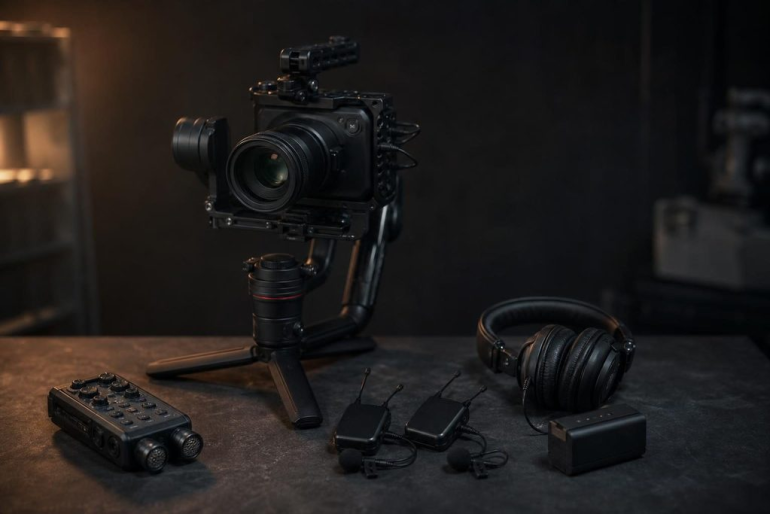
The technical answer is redundancy. A serious operator does not rely on a single source. That usually means a lapel transmitter on the officiant, a second on one partner, a recorder plugged into the venue’s own system when there is one, and a camera-mounted microphone as a fallback. Four sources, of which three will be usable and one will save the sequence.
The questions to ask are specific and easy to score:
- How many independent audio sources will be recording during the ceremony?
- Are the transmitters placed before the ceremony or at the last minute?
- What happens if the venue refuses a connection to its sound desk?
- Are the speeches covered by the same setup, or is that a separate arrangement?
A filmmaker who answers these fluently has been burned before and has built a method. One who says the audio “will be fine” has not.
Drones: what is actually allowed
Aerial footage sells well in a showreel and is heavily constrained in practice. Across the European Union and the EEA, Regulation (EU) 2019/947 has applied since 31 December 2020. It splits civil drone operations into “open”, “specific” and “certified” categories, with the open category itself subdivided into A1, A2 and A3 according to operational limits, remote pilot requirements and the technical class of the aircraft. Operators must be registered in the country where they live or have their principal place of business.
The consequence for a wedding is concrete. Flying over an assembled crowd is not a matter of the pilot’s confidence, it is a matter of which subcategory the operation falls into and which aircraft is being used. Many venues also have their own restrictions, and some sites are in zones where flight is simply not permitted.
So the right question is not “do you do drone shots”. It is: are you registered, which subcategory do you operate in, have you checked the airspace at this specific venue, and what is the plan if the answer on the day is no.
The contract clauses that matter
Most disputes after a wedding are not about artistic quality. They are about expectations that were discussed and never written.
Delivery time. Get a date, not a season. “Eight to twelve weeks” is a commitment; “a few months” is not.
What exactly is delivered. Number of edits, approximate runtime of each, resolution, and whether raw footage is included or available. Raw footage is usually not included, which is normal, but it should be stated.
Archive duration. How long the filmmaker keeps the material after delivery. This matters more than couples realise, because it determines whether a lost file can be recovered in year two.
Music licensing. A film using unlicensed commercial music is a film that can be muted or taken down on the platforms where you will actually share it. Ask which licensing library is used.
The substitution clause. Who shoots if the person you booked is ill. Either there is a named process or there is not.
Frequently asked questions
How far in advance should we book?
Established filmmakers in peak season are typically committed a year ahead or more. Booking late narrows the field to whoever is still free, which is a poor selection criterion.
Do we need both a photographer and a videographer?
They produce different objects: one is looked at, the other is watched, and they are consumed at different moments of life. Couples who cut one usually regret cutting the film, because it carries voices. That said, the two must be able to work in the same space without fighting for position, which is worth raising with both.
Is a second operator worth the cost?
For anything above roughly eighty guests, or for a ceremony where two locations run in parallel, yes. Below that, a single experienced operator with good audio usually beats two mediocre ones.
What should we actually do on the day?
Very little, which is the point. The main thing within your control is time: a schedule with fifteen minutes of margin at each transition produces a better film than any equipment decision.
ALSO READ: How to Choose the Best IPTV Portugal Service in 2026