



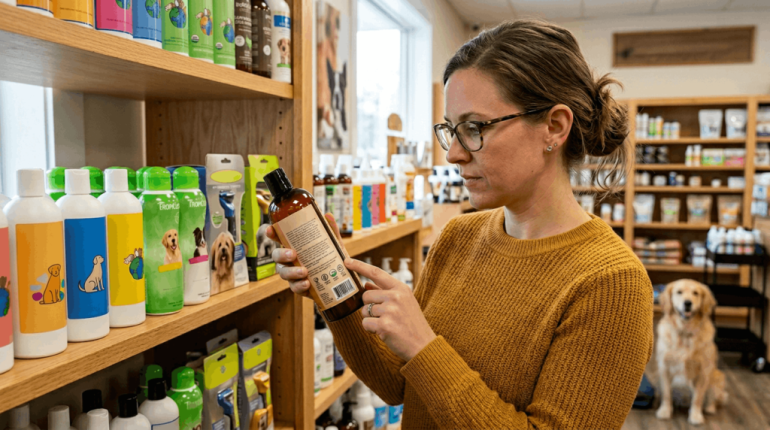
The front of a dog shampoo bottle is marketing. The back of a dog shampoo bottle is information. Most people read the front, make a decision based on whichever combination of claims feels most reassuring, and never turn the bottle over.
The result is that dog shampoo purchasing decisions are made primarily on the basis of packaging design, brand recognition, and the particular arrangement of words like “natural,” “professional,” “gentle,” and “veterinary formula” that the manufacturer chose to feature.
None of those words are regulated in the way that food or pharmaceutical labelling is. They don’t have to mean anything specific. The ingredient list does, and it’s the only part of the label that gives you verifiable information about what you’re actually buying.
How Ingredient Lists Work
The ingredient list on any cosmetic or personal care product, including The Dogs Shampoo you’re evaluating, is required to list ingredients in descending order of concentration. The first ingredient is present in the highest amount. The last ingredient is present in the smallest amount.
This ordering is useful in two ways. First, it tells you what the product is primarily made of. The first three to five ingredients typically account for the majority of the formula. A shampoo whose first ingredient is water, followed by a surfactant, followed by a conditioning agent is telling you something quite different from one whose first ingredient is a fragrance compound.
Second, it tells you how significant each ingredient actually is. An ingredient listed at position twelve in a twenty-ingredient formula is present in a very small amount, likely less than one percent.
When manufacturers lead with “contains colloidal oatmeal” on the front label but the oatmeal appears seventeenth on the ingredient list, the actual contribution of that ingredient to the product’s performance is minimal. It’s a label claim built on a trace amount.
Understanding the Active Ingredients
Shampoos for dogs with specific conditions, medicated shampoos in particular, will have an “active ingredients” section separate from the general ingredient list. The active ingredients are the ones with a defined therapeutic function: chlorhexidine for antibacterial action, ketoconazole for antifungal action, benzoyl peroxide for degreasing and antibacterial effect, selenium sulfide for seborrheic conditions.
For medicated shampoos, the concentration of the active ingredient matters as much as its presence. Chlorhexidine at two percent is meaningfully different from chlorhexidine at four percent in its effect and in its appropriate use. These are generally veterinary-directed products rather than general consumer choices, but understanding the active ingredient section allows you to verify that the concentration matches what was recommended.
Most everyday dog shampoos don’t have an active ingredients section in the regulated sense. Their functional ingredients, the surfactants that clean, the conditioning agents that soften, the humectants that retain moisture, appear within the general ingredient list without special designation.
The Ingredients Worth Identifying
A few categories of ingredients appear across most dog shampoos and are worth recognising on a label.
Surfactants are the cleaning agents. They reduce water’s surface tension and allow it to lift oils and debris from the coat. Common mild surfactants include sodium cocoyl isethionate, decyl glucoside, and coco-glucoside. Sodium lauryl sulfate (SLS) is a more aggressive surfactant that appears in cheaper formulas and can be drying with regular use.
Conditioning agents coat the hair shaft to reduce tangles, add shine, and reduce static. Quaternary ammonium compounds like behentrimonium chloride are common in this role. Panthenol, which is provitamin B5, is frequently used and has both conditioning and mild moisturising properties.
Humectants draw moisture into the skin. Glycerin is the most common. Sodium PCA is another. Their presence suggests a formula that’s oriented toward skin hydration rather than purely surface cleaning.
Preservatives keep the formula stable and prevent microbial contamination. Common preservatives include phenoxyethanol, sodium benzoate, and potassium sorbate. Some older preservative systems used parabens, which remain effective but which many consumers prefer to avoid. An absence of any preservative in a water-based product is actually a concern rather than a positive sign: water-based formulas without preservatives are susceptible to microbial contamination.
The Claims That Mean Nothing
“Veterinarian recommended” can mean anything from a formal clinical endorsement to a single vet somewhere, sometime, saying the product seemed fine. It’s not a certification. There’s no governing body that issues it.
“Natural” has no regulatory definition in pet product labelling. A shampoo can be labelled natural while containing synthetic preservatives, artificial fragrance, and petroleum-derived surfactants.
“Hypoallergenic” is similarly unregulated. It typically means the manufacturer has excluded some common allergens, but it doesn’t mean the product won’t cause a reaction in a specific dog.
“pH balanced” is a more useful claim because pH is measurable, but it’s only meaningful if the stated pH is appropriate for canine skin, which is typically around 6.5 to 7.5. Human skin pH runs considerably lower, around 4.5 to 5.5, so a product described as pH balanced without specifying the target pH may be balanced for human skin rather than canine skin.
Putting It Together at the Shelf
Reading a dog shampoo label properly takes two minutes. Check the first five ingredients to understand what the product is primarily made of. Look for the presence or absence of fragrance, which appears simply as “fragrance” or “parfum” in the list and represents an undisclosed mixture of compounds. Note where the functional ingredients you’re looking for appear in the list. Check for the active ingredients section if you’re buying for a specific condition.
A dog shampoo with a short, recognisable ingredient list, no artificial fragrance in the first half of the list, and the functional ingredients you need appearing in a meaningful position is worth more than any front-label claim. The back of the bottle is where the honest conversation happens.