



In the manufacturing of home appliances, the housing serves as far more than just a protective shell. It is the first element customers see, the surface they physically interact with, and the component that most directly shapes their perception of the product’s overall quality. Refrigerator door panels, washing machine casings, air conditioner housings, and vacuum cleaner shells must all meet rigorous standards regarding aesthetics, dimensional precision, structural integrity, and consistency in mass production.
Consequently, production lines for injection-moulded appliance housings must not only operate at high speeds but also maintain stability and repeatability, while exercising strict control over quality deviations. Many production teams invest heavily in high-performance injection moulding machines. Yet, they continue to grapple with issues such as warping, inconsistent surface gloss, sink marks, flow lines, and unstable cycle times. In reality, the root cause of these problems often lies not in the injection moulding machine itself, but in improper mould temperature control.
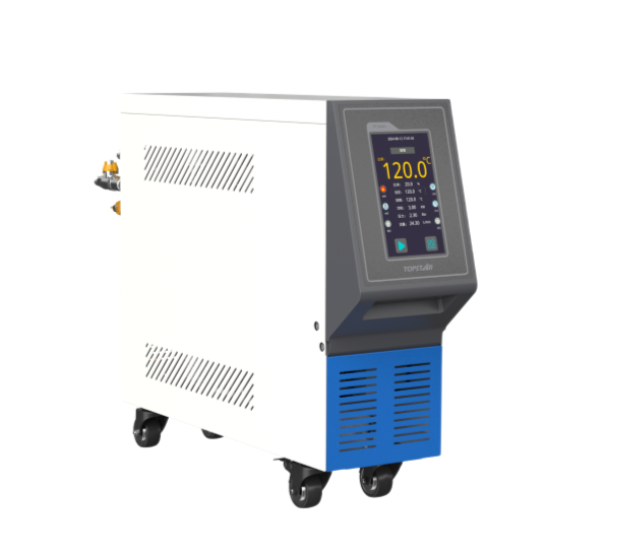
Mould Temperature Controller: The Key to Stable Forming of Appliance Housings
Home appliance housings typically feature large surface areas and thin walls, and are subject to stringent aesthetic requirements. These factors impose extremely demanding conditions on the mould during the forming process. Even minute temperature fluctuations can result in significant variations in surface gloss, shrinkage rates, and dimensional accuracy. In a mass production environment, these minor deviations can quickly escalate into costly defects.
Mould temperature controllers stabilize the mould’s thermal environment, ensuring the mould cavity remains within the target temperature range throughout the production cycle. This stable environment is critical, as the performance characteristics of plastic materials vary significantly with temperature. If the mould temperature is too low, the resin may freeze prematurely, leading to incomplete filling, prominent weld lines, and surface imperfections. Conversely, if the mould temperature is too high—or fluctuates erratically—the material may overheat, warp, or lose dimensional stability during cooling.
Mould Temperature Controller: Enhancing Surface Aesthetics and Elevating Brand Quality
In the home appliance market, aesthetics are not a secondary consideration; they constitute a distinct competitive advantage. The first thing consumers notice is a product’s visual appearance: a uniform gloss, a consistent texture, crisp, clean edges, and an absence of visible defects. For appliance manufacturers, the housing of every single product must serve as a tangible embodiment of their brand standards.
Mould temperature controllers play a pivotal role in ensuring superior surface quality. During injection moulding, the molten resin must flow smoothly and evenly throughout the mould cavity before it begins to solidify. If the mould temperature is too low, the resin will solidify prematurely, resulting in flow marks, dull areas, weld lines, and incomplete surface replication. Furthermore, if the temperature within different cavity regions of the mould is unstable—even if the machine settings remain constant—discrepancies may arise between the two sides of the housing.
Reduces Warpage, Shrinkage, and Dimensional Deviations
Housings for large home appliances are particularly susceptible to warpage and dimensional instability. Since these components typically cover a large surface area and incorporate reinforcing ribs, bosses, edges, and mounting structures, their cooling rates vary across different sections. Uneven cooling generates internal stresses, which in turn lead to warpage. Warpage subsequently results in assembly difficulties, fitment issues, and cosmetic defects.
This is precisely one of the reasons why mould temperature controllers are critical in the production of appliance housings. These controllers not only help regulate the average mould temperature but also ensure uniform temperature throughout the entire mould system. This uniformity minimizes thermal imbalances—one of the primary causes of dimensional deviations.
Enhances Injection Moulding Machine Efficiency and Cycle Stability
High-performance injection moulding machines can only deliver their full value when mould conditions remain stable. If mould temperature fluctuates continuously, the machine is forced to compensate by extending cooling times, making repeated adjustments, and interrupting the production process, thereby reducing throughput and leading to unstable production cycles.
Mould temperature controller enhances machine efficiency by establishing repeatable thermal cycles. When the mould rapidly reaches its target temperature and maintains it steadily, the injection moulding machine can operate within a stable process window. This reduces cooling times, mitigates the risk of excessive adjustments, and improves overall cycle consistency.
Supports Diverse Resins and Complex Appliance Designs
Home appliance housings are no longer manufactured using a single standard material. Manufacturers typically select from a range of materials—including ABS, PC, PC/ABS blends, PP, and other engineering plastics—based on specific requirements for strength, aesthetics, heat resistance, and cost structure. Some products require flame-retardant properties, while others demand high gloss finishes, impact resistance, or increased rigidity.
Each material reacts differently to temperature variations. Some materials require higher mould temperatures to achieve superior flow characteristics and surface quality. In contrast, others necessitate stricter temperature control to prevent shrinkage or internal stress. Consequently, a one-size-fits-all approach to mould heating is not applicable. Mould temperature controllers must provide precise temperature control to accommodate the varying requirements of different resins and diverse mould structures.
The mould temperature controllers designed by Topstar are engineered to meet these demanding application requirements. In practical production scenarios, this means the controller must maintain its precision even as process parameters shift; withstand repetitive cycles without compromising stability; and work in harmony with the mould and materials rather than against them.
Delivering Real Value in Home Appliance Housing Injection Moulding
The production of home appliance housings requires striking a delicate balance between aesthetics, precision, speed, and cost control. This equilibrium cannot be achieved solely through the injection moulding machine; it also requires consistent mould temperature control throughout the production process.
Topstar mould temperature controllers empower manufacturers to achieve this stability. They enhance surface quality, minimize warping, ensure dimensional consistency, support the processing of diverse materials, boost machine efficiency, reduce energy waste, and strengthen long-term process control. In essence, they transform temperature management into a distinct production advantage.