



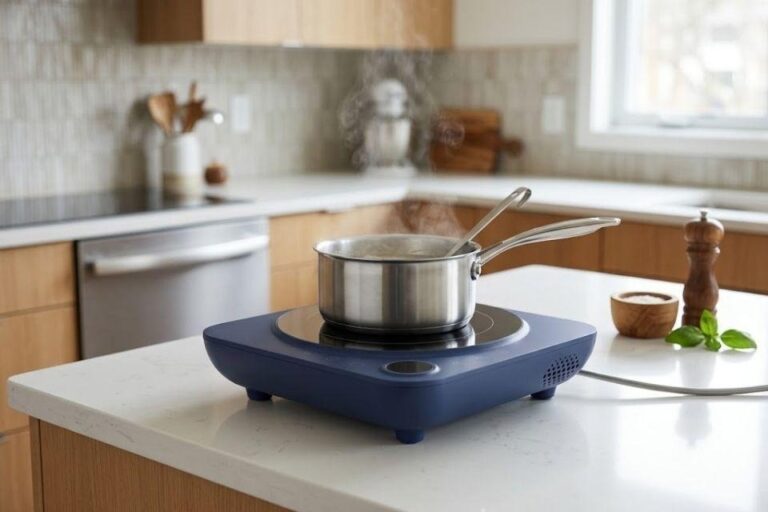
An induction cooker may be labeled 1,500W, 1,800W, or 2,000W, but that number does not tell you exactly how much electricity the appliance will use during every cooking session. Wattage measures electrical power, or the rate at which electricity is being used at a particular moment. Total electricity consumption depends on more than that number.
Cooking time, selected heat level, cookware, food quantity, temperature control, and the way the appliance regulates power can all affect energy use. This is why two cooking sessions using the same induction cooker can consume different amounts of electricity.
Understanding the difference between watts and kilowatt-hours (kWh) makes it much easier to estimate real energy use. Once you know what the wattage rating actually represents, you can make more meaningful comparisons and avoid assuming that a higher number automatically means higher electricity consumption.
What Does an Induction Cooker’s Wattage Actually Mean?
Wattage is a measurement of power. On an induction cooker, the wattage rating indicates how much electrical power the appliance can draw under its rated operating conditions. For example, a cooker rated at 2,000W has a maximum or rated power level of 2 kilowatts (kW).
However, watts do not measure the total amount of electricity consumed over an entire cooking session. That is where kilowatt-hours become important. A watt tells you the rate of energy use, while a kilowatt-hour measures energy used over time.
For example, if a 2,000W cooker operated continuously at 2kW for 30 minutes, the theoretical energy consumption would be 1kWh. The calculation is simple: 2kW multiplied by 0.5 hours equals 1kWh.
The important word is “continuously.” Normal cooking does not necessarily involve operating at the maximum rated power for the entire time. The actual energy used can therefore be different from a simple calculation based only on the label.
Why Rated Wattage Is Not the Same as Actual Electricity Use
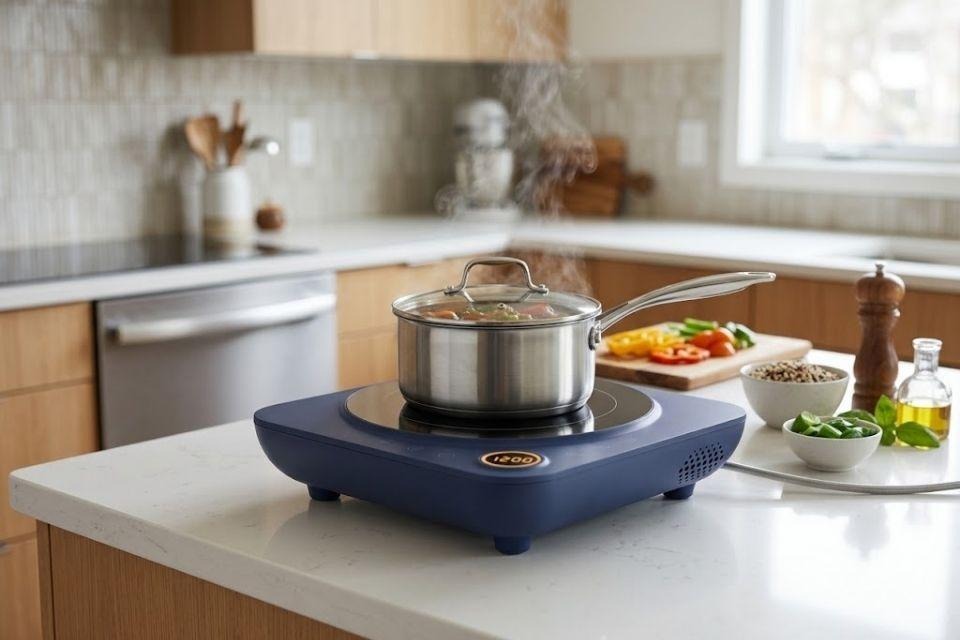
The wattage printed on an induction cooker is useful because it tells you about the appliance’s available electrical power. It can help indicate potential heating capability, but it should not be treated as a measurement of average electricity consumption.
During everyday cooking, the appliance may operate at different power levels depending on the selected setting and cooking conditions. Bringing cold water to a boil may require more heating power than maintaining a gentle simmer afterward. The total time spent cooking also affects the amount of energy consumed.
This means a 2,000W rating does not automatically mean the cooker uses 2,000W every second that it is switched on. Instead, the actual electrical demand can change during operation.
A useful way to think about it is that wattage describes the cooker’s power capability, while kWh provides a better indication of how much energy was consumed over a period of time. Looking at both concepts gives you a much more realistic understanding of electricity use.
How an Induction Cooker Changes Power During Cooking
Induction cooking uses an electromagnetic field to heat compatible cookware directly. The appliance’s control system can adjust how much heating power is delivered according to the selected setting and the cooking conditions.
For instance, a cooking process might begin at a higher setting to heat a pan or bring water toward boiling. Once the desired temperature is reached, the user may reduce the setting to simmer or maintain the food at a suitable temperature. The electrical behavior during these stages can therefore differ.
Depending on the model, an induction cooker may regulate its output in different ways. Some appliances adjust power electronically, while others may cycle heating activity at lower settings. The exact behavior is determined by the appliance’s design and controls.
This is another reason the maximum wattage printed on the cooker should not be interpreted as its constant electricity use. The rating describes what the appliance can draw at a particular operating level, not necessarily what it consumes throughout an entire meal.
How Cooking Time Affects Induction Cooker Power Consumption
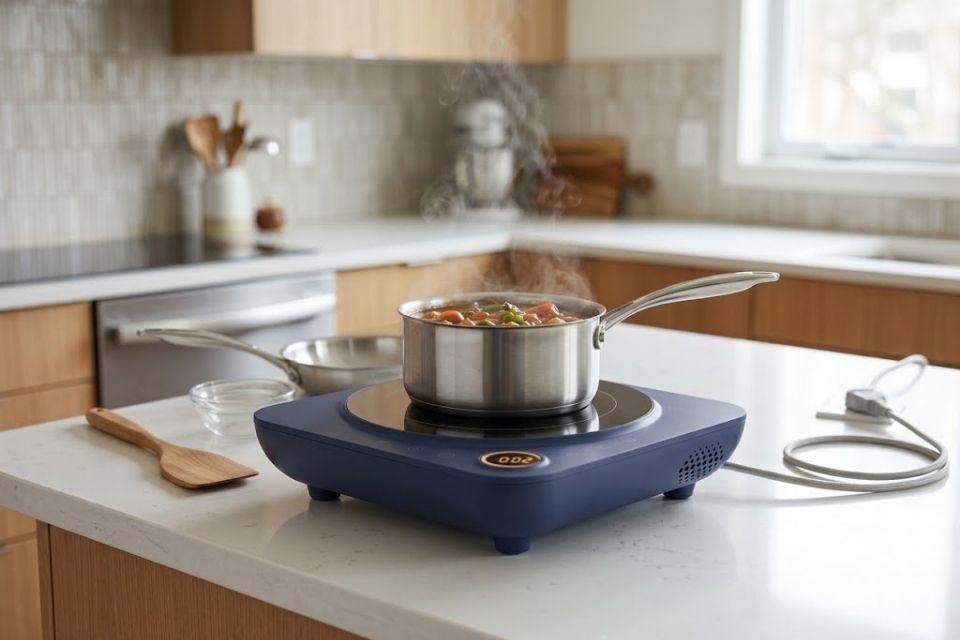
Understanding induction cooker power consumption requires looking at both power and time. A simple energy calculation uses the relationship between power, measured in kilowatts, and operating time, measured in hours.
The basic formula is:
Energy consumed (kWh) = Power (kW) × Time (hours)
Suppose a 2,000W induction cooker operates continuously at 2kW for 30 minutes. Because 30 minutes equals half an hour, the theoretical consumption is 2 × 0.5, or 1kWh.
Now consider a 1,500W cooker operating continuously at 1.5kW for 20 minutes. Twenty minutes is approximately one-third of an hour, so the theoretical consumption is about 1.5 × 0.33, or 0.5kWh.
These examples demonstrate why cooking duration matters. A cooker with a higher wattage rating can potentially use more power at a given moment, but a shorter operating period can result in less total energy consumption. Actual use may also differ when the appliance does not continuously operate at the assumed power level.
What Factors Affect an Induction Cooker’s Real Electricity Use?
Wattage is only one part of the picture. The amount of electricity used during cooking can change depending on how the appliance is operated and what it is heating. Understanding these variables is also useful when researching everyday kitchen appliances and practical cooking technology from resources such as Ciarra Gadgets.
Several practical factors can influence the result:
- Heat setting: Higher settings can require greater power during active heating.
- Cooking duration: Longer operation generally increases total energy consumption.
- Cookware: Pan size, construction, flatness, and induction compatibility can affect heating performance.
- Food quantity: Larger quantities may require more heating time or energy.
- Cooking task: Boiling, frying, simmering, and warming do not necessarily require the same power.
- Temperature control: Once the desired temperature is reached, maximum output may no longer be necessary.
These factors can also interact. A large quantity of cold food may take longer to reach the desired temperature than a smaller portion. Similarly, a high initial heat setting may be useful for rapid heating, while a lower setting can be sufficient for maintaining the temperature afterward.
For this reason, there is no single wattage number that can accurately predict the electricity used for every cooking task. Real-world consumption depends on what you cook, how you cook it, and how long the cooker operates.
Does a Higher-Wattage Induction Cooker Always Use More Electricity?
No, not necessarily. A higher-wattage induction cooker has the ability to draw more electrical power when operating at a higher output, but total electricity consumption also depends on operating time and actual power use.
Imagine a 2,200W cooker used for a short heating task and a 1,500W cooker used for a much longer cooking process. The lower-wattage appliance could ultimately consume more total energy because it remained in operation longer.
This is why comparing appliances solely by their wattage can give an incomplete picture. A higher rating may provide greater potential heating power or faster cooking under certain conditions, but it does not automatically establish how much electricity the appliance will consume over a day, week, or month.
When evaluating energy use, it is more useful to consider actual operating patterns rather than looking at the largest number printed on the appliance.
How to Calculate Your Induction Cooker’s Electricity Use
You can estimate electricity consumption using a simple two-step calculation. First, convert watts into kilowatts by dividing the wattage by 1,000. Then multiply the resulting kilowatt figure by the operating time in hours.
The formula is:
Watts ÷ 1,000 = kilowatts
Kilowatts × hours used = kWh
For example, imagine a 1,800W cooker operating continuously for 20 minutes. Dividing 1,800 by 1,000 gives 1.8kW. Twenty minutes is approximately 0.33 hours. Multiplying 1.8 by 0.33 gives roughly 0.6kWh.
This is an estimate based on continuous operation at 1,800W. If the cooker actually uses less power during part of the cooking process, the measured consumption can be lower.
You can use the same method with different wattage ratings and cooking times. The calculation is useful for understanding potential energy use, but it should not be mistaken for a precise measurement of every cooking session.
The Most Accurate Way to Know How Much Electricity Your Cooker Uses
A wattage-based calculation provides an estimate, but measuring actual electricity use can give you a clearer picture of what happens during normal cooking. An appropriate energy-monitoring device can measure electricity consumption where it is compatible with the appliance’s electrical rating and connection arrangement.
Direct measurement is especially useful because it captures the appliance’s real operating behavior rather than assuming it continuously draws its maximum rated power.
If you want a more representative result, looking at several different cooking sessions can be more informative than measuring one short task. For example, boiling water, simmering food, and preparing a longer meal can produce different consumption patterns.
The goal is not simply to find the highest possible wattage draw. It is to understand how much energy the cooker actually uses during the types of cooking you regularly perform.
Common Mistakes People Make When Reading Induction Cooker Wattage
Many misunderstandings about induction electricity use come from treating power and energy as if they were the same thing.
Common mistakes include:
- Assuming the maximum wattage is constant consumption.
- Confusing watts with kilowatt-hours.
- Ignoring how long the cooker operates.
- Comparing cookers by wattage alone.
- Assuming every heat setting has identical electrical demand.
- Treating theoretical calculations as exact measurements.
The broader lesson is simple: wattage is an important appliance specification, but it does not provide a complete picture of total electricity consumption. To understand energy use properly, you need to consider both the power being used and the amount of time the appliance operates.
What Wattage Should You Consider When Choosing an Induction Cooker?
Wattage can be useful when comparing the potential heating power of different induction cookers, but it should not be the only specification you consider. The appropriate power level depends on how you normally cook and what you expect from the appliance.
Think about typical meal sizes, cooking frequency, desired heating speed, cookware, and the electrical supply available for the appliance. Someone who frequently prepares large quantities or wants rapid heating may value a higher power rating, while another user may have different priorities.
Most importantly, do not assume that the highest wattage automatically means the highest electricity bill. Actual energy use depends on operating time, power level, cooking conditions, and how the appliance regulates its output.
Final Takeaway
Your induction cooker’s wattage tells you how much electrical power the appliance can draw under its rated conditions, but it does not tell you exactly how much electricity an entire cooking session will consume. That depends on how much power is actually used, how long the cooker operates, and what you are cooking.
The most useful distinction is between power and energy. Watts describe the rate of electrical power, while kilowatt-hours describe the amount of energy consumed over time. Cooking duration, heat settings, cookware, food quantity, and appliance controls can all change the final result.
Once you understand this difference, it becomes easier to estimate electricity use without assuming that the wattage printed on the appliance represents constant consumption. For more practical kitchen-appliance information and ideas, Ciarra Gadgets can also be a useful resource to explore.
FAQs
1. Does a 2,000W induction cooker always use 2,000 watts?
No. A 2,000W rating indicates the cooker’s rated or maximum power capability under relevant operating conditions. Actual electricity use can vary depending on the selected heat level, cooking time, temperature control, cookware, and how the appliance regulates its output.
2. How much electricity does a 2,000W induction cooker use?
If a 2,000W cooker operated continuously at its full 2kW rating for one hour, it would theoretically use 2kWh of electricity. However, normal cooking may use less because the appliance may not operate continuously at maximum power.
3. Is a higher-wattage induction cooker more expensive to run?
Not necessarily. A higher-wattage cooker can draw more power when operating at a high setting, but total electricity consumption also depends on how long it runs and how much power it actually uses. A lower-wattage cooker operated for longer can consume more total energy.
4. How can I calculate my induction cooker’s electricity consumption?
Convert the wattage to kilowatts by dividing it by 1,000, then multiply the result by the operating time in hours. For example, a 1,800W cooker running continuously for 20 minutes would theoretically use about 0.6kWh. Actual consumption may differ if the cooker changes its power output.
5. What is the difference between watts and kilowatt-hours?
Watts measure power, which describes the rate of electrical energy use. Kilowatt-hours measure energy, which represents the amount of electricity consumed over a period of time. For understanding the electricity used during an entire cooking session, kWh is the more relevant measurement.