



Quick Definition
Cataract surgery instruments are specialized ophthalmic tools used to remove the clouded natural lens and implant an artificial intraocular lens, ensuring precise control, stable tissue handling, and optimal visual outcomes during eye surgery.
Introduction to Cataract Surgery and Instrument Precision
Cataract surgery is one of the most refined microsurgical procedures, requiring extreme accuracy at every step. The procedure involves removing a clouded lens and replacing it with a clear artificial lens to restore vision. While surgical expertise is critical, the role of ophthalmology instruments is equally decisive in determining outcomes.
In microsurgical environments like the eye, even minimal deviations in instrument performance can significantly affect results. Poor grip, inconsistent cutting edges, or lack of stability can lead to complications such as capsular rupture or improper lens positioning. In cataract surgery, even minor instrument inconsistencies can lead to complications that directly affect visual outcomes and patient satisfaction.
Clinics using high-quality ophthalmology surgical instruments can achieve more consistent procedural accuracy and improved visual outcomes. This highlights why instrument quality is not just a preference—it is a clinical requirement.
Core Categories of Cataract Surgery Instruments
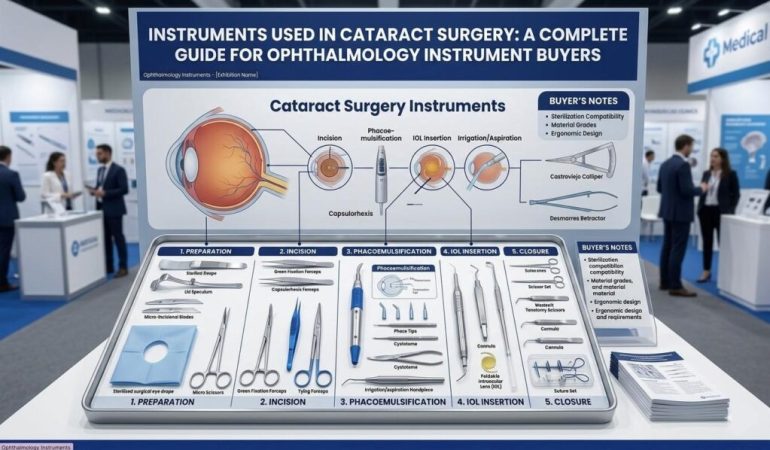
Cataract procedures rely on a coordinated system of ophthalmic surgical tools, often organized as a phacoemulsification instrument set or a complete cataract surgical instrument kit. Each category plays a specific role in the surgical workflow.
Cutting and Incision Instruments
Precision knives and blades are used to create corneal incisions. These must be accurate in depth and placement to ensure proper surgical access while maintaining structural integrity. High-quality cutting instruments provide consistent sharpness and control.
Capsulorhexis Instruments
Capsulorhexis involves creating a circular opening in the lens capsule. This step requires specialized forceps or needles designed for controlled tearing. Accuracy here directly affects intraocular lens positioning and long-term stability.
Lens Removal Instruments
Phacoemulsification devices are used to break up and remove the clouded lens using ultrasonic energy. These devices combine fragmentation with suction, making them essential components of modern cataract surgery.
Irrigation and Aspiration Instruments
Maintaining a clear surgical field is essential for visibility. Irrigation and aspiration tools remove debris, maintain intraocular pressure, and support stable surgical conditions throughout the procedure.
Implantation Instruments
Lens injectors are used to insert the intraocular lens into the capsule. These instruments allow controlled delivery and accurate positioning of the implant.
Commonly Used Ophthalmology Instruments in Cataract Surgery
Micro Scissors
Micro scissors are used for the precise cutting of delicate ocular tissues. Their fine tips allow accurate trimming while minimizing tissue trauma.
Forceps
Forceps are essential for grasping and manipulating tissue. Capsulorhexis forceps, in particular, are designed for controlled and precise capsule handling.
Lid Retractors
These instruments keep the eyelids open during surgery, ensuring unobstructed access to the surgical field.
Calipers
Calipers are used to measure incision size and placement, ensuring consistency and accuracy throughout the procedure.
Fixation Forceps
Fixation forceps stabilize the eye, allowing surgeons to maintain precise control during delicate stages of the operation.
Surgical Workflow in Cataract Procedures
Cataract surgery follows a structured and highly controlled workflow:
- Creation of corneal incision using precision blades
- Capsulorhexis using specialized forceps
- Lens fragmentation using phacoemulsification devices
- Removal of lens material using irrigation and aspiration tools
- Insertion of an intraocular lens using implantation instruments
Clinics performing high-volume cataract procedures often rely on complete ophthalmology instrument kits to maintain consistency and efficiency. This approach standardizes performance across multiple procedures and reduces variability.
Instrument Selection in Cataract Surgery (Expert Insight)
Selecting the appropriate instruments depends on several procedural factors, including cataract density, incision size, and tissue sensitivity. Dense cataracts may require more robust phacoemulsification systems, while delicate cases demand finer instruments for enhanced control.
Ergonomic design also plays a significant role. Instruments with poor handling characteristics can reduce precision and increase surgeon fatigue during longer procedures. Consistent grip, balanced weight, and stable tip geometry are essential for optimal performance.
In cataract surgery, precision is not optional—it is fundamental to achieving predictable outcomes.
Precision Challenges in Cataract Surgery (Advanced Insight)
Cataract surgery involves operating within extremely confined anatomical spaces where visibility and control are limited. Even minor instability in instrument handling can lead to complications such as capsular tears or incorrect lens placement.
Maintaining consistent movement and alignment is critical throughout the procedure. Instruments must perform reliably under varying conditions, ensuring that each step is executed with accuracy.
Poor instrument precision can compromise surgical control, directly affecting visual outcomes and increasing the risk of complications.
Capsular Integrity and Instrument Control (Advanced Insight)
Damage to the lens capsule during cataract surgery can compromise intraocular lens placement and lead to complications such as lens dislocation. Maintaining capsular integrity requires precise instrument control, particularly during capsulorhexis and lens fragmentation.
Instruments with stable tips and consistent grip allow surgeons to perform controlled movements without excessive force. This reduces the risk of unintended capsule damage. Precision-engineered tools are essential for maintaining structural integrity and ensuring the long-term success of the procedure.
Ophthalmology Instruments vs General Surgical Tools
Feature Ophthalmology Instruments General Surgical Tools
Precision Microsurgical Accuracy Limited
Design Eye-specific Generalized
Control High Moderate
Outcome: Predictable visual results Variable
General surgical tools are not suitable for ophthalmic procedures due to the level of precision required.
Risks of Using Low-Quality Instruments
Using substandard instruments can result in poor incision quality, tissue damage, and reduced surgical efficiency. In cataract surgery, where every step requires accuracy, even small inconsistencies can lead to significant complications.
Low-quality tools may compromise stability and control, increasing the likelihood of errors during critical stages of the procedure. This can negatively impact both surgical outcomes and patient satisfaction.
Materials and Manufacturing Standards
High-quality ophthalmic instruments are made from surgical-grade stainless steel and advanced alloys. These materials provide durability, resistance to corrosion, and consistent performance under repeated sterilization.
Precision manufacturing ensures that each instrument meets the strict tolerances required for microsurgical applications.
Sterilization and Maintenance Protocols
Proper sterilization is essential to prevent infection and maintain instrument performance. Instruments must be thoroughly cleaned, sterilized, and inspected after each use to ensure reliability.
Routine maintenance extends instrument lifespan and ensures consistent surgical outcomes.
Cost and Procurement Considerations
Investing in a complete cataract surgical instrument kit or phacoemulsification instruments set ensures long-term efficiency and reliability. While high-quality instruments may involve higher initial costs, they reduce complication rates and improve procedural consistency.
Conclusion
Cataract surgery is a precision-driven procedure that relies heavily on specialized instruments. From incision to lens implantation, each step requires controlled handling and accurate Performance. High-quality ophthalmology instruments ensure consistent results, improved efficiency, and better patient outcomes.
Clinics that prioritize advanced instrument systems and reliable instruments can achieve superior surgical performance and long-term success.
FAQs
1. What instruments are used in cataract surgery?
Micro scissors, forceps, phacoemulsification devices, irrigation systems, and lens injectors are commonly used.
2. Why are specialized ophthalmology instruments important?
They provide the precision required for delicate eye procedures.
3. What is a phacoemulsification instrument set?
It is a collection of tools used to fragment and remove the cataract lens.
4. Can general surgical tools be used in cataract surgery?
No, ophthalmic procedures require highly specialized instruments.
5. How do instruments affect surgical outcomes?
High-quality instruments improve precision, reduce complications, and enhance visual results.