



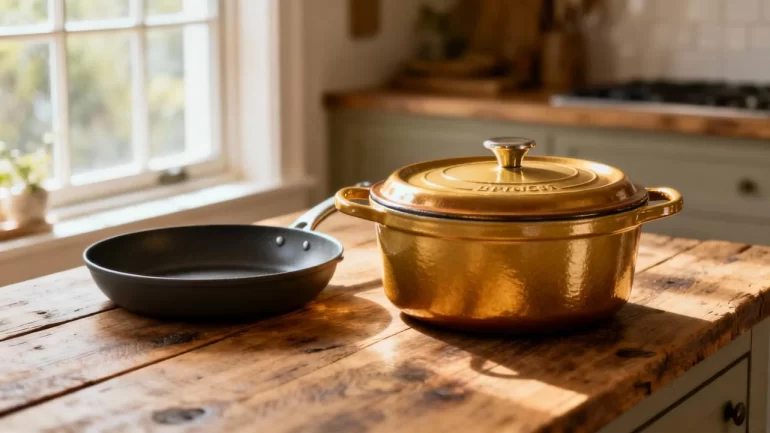
Yes — if you braise, simmer, or cook anything acidic. Enamel cookware gives you a non-reactive, glass-hard surface over a metal core, so tomato, tamarind and curd can sit in it for hours without picking up a metallic edge. It’s not worth it if you want something light, cheap, or capable of dry, ripping-hot searing. That’s the whole answer. Here’s the reasoning, including the parts most buying guides skip.
What Is Enamel Cookware, and What Is the Enamel Actually Made Of?
Enamel is glass. Not a polymer, not a spray-on non-stick film — actual vitrified glass. Manufacturers grind a silica-based mix into a powder called frit, apply it to a metal body, and fire it at roughly 800°C until it fuses into a glassy layer bonded to the metal beneath. The colour comes from mineral oxides in the frit, which is why good enamel doesn’t fade or peel the way a coating does.
Is enamel the same as non-stick? No. PTFE-style non-stick is a soft polymer film with a service life measured in months; enamel is fused glass with no fluoropolymers in it at all. It releases food reasonably well when hot and oiled, but it is not slippery, and anyone selling it as equivalent to a non-stick pan is overselling it.
Enamel on Steel vs Enamel on Cast Iron: The Difference That Decides Everything
This is the distinction most articles get lazy about, and it explains why reviews of “enamel cookware” contradict each other so wildly.
| Enamel on steel | Enamel on cast iron | |
| Wall thickness | Thin (0.4–1 mm) | Thick (3–6 mm) |
| Weight | Light | Heavy — 2–5 kg is normal |
| Heats up | Fast | Slow |
| Holds heat | Poorly | Exceptionally |
| Thermal shock risk | High | Moderate |
| Typical price | Low | 3–5x higher |
| Best for | Storage, boiling, camping | Braising, slow cooking, deep frying |
Enamel-on-steel is the speckled camping mug and the old dabba in your grandmother’s kitchen. Enamel-on-cast-iron is the Dutch oven, the kadai, the braiser. When people call enamel cookware fragile and disappointing, they’re usually describing thin enamelled steel. When people call it a lifetime purchase, they mean cast iron.
Is Enamel Cookware Safe? What the Food-Contact Standards Actually Say
Is enamel cookware safe to cook in every day? Yes, provided it’s made to a recognised food-contact standard. Fired enamel is chemically inert and non-porous, so it doesn’t react with acid, doesn’t absorb flavours, and contains no PTFE, PFOA or PFAS by definition — those are fluoropolymer chemistries, and enamel isn’t a polymer.
The part worth knowing is that “safe” is a testable claim, not a slogan. The relevant standard for enamelled cookware is ISO 4531, Vitreous and porcelain enamels — Release from enamelled articles in contact with food, which sets both the test method and the permissible limits for metal-ion release under realistic cooking conditions. Above it sits Regulation (EC) No 1935/2004, the EU rule that a food-contact material must not release its constituents into food at levels harmful to health, nor alter the food’s taste, odour or composition unacceptably. Germany’s LFGB is the national code usually cited as the strictest mainstream test, and in the US the FDA regulates leachable lead in ceramicware through 21 CFR 109.16 and Compliance Policy Guide Sec. 545.450.
If a brand can’t tell you which of those its enamel has been tested against, that’s your answer. Indian enamel cookware brand Cumin Co., for instance, publishes that its Enviromax™ Pro enamel is certified to US FDA, LFGB and EU EC 1935/2004 standards, and declares the cooking surface free from PTFE, PFOA, PFAS, lead, cadmium, mercury and phthalates. Whether or not you buy that particular pan, that’s the level of specificity worth demanding.
The Lead Question: When Enamel Cookware Genuinely Is a Risk
Does enamel cookware have lead in it? Modern enamel cookware made to FDA, LFGB or ISO 4531 standards does not contribute meaningful lead to food. Vintage enamelware, decorative pieces and unbranded imports with no test documentation genuinely can — lead oxide was historically used as a flux to lower firing temperature and brighten colour, especially in reds and yellows.
- Myth: Bright colours mean lead. Fact: Colour tells you nothing; the pigment chemistry and the test report do. Mineral-oxide pigments give bright colour with no lead or cadmium.
- Myth: A chip makes the pot poisonous. Fact: A chip exposes bare metal — that’s a rust and reactivity problem, not a lead one.
- The one that matters: decorative and antique enamelware is not cookware. Display it; don’t cook acid in it.
What Enamel Cookware Is Genuinely Bad At
Any guide that only lists advantages is selling you something.
It’s heavy. A 4-litre enamelled cast iron Dutch oven runs 4–6 kg empty. With wrist or shoulder issues, handle one in person before ordering.
It’s slow to heat. Cast iron is a mediocre conductor — roughly 50 W/m·K against about 200 for aluminium. It excels at storing heat, not moving it. Preheat on medium for 4–5 minutes and never crank the flame to hurry it.
Enamel Cookware vs Bare Cast Iron vs Stainless Steel
Is enamel cookware better than cast iron? For acidic and slow-cooked food, yes — enamel is non-reactive and needs no seasoning, so tomato gravies, sambhar and vinegar braises won’t strip a seasoning layer or taste metallic. For high-heat searing and lower cost, bare cast iron wins.
Against stainless steel the trade is thermal mass versus responsiveness: stainless heats and cools fast, right for a sauce you’re adjusting minute by minute, while enamelled cast iron holds a low steady temperature for hours, right for a dal or a slow braise. Neither replaces the other.
How to Care for Enamel Cookware So the Finish Survives
- Preheat on medium, never empty for long. Add fat within the first minute.
- Let it cool before it meets water. This one habit prevents most crazing.
- Wood, silicone or nylon on gloss interiors. Sand-matte tolerates metal better, but why risk it.
- For stains: baking soda paste left 20 minutes, then a nylon scrubber. Never steel wool or oven cleaner.
- Hand wash, and stack with cloth between pieces. Most chips happen in the cupboard, not on the stove.
How to Choose Enamel Cookware: 5 Checks Before You Buy
- Confirm the substrate. Steel or cast iron? If the listing only says “enamel”, assume thin steel.
- Ask which standard it’s tested to. FDA, LFGB, EC 1935/2004 or ISO 4531 — a named standard, not the word “non-toxic”.
- Look at the interior finish. Sand-matte hides stains and browns better; gloss cream lets you read the fond but stains faster. Both fine — pick knowingly.
- Check the lid and handles. Interior condensation ridges baste as the pot simmers, and wide loop handles matter more than you’d think on a 5 kg pan.
- Read the warranty as a spec, not a promise. Enamel quality shows up in warranty length — Cumin Co., for example, backs most of its enamelled cast iron for 10 years and describes the finish as a four-layer, titanium-infused mineral enamel. That kind of detail tells you more than any “premium” label.
So, Is Enamel Cookware Worth It?
Buy it if you cook acidic Indian or Mediterranean food, braise, slow-cook, deep-fry or bake bread; if you want a pan that needs no seasoning and won’t rust; and if you accept weight and a higher upfront price for something that should outlive the kitchen it’s in.
Skip it if you need lightweight everyday pans, cook mostly fast and hot, want dishwasher-and-forget convenience, or would be better served by one good bare cast iron pan and a decent stainless sauté.
For most home cooks the sensible move isn’t a full enamel set — it’s one good enamelled cast iron piece, a 4-litre Dutch oven or a kadai, for the third of your cooking that actually benefits from it. Buy it once, from a brand that will name the standard its enamel is tested against, and it stops being a decision you have to revisit.
Enamel Cookware FAQs
Is enamel cookware safe?
Yes. Enamel is fused glass, which is chemically inert and contains no PTFE, PFOA or PFAS. Cookware certified to standards such as ISO 4531, EU Regulation (EC) No 1935/2004, Germany’s LFGB or the FDA’s ceramicware requirements has been tested for metal-ion release under real cooking conditions.
Does enamel cookware contain lead?
Modern enamel cookware certified to FDA, LFGB or ISO 4531 standards does not release meaningful lead into food. Vintage enamelware, decorative pieces and untested imports can, because lead oxide was historically used as a glaze flux — so cook only in cookware with current certification.
Can you still use enamel cookware after it chips?
It depends where the chip is. A chip on the outer rim is cosmetic and safe to keep using; a chip on the interior that exposes bare metal will rust and react with acidic food, so retire that piece from acidic cooking or replace it.
Why does my enamel cookware stain?
Light-coloured enamel interiors stain from browned food residue, turmeric and polymerised oil — that’s discolouration on the glass, not damage. A baking soda paste left for 20 minutes, or a 10-minute simmer of water with baking soda, removes almost all of it.
How long should enamel cookware last?
Well-made enamelled cast iron, hand washed and protected from thermal shock, lasts decades, and quality brands back it with warranties of 10 years or more. Thin enamel-on-steel is a different product and typically starts chipping within a few years of daily use.